Docodontidae
Docodonta is an order of extinct Mesozoic mammaliaforms. They were among the most common mammaliaforms of their time, persisting from the Early Jurassic to the Early Cretaceous across the continent of Laurasia. They are distinguished from other early mammaliaforms by their relatively complex molar teeth.

Elsa Panciroli,Roger B.J. Benson,Vincent Fernandez,Matthew Humpage,Alberto Martín-Serra,Stig Walsh,Zhe-Xi Luo,Nichola… · CC BY 4.0 · via Wikipedia/Commons. May be a photograph of a specimen, or an artist’s reconstruction — an interpretation of a skeleton, since colour and soft tissue are almost never preserved.
On record
Recorded, not inferred- Sits inside
- DocodontaPBDB
- Diet
- insectivorePBDB, for Mammaliaformes
- Life habit
- scansorialPBDB, for Mammaliaformes
- Motility
- actively mobilePBDB, for Osteichthyes
- Environment
- terrestrialPBDB, for Amniota
Time the record covers
At least 29 million years on record.
The record covers at least 170.9 Mya to 141 Mya. No occurrence read is dated outside 184.2 Mya to 139.1 Mya.
28 occurrences of Docodontidae on record, most of them in the Late Jurassic. Bar height is expected occurrences, not a count: each fossil is spread across the span it is dated to, so a tall narrow bar means tight dating and a low wide one means loose.
When
28 occurrencesThese are dates about fossils, not the animal: the record can only begin after it arose and end before it died out, so either end may reach further. Shares are expected occurrences: a fossil dated to a span is counted partly in each period it straddles. More on what this infers.
Found in
9 formations
- Morrison Formation15
- Forest Marble Formation · Great Oolite Group5
- Lulworth Formation · Purbeck Group2
- Qigu Formation1
- Kota Formation · Gondwana Group1
- Alcobaça Formation1
Loading coastlines…
The named rock units Docodontidae has been recovered from, largest first. Drawn where the rock is now, not where it formed.
Docodontidae and its relatives
Late JurassicWhere Docodontidae and its relatives were recorded in the Late Jurassic.
Found in the same rock
436 taxa- Mammalia11 sites
- Goniopholis10 sites
- Caudata9 sites
- Glyptops8 sites
- Theropoda8 sites
- Actinopterygii7 sites
- Anura7 sites
- Ankylosauria6 sites
- Cteniogenys antiquus6 sites
- Docodon victor6 sites
- Dryolestidae6 sites
- Testudines6 sites
- Ceratodus5 sites
- Docodon5 sites
- Paramacellodus5 sites
- Pterosauria5 sites
- Squamata5 sites
- Allosaurus4 sites
- Camarasaurus4 sites
- Crocodyliformes4 sites
- Cteniogenys4 sites
- Dorsetisaurus4 sites
- Dromaeosauridae4 sites
- Gastropoda4 sites
The Paleobiology Database records 20 sites for Docodontidae, and this reads all of them. The number is how many of those sites it was catalogued from too. The 24 sharing the most are listed.
This is not a list of everything alive at the time. It is only what has come out of the same ground as this animal and been written down.
Entered from
21 references- Docodonts from the British Mesozoic4
- New Jurassic mammals from Como Bluff, Wyoming, and the interrelationships of non-tribosphenic Theria3
- The Late Jurassic mammal Docodon, from the Morrison Formation of The Black Hills, Wyoming: implications for abundance and biogeography of the genus2
- Paleoecological analysis of the vertebrate fauna of the Morrison Formation (Upper Jurassic), Rocky Mountain region, U.S.A.2
- An unusually diverse northern biota from the Morrison Formation (Upper Jurassic), Black Hills, Wyoming1
- Palaeontology, stratigraphy and sedimentology of Woodeaton Quarry (Oxfordshire) and a new microvertebrate site from the White Limestone Formation (Bathonian, Jurassic)1
- A new species of Docodon (Mammaliaformes: Docodonta) from the Upper Jurassic Morrison Formation and a reassessment of selected craniodental characters in basal mammaliaforms1
- Ichthyoliths and other microvertebrate remains from the Morrison Formation (Upper Jurassic) of northeastern Wyoming: A screen-washed sample indicates a significant aquatic component to the fauna1
- A new Late Jurassic docodont (Mammalia) from northeastern Xinjiang, China1
- A new docodont mammal from the Jurassic Kota Formation of India1
- A new docodont mammal from the Late Jurassic of the Junggar Basin in Northwest China1
- Marsh's Dinosaurs: The Collections from Como Bluff1
Each of the 28 occurrences read was entered from one of these publications, ordered by how many each accounts for. This is not a search for papers mentioning the name. 9 further references are not listed. Entries link to doi.org where the Paleobiology Database holds an identifier, and to its own record where it does not. Relayed as the Paleobiology Database holds them, not checked against what they resolve to.
Media and terms
Media content1
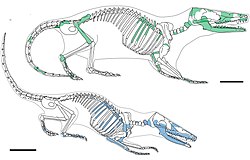
Picture of Docodontidae
- Source
- Wikipedia/Commons
- Credit
- Elsa Panciroli,Roger B.J. Benson,Vincent Fernandez,Matthew Humpage,Alberto Martín-Serra,Stig Walsh,Zhe-Xi Luo,Nichola…
- Licence
- CC BY 4.0
- Commercial use
- the licence allows it
No 3D scan was found. Smithsonian Open Access, MorphoSource and Sketchfab were all searched.
The description on this site
- Source
- Wikipedia, “Docodonta”
- Licence
- CC BY-SA 4.0
This is what the site found, which is not the same as what exists.
Keep going
What may have been alongside itDocodonta through timeFormations of the Late JurassicThe world it lived on
Occurrence data from the Paleobiology Database, CC BY 4.0. Simpson 1929