Dinogorgon
Dinogorgon is a genus of gorgonopsid from the Late Permian of South Africa and Tanzania. The generic name Dinogorgon is derived from Greek, meaning "terrible gorgon", while its species name rubidgei is taken from the surname of renowned Karoo paleontologist, Professor Bruce Rubidge, who has contributed to much of the research conducted on therapsids of the Karoo Basin. The type species of the genus is D. rubidgei.

Christian F. Kammerer · CC BY 4.0 · via Wikipedia/Commons. May be a photograph of a specimen, or an artist’s reconstruction — an interpretation of a skeleton, since colour and soft tissue are almost never preserved.
On record
Recorded, not inferred- Sits inside
- RubidgeiniPBDB
- Diet
- carnivorePBDB, for Gorgonopsia
- Motility
- actively mobilePBDB, for Osteichthyes
- Environment
- terrestrialPBDB, for Amniota
Time the record covers
At most 8 million years on record.
Every occurrence read is dated to somewhere between 259.857 Mya and 251.902 Mya, and nothing in the dating separates them, so that window is what the record shows rather than a span.
11 occurrences of Dinogorgon on record, most of them in the Permian. Bar height is expected occurrences, not a count: each fossil is spread across the span it is dated to, so a tall narrow bar means tight dating and a low wide one means loose.
When
11 occurrences- Permian100%
These are dates about fossils, not the animal: the record can only begin after it arose and end before it died out, so either end may reach further. Shares are expected occurrences: a fossil dated to a span is counted partly in each period it straddles. More on what this infers.
Found in
3 formations
- Usili Formation · Songea Group3
- Balfour Formation · Beaufort Group2
- Madumabisa Mudstone Formation2
Loading coastlines…
The named rock units Dinogorgon has been recovered from, largest first. Drawn where the rock is now, not where it formed. 4 occurrences have no formation on record, which is common for older literature.
Dinogorgon and its relatives
PermianWhere Dinogorgon and its relatives were recorded in the Permian.
Found in the same rock
24 taxa- Katumbia parringtoni2 sites
- Aloposaurus1 site
- Arctognathus nasuta1 site
- Cistecephalus microrhinus1 site
- Daptocephalus huenei1 site
- Dicynodon angielczyki1 site
- Dicynodontoides nowacki1 site
- Euptychognathus bathyrhynchus1 site
- Geikia locusticeps1 site
- Gorgonopidae1 site
- Gorgonopsia1 site
- Kawingasaurus fossilis1 site
- Platypodosaurus huenei1 site
- Procynosuchus1 site
- Procynosuchus delaharpeae1 site
- Rhachiocephalus behemoth1 site
- Rhachiocephalus magnus1 site
- Rubidgea atrox1 site
- Ruhuhucerberus haughtoni1 site
- Silphoictidoides ruhuhuensis1 site
- Sycosaurus1 site
- Sycosaurus nowaki1 site
- Theriognathus1 site
- Theriognathus microps1 site
The Paleobiology Database records 2 sites for Dinogorgon, and this reads all of them. The number is how many of those sites it was catalogued from too.
This is not a list of everything alive at the time. It is only what has come out of the same ground as this animal and been written down.
Entered from
5 references- Systematics of the Rubidgeinae (Therapsida: Gorgonopsia)5
- Theriodontia I: Phthinosuchia, Biarmosuchia, Eotitanosuchia, Gorgonopsia2
- A re-examination of the Karroo succession and fossil localities of part of the Upper Luangwa Valley2
- The distribution of the Karroo vertebrate fauna1
- Die Theriodontier des ostafrikanischen Ruhuhu-Gebietes in der Tuebinger Sammlung1
Each of the 11 occurrences read was entered from one of these publications, ordered by how many each accounts for. This is not a search for papers mentioning the name. Each entry links to the Paleobiology Database's own record for the work.
Media and terms
Media content1
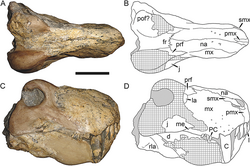
Picture of Dinogorgon
- Source
- Wikipedia/Commons
- Credit
- Christian F. Kammerer
- Licence
- CC BY 4.0
- Commercial use
- the licence allows it
No 3D scan was found. Smithsonian Open Access, MorphoSource and Sketchfab were all searched.
The description on this site
- Source
- Wikipedia, “Dinogorgon”
- Licence
- CC BY-SA 4.0
This is what the site found, which is not the same as what exists.
Keep going
What may have been alongside itRubidgeini through timeFormations of the PermianThe world it lived on
Occurrence data from the Paleobiology Database, CC BY 4.0. Broom 1936