Dicranurus
Dicranurus is a genus of Lower to Middle Devonian odontopleurid trilobites that lived in a shallow sea that lay between Euramerica and Gondwana, corresponding to modern-day Oklahoma and New York, and Morocco, respectively. As such, their fossils are found in New York, Oklahoma, and Morocco. Their bodies averaged about 1 in (25 mm) or so, in length, though their large spines made them at least 2 in (51 mm) in length. Such tremendous spines may have hampered the ability of predators, such as arthrodire placoderms, to attack them, and to help prevent them from sinking into the soft mud of their environment. Dicranurus trilobites are distinguished from other odontopleurids by the pair of large, curled, horn-like spines that emanate from behind the glabellum. The genus name refers to its distinctive horns.

Daderot · CC0 · via Wikipedia/Commons. May be a photograph of a specimen, or an artist’s reconstruction — an interpretation of a skeleton, since colour and soft tissue are almost never preserved.
On record
Recorded, not inferred- Sits inside
- OdontopleuridaePBDB
- Diet
- carnivorePBDB, for Odontopleuridae
- Life habit
- low-level epifaunalPBDB, for Trilobita
- Motility
- fast-movingPBDB, for Trilobita
- Vision
- well-developedPBDB, for Odontopleuridae
- Environment
- marinePBDB, for Trilobita
Time the record covers
At least 45 million years on record.
The record covers at least 458.2 Mya to 413.02 Mya. No occurrence read is dated outside 461.1 Mya to 382.31 Mya.
22 occurrences of Dicranurus on record, most of them in the Devonian. Bar height is expected occurrences, not a count: each fossil is spread across the span it is dated to, so a tall narrow bar means tight dating and a low wide one means loose.
When
22 occurrences- Ordovician5%
- Silurian1%
- Devonian94%
These are dates about fossils, not the animal: the record can only begin after it arose and end before it died out, so either end may reach further. Shares are expected occurrences: a fossil dated to a span is counted partly in each period it straddles. More on what this infers.
Found in
12 formations
- Garra Formation2
- Haragan Formation1
- Bois d'Arc Formation1
- Vinarice Limestone Formation1
- Bou Regreg Limestone Formation1
- Rechoua Limestone Formation1
Loading coastlines…
The named rock units Dicranurus has been recovered from, largest first. Drawn where the rock is now, not where it formed. 9 occurrences have no formation on record, which is common for older literature.
Dicranurus and its relatives
DevonianWhere Dicranurus and its relatives were recorded in the Devonian.
Found in the same rock
354 taxa- Reedops sternbergi12 sites
- Reedops bronni11 sites
- Crotalocephalina gibbus10 sites
- Nowakia10 sites
- Zlichovaspis (Zlichovaspis) rugosa10 sites
- Platyscutellum9 sites
- Cyphaspis convexum8 sites
- Odontochile hausmanni8 sites
- Reedops cephalotes8 sites
- Leonaspis7 sites
- Caplinoplia6 sites
- Ceratonurus6 sites
- Reedops prospicens6 sites
- Tropidocoryphe6 sites
- Viriatellina6 sites
- Boeckops boecki5 sites
- Cingulodermis5 sites
- Crotalocephalus pauper5 sites
- Cyphaspides5 sites
- Ostracoda5 sites
- Poroscutellum5 sites
- Rugoleptaena5 sites
- Acanthopyge (Perunaspis) minuta4 sites
- Ambocoelia4 sites
The Paleobiology Database records 22 sites for Dicranurus, and this reads all of them. The number is how many of those sites it was catalogued from too. The 24 sharing the most are listed.
This is not a list of everything alive at the time. It is only what has come out of the same ground as this animal and been written down.
Entered from
10 references- Trilobite assemblages in the Devonian of the Barrandian area and their relations to palaeoenvironments4
- The Bohemian Lower Devonian Stages4
- Trilobiten des juengeren Siluriums sowie des Unter- und Mitteldevons. I. Mit Beitraegen zur Silur-Devon-Stratigraphie einiger Gebiete Marokkos und Oberfrankens4
- Lower Devonian aulacopleuroidean trilobites from Oklahoma2
- The Lochkovian-Pragian boundary in the Lower Devonian of the Barrandian area (Czechoslovakia)2
- Silicified Lower Devonian trilobites from New South Wales2
- Proetid Trilobites from the Lower Devonian (Pragian) Ihandar Formation, Anti-Atlas, Morocco1
- Trilobites from the Ordovician Shihtzupu Formation, Zunyi, Guizhou Province, China1
- Silurian to early Devonian facies and biofacies patterns for the Melbourne Trough, central Victoria1
- Trilobites of the Haragan, Bois d'Arc and Frisco Formations (Early Devonian) Arbuckle Mountains region, Oklahoma1
Each of the 22 occurrences read was entered from one of these publications, ordered by how many each accounts for. This is not a search for papers mentioning the name. Entries link to doi.org where the Paleobiology Database holds an identifier, and to its own record where it does not. Relayed as the Paleobiology Database holds them, not checked against what they resolve to.
Media and terms
Media content2

Picture of Dicranurus
- Source
- Wikipedia/Commons
- Credit
- Daderot
- Licence
- CC0
- Commercial use
- the licence allows it
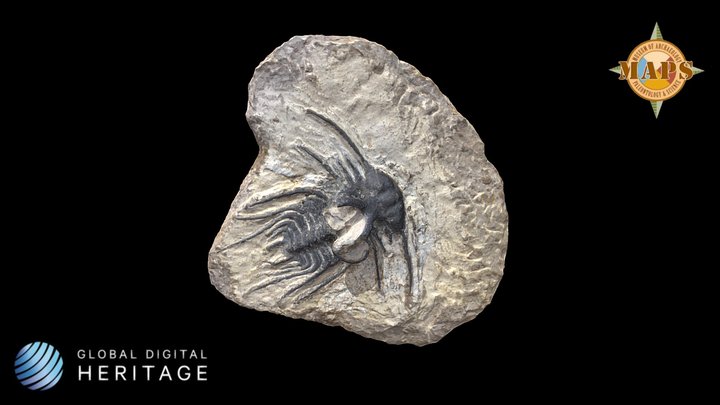
3D model
- Source
- Sketchfab
- Licence
- CC Attribution-NonCommercial
- Commercial use
- the licence does not allow it
The description on this site
- Source
- Wikipedia, “Dicranurus”
- Licence
- CC BY-SA 4.0
This is what the site found, which is not the same as what exists.
Keep going
What may have been alongside itOdontopleuridae through timeFormations of the DevonianThe world it lived on
Occurrence data from the Paleobiology Database, CC BY 4.0. Conrad 1841