Dicraeosauridae
Searched as Dicraeosauridae indet.. The Paleobiology Database treats Dicraeosauridae as the accepted name.
Dicraeosauridae is a family of diplodocoid sauropods that are the sister group to Diplodocidae. Dicraeosaurids are a part of the Flagellicaudata, along with Diplodocidae. Dicraeosauridae includes genera such as Amargasaurus, Suuwassea, Dicraeosaurus, and Brachytrachelopan. Definitive genera of this family have been found in North America, Africa, and South America. The Asian taxa Lingwulong and Tharosaurus have been suggested to be dicraeosaurids, but some authors disagree with this classification. Dicraeosaurids were alive from the Early or Middle Jurassic to the Early Cretaceous. A few dicraeosaurids survived into the Cretaceous, the youngest of which was Amargasaurus.

Sainterx · Public Domain · via Wikipedia/Commons. May be a photograph of a specimen, or an artist’s reconstruction — an interpretation of a skeleton, since colour and soft tissue are almost never preserved.
On record
Recorded, not inferred- Also called
- dicraeosauridPBDB
- Sits inside
- FlagellicaudataPBDB
- Diet
- herbivorePBDB, for Sauropoda
- Life habit
- ground dwelling, gregariousPBDB, for Sauropoda
- Motility
- actively mobilePBDB, for Sauropoda
- Environment
- terrestrialPBDB, for Sauropoda
Time the record covers
At least 23 million years on record.
The record covers at least 149.2 Mya to 125.77 Mya. No occurrence read is dated outside 154.8 Mya to 121.4 Mya.
5 occurrences of Dicraeosauridae on record, most of them in the Late Jurassic. Bar height is expected occurrences, not a count: each fossil is spread across the span it is dated to, so a tall narrow bar means tight dating and a low wide one means loose.
When
5 occurrencesThese are dates about fossils, not the animal: the record can only begin after it arose and end before it died out, so either end may reach further. Shares are expected occurrences: a fossil dated to a span is counted partly in each period it straddles. More on what this infers.
Found in
4 formations
- Morrison Formation2
- Kadzi Formation1
- Mulichinco Formation1
- La Amarga Formation · Bajada del Agrio Group1
Loading coastlines…
The named rock units Dicraeosauridae has been recovered from, largest first. Drawn where the rock is now, not where it formed.
Dicraeosauridae and its relatives
Late JurassicWhere Dicraeosauridae and its relatives were recorded in the Late Jurassic.
Found in the same rock
101 taxa- Dicraeosaurus sattleri12 sites
- Giraffatitan brancai9 sites
- Sauropoda8 sites
- Camarasaurus5 sites
- Dicraeosaurus hansemanni5 sites
- Diplodocidae5 sites
- Kentrosaurus aethiopicus5 sites
- Diplodocinae4 sites
- Theropoda4 sites
- Apatosaurus3 sites
- Brachiosaurus3 sites
- Diplodocoidea3 sites
- Stegosauria3 sites
- Stegosaurus3 sites
- Abelisauroidea2 sites
- Allosaurus2 sites
- Allosaurus fragilis2 sites
- Amargasaurus cazaui2 sites
- Barosaurus2 sites
- Ceratosauria2 sites
- Ceratosaurus2 sites
- Dicraeosaurus2 sites
- Diplodocus longus2 sites
- Goniopholis2 sites
The Paleobiology Database records 33 sites for Dicraeosauridae, and this reads all of them. The number is how many of those sites it was catalogued from too. The 24 sharing the most are listed.
This is not a list of everything alive at the time. It is only what has come out of the same ground as this animal and been written down.
Entered from
5 references- Critical reappraisal of a putative dicraeosaurid sauropod dinosaur from the Middle Jurassic of Gondwana and a revised view of diplodocoid evolutionary relationships and biogeography1
- New Dicraeosauridae (Sauropoda, Diplodocoidea) remains from the La Amarga Formation (Barremian–Aptian, Lower Cretaceous), Neuquén Basin, Patagonia, Argentina1
- The Late Jurassic sauropod dinosaur ‘Morosaurus’ agilis Marsh, 1889 reexamined and reinterpreted as a dicraeosaurid1
- Taxonomic affinities of the putative titanosaurs from the Late Jurassic Tendaguru Formation of Tanzania: phylogenetic and biogeographic implications for eusauropod dinosaur evolution1
- A possible dicraeosaurid (Sauropoda, Diplodocoidea) cranial endocast from the Early Cretaceous of Patagonia1
Each of the 5 occurrences read was entered from one of these publications, ordered by how many each accounts for. This is not a search for papers mentioning the name. Entries link to doi.org where the Paleobiology Database holds an identifier, and to its own record where it does not. Relayed as the Paleobiology Database holds them, not checked against what they resolve to.
Media and terms
Media content1
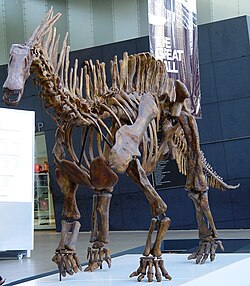
Picture of Dicraeosauridae
- Source
- Wikipedia/Commons
- Credit
- Sainterx
- Licence
- Public Domain
- Commercial use
- the licence allows it
No 3D scan of Dicraeosauridae was found in MorphoSource and Sketchfab.
Smithsonian Open Access was not reached for this taxon, so this list is what the others held rather than everything there is.
The description on this site
- Licence
- CC BY-SA 4.0
This is what the site found, which is not the same as what exists.
Keep going
What may have been alongside itFlagellicaudata through timeFormations of the Late JurassicThe world it lived on
Occurrence data from the Paleobiology Database, CC BY 4.0. (Huene 1927)