Diadectomorpha
Diadectomorpha is a clade of large tetrapods that lived in Euramerica during the Carboniferous and Early Permian periods and in Asia during Late Permian (Wuchiapingian), They have typically been classified as advanced reptiliomorphs positioned close to, but outside of the clade Amniota, though some recent research has recovered them as the sister group to the traditional Synapsida within Amniota, based on inner ear anatomy and cladistic analyses. They include both large carnivorous and even larger herbivorous forms, some semi-aquatic and others fully terrestrial. The diadectomorphs seem to have originated during late Mississippian times, although they only became common after the Carboniferous rainforest collapse and flourished during the Late Pennsylvanian and Early Permian periods.

Ghedoghedo · Public Domain · via Wikipedia/Commons. May be a photograph of a specimen, or an artist’s reconstruction — an interpretation of a skeleton, since colour and soft tissue are almost never preserved.
On record
Recorded, not inferred- Sits inside
- CotylosauriaPBDB
- Motility
- actively mobilePBDB, for Osteichthyes
- Environment
- brackish,freshwater,terrestrialPBDB, for Tetrapoda
Time the record covers
At least 47 million years on record.
The record covers at least 307.4 Mya to 259.857 Mya. No occurrence read is dated outside 314.6 Mya to 251.902 Mya.
100 occurrences of Diadectomorpha on record, most of them in the Permian. Bar height is expected occurrences, not a count: each fossil is spread across the span it is dated to, so a tall narrow bar means tight dating and a low wide one means loose.
When
100 occurrences- Carboniferous12%
- Permian88%
These are dates about fossils, not the animal: the record can only begin after it arose and end before it died out, so either end may reach further. Shares are expected occurrences: a fossil dated to a span is counted partly in each period it straddles. More on what this infers.
Found in
31 formations
- Cutler Formation12
- Arroyo Formation · Clear Fork Group8
- Belle Plains Formation · Wichita Group7
- Waggoner Ranch Formation · Wichita Group7
- Admiral Formation · Wichita Group6
- Abo/Cutler Formation6
Loading coastlines…
The named rock units Diadectomorpha has been recovered from, largest first. Drawn where the rock is now, not where it formed. 7 further formations hold fewer occurrences each and are not listed. 7 occurrences have no formation on record, which is common for older literature.
Diadectomorpha and its relatives
PermianWhere Diadectomorpha and its relatives were recorded in the Permian.
Found in the same rock
278 taxa- Diadectes37 sites
- Eryops33 sites
- Trimerorhachis17 sites
- Dimetrodon15 sites
- Ophiacodon15 sites
- Archeria11 sites
- Eryops megacephalus11 sites
- Diplocaulus10 sites
- Edaphosaurus10 sites
- Xenacanthus10 sites
- Ophiacodon retroversus9 sites
- Diadectes sideropelicus8 sites
- Dimetrodon limbatus8 sites
- Platyhystrix rugosus8 sites
- Sphenacodon ferox8 sites
- Captorhinus aguti7 sites
- Eryops grandis7 sites
- Ophiacodon mirus7 sites
- Trimerorhachis insignis7 sites
- Zatrachys7 sites
- Zatrachys serratus7 sites
- Chenoprosopus milleri6 sites
- Diplocaulus magnicornis6 sites
- Brachydectes newberryi5 sites
The Paleobiology Database records 71 sites for Diadectomorpha, and this reads all of them. The number is how many of those sites it was catalogued from too. The 24 sharing the most are listed.
This is not a list of everything alive at the time. It is only what has come out of the same ground as this animal and been written down.
Entered from
42 references- Vertebrate faunal horizons in the Texas Permo-Carboniferous red beds28
- Morphology, Phylogeny, and Evolution of Diadectidae (Cotylosauria: Diadectomorpha)12
- Early Permian Vertebrate Assemblage and its Biostratigraphic Significance, Arroyo del Agua, Rio Arriba County, New Mexico6
- Lower Permian vertebrate localities of New Mexico and their assemblages5
- The Localities and Horizons of Permian Vertebrate Fossils in Texas4
- Early Permian Vertebrates3
- Early Permian Vertebrates from the Cutler Formation of the Placerville Area, Colorado3
- The Vale Formation (Lower Permian): Its Vertebrates and Paleoecology2
- Vertebrates from the Organ Rock Shale of the Cutler Group, Permian of Monument Valley and vicinity, Utah and Arizona2
- Die Tierfährten in dem Rotliegenden “Deutschlands” [The animal tracks in the “German” Rotliegenden]2
- Second contribution to the history of the Cotylosauria2
- An articulated skeleton of Varanops with bite marks: the oldest known evidence of scavenging among terrestrial vertebrates1
Each of the 100 occurrences read was entered from one of these publications, ordered by how many each accounts for. This is not a search for papers mentioning the name. 30 further references are not listed. Entries link to doi.org where the Paleobiology Database holds an identifier, and to its own record where it does not. Relayed as the Paleobiology Database holds them, not checked against what they resolve to.
Media and terms
Media content1
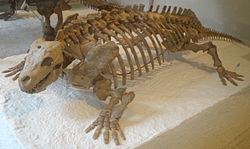
Picture of Diadectomorpha
- Source
- Wikipedia/Commons
- Credit
- Ghedoghedo
- Licence
- Public Domain
- Commercial use
- the licence allows it
No 3D scan of Diadectomorpha was found in Sketchfab.
Smithsonian Open Access and MorphoSource were not reached for this taxon, so this list is what the others held rather than everything there is.
The description on this site
- Licence
- CC BY-SA 4.0
This is what the site found, which is not the same as what exists.
Keep going
What may have been alongside itCotylosauria through timeFormations of the PermianThe world it lived on
Occurrence data from the Paleobiology Database, CC BY 4.0. (Watson 1917)