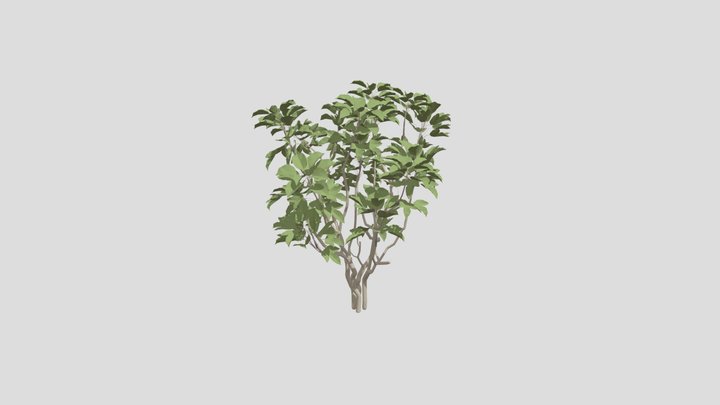
Dendropanax sp.
Dendropanax is a genus of flowering plants in the family Araliaceae, consisting of 92 species of evergreen trees and shrubs, first described by Joseph Decaisne & Jules Émile Planchon in 1854. They are native to Central and South America, eastern Asia and the Malay Peninsula. Species such as Dendropanax trifidus or "kakuremino" in Japanese, are used in roji gardens, traditional moist and mossy areas leading to the chashitsu for tea ceremonies.

KENPEI · CC BY-SA 3.0 · via Wikipedia/Commons. May be a photograph of a specimen, or an artist’s reconstruction — an interpretation of a skeleton, since colour and soft tissue are almost never preserved.
Time the record covers
At least 17 million years on record.
The record covers at least 51.1 Mya to 33.9 Mya. No occurrence read is dated outside 56 Mya to 23.04 Mya.
5 occurrences of Dendropanax sp. on record, most of them in the Eocene. Bar height is expected occurrences, not a count: each fossil is spread across the span it is dated to, so a tall narrow bar means tight dating and a low wide one means loose.
When
5 occurrencesThese are dates about fossils, not the animal: the record can only begin after it arose and end before it died out, so either end may reach further. Shares are expected occurrences: a fossil dated to a span is counted partly in each period it straddles. More on what this infers.
Found in
3 formations
- Wasatch Formation3
- Okinoyama Formation · Ube Group1
- San Sebastian Formation · Rio Guatemala Group1
Loading coastlines…
The named rock units Dendropanax sp. has been recovered from, largest first. Drawn where the rock is now, not where it formed.
Dendropanax sp. and its relatives
EoceneWhere Dendropanax sp. and its relatives were recorded in the Eocene.
Found in the same rock
89 taxa- Dendropanax latens3 sites
- Dicotyledoneae3 sites
- Lygodium kaulfussi3 sites
- Zingiberopsis isonervosa3 sites
- Alnus2 sites
- Cyathea2 sites
- Dombeya novimundi2 sites
- Equisetum2 sites
- Gleditsia2 sites
- Platycarya2 sites
- Salvinia preauriculata2 sites
- Schoepfia republicensis2 sites
- <Fern>1 site
- <Sabalites/Amesoneuron>1 site
- Acrostichum hesperium1 site
- Alchornea1 site
- Allantodiopsis erosa1 site
- Allophylus1 site
- Apocynaceae1 site
- Arecaceae1 site
- Averrhoites affinis1 site
- Bernoullia1 site
- Brunellia sp.1 site
- Caesalpinea microphylla1 site
The Paleobiology Database records 5 sites for Dendropanax sp., and this reads all of them. The number is how many of those sites it was catalogued from too. The 24 sharing the most are listed.
This is not a list of everything alive at the time. It is only what has come out of the same ground as this animal and been written down.
Entered from
3 references- Late Paleocene-early Eocene climate changes in southwestern Wyoming: Paleobotanical analysis3
- The Eocene flora of the Ube coal-field, southwest Honshu, Japan1
- Studies in neotropical paleobotany. I. The Oligocene communities of Puerto Rico1
Each of the 5 occurrences read was entered from one of these publications, ordered by how many each accounts for. This is not a search for papers mentioning the name. Entries link to doi.org where the Paleobiology Database holds an identifier, and to its own record where it does not. Relayed as the Paleobiology Database holds them, not checked against what they resolve to.
Media and terms
Media content2

Picture of Dendropanax sp.
- Source
- Wikipedia/Commons
- Credit
- KENPEI
- Licence
- CC BY-SA 3.0
- Commercial use
- the licence allows it
Smithsonian Open Access was not reached for this taxon, so this list is what the others held rather than everything there is.
The description on this site
- Source
- Wikipedia, “Dendropanax”
- Licence
- CC BY-SA 4.0
This is what the site found, which is not the same as what exists.
Keep going
What may have been alongside itFormations of the EoceneThe world it lived on
Occurrence data from the Paleobiology Database, CC BY 4.0.