Cymbiola
Cymbiola is a genus of large predatory sea snail, a marine gastropod mollusk in the subfamily Amoriinae of the family Volutidae, the volutes.

Marie Hennion · CC BY 4.0 · via Wikipedia/Commons. May be a photograph of a specimen, or an artist’s reconstruction — an interpretation of a skeleton, since colour and soft tissue are almost never preserved.
On record
Recorded, not inferred- Sits inside
- VolutinaePBDB
- Diet
- carnivorePBDB, for Volutidae
- Life habit
- epifaunalPBDB, for Volutidae
- Motility
- actively mobilePBDB, for Volutidae
- Vision
- limitedPBDB, for Gastropoda
Time the record covers
At least 10 million years on record.
The record covers at least 13.82 Mya to 3.6 Mya. No occurrence read is dated outside 15.98 Mya to 2.58 Mya.
13 occurrences of Cymbiola on record, most of them in the Miocene. The Paleobiology Database records this as a living group, and the chart stops with its fossils rather than at the present. Bar height is expected occurrences, not a count: each fossil is spread across the span it is dated to, so a tall narrow bar means tight dating and a low wide one means loose.
When
13 occurrencesThese are dates about fossils, not the animal: the record can only begin after it arose and end before it died out, so either end may reach further. Shares are expected occurrences: a fossil dated to a span is counted partly in each period it straddles. More on what this infers.
Found in
7 formations
- Cilanang Formation3
- Muddy Creek Formation3
- Rembang Formation2
- Dry Creek Sands Formation1
- Upper Kalibeng Formation1
- Fyansford Formation1
Loading coastlines…
The named rock units Cymbiola has been recovered from, largest first. Drawn where the rock is now, not where it formed. 1 occurrence has no formation on record, which is common for older literature.
Cymbiola and its relatives
MioceneWhere Cymbiola and its relatives were recorded in the Miocene.
Found in the same rock
275 taxa- Turbo (Marmarostoma)3 sites
- Amusium hulshofi2 sites
- Anadara2 sites
- Antigona2 sites
- Conus2 sites
- Cryptospira2 sites
- Erronea (Adusta) sondeiana2 sites
- Marginella (Cryptospira) ventricosa2 sites
- Mimachlamys senatoria2 sites
- Mitra (Mitra)2 sites
- Mitra (Tiara)2 sites
- Mitraria2 sites
- Nassarius (Zeuxis)2 sites
- Placamen2 sites
- Strombus2 sites
- Turris2 sites
- Turritella (Kurosioia) cingulifera2 sites
- Vexillum (Costellaria)2 sites
- Acar plicata1 site
- Afrozoila gendinganensis1 site
- Alocospira1 site
- Amalda (Baryspira)1 site
- Amoria1 site
- Anadara (Anadara) antiquata1 site
The Paleobiology Database records 6 sites for Cymbiola, and this reads all of them. The number is how many of those sites it was catalogued from too. The 24 sharing the most are listed.
This is not a list of everything alive at the time. It is only what has come out of the same ground as this animal and been written down.
Entered from
6 references- Skwarko, 19946
- The gastropods of the older Tertiary of Australia (Part 2)3
- Types of Cenozoic Mollusca from Java in the Martin Collection of Naturalis1
- Preangerian (Late Miocene) Mollusca from a hill near Sekurau, northern Kutai, Kalimantan Timur (East Borneo)1
- The molluscan fauna of the Pliocene strata underlying the Adelaide Plains. Part V - Gastropoda (Eratoidae to Scaphandridae)1
- The gastropods of the older Tertiary of Australia (Part 1)1
Each of the 13 occurrences read was entered from one of these publications, ordered by how many each accounts for. This is not a search for papers mentioning the name. Each entry links to the Paleobiology Database's own record for the work.
Media and terms
Media content2

Picture of Cymbiola
- Source
- Wikipedia/Commons
- Credit
- Marie Hennion
- Licence
- CC BY 4.0
- Commercial use
- the licence allows it
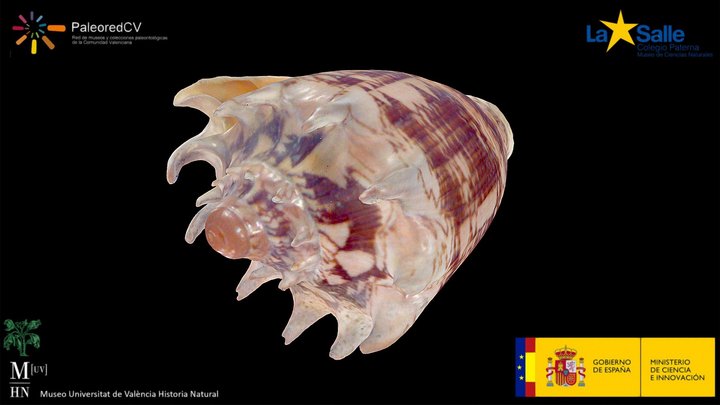
3D model
- Source
- Sketchfab
- Licence
- CC Attribution
- Commercial use
- cannot be read from the licence given — check the record
The description on this site
- Source
- Wikipedia, “Cymbiola”
- Licence
- CC BY-SA 4.0
This is what the site found, which is not the same as what exists.
Keep going
What may have been alongside itVolutinae through timeFormations of the MioceneThe world it lived on
Occurrence data from the Paleobiology Database, CC BY 4.0. Swainson 1831