Cryptoprocta
Cryptoprocta is a genus of carnivoran endemic to Madagascar. It contains the living fossa and its two larger, recently extinct relatives, Cryptoprocta spelea and Cryptoprocta bevatabe. The fossa is the largest of Madagascar's mammalian carnivores; the extant fossa is a generalist carnivore, capable of hunting even the largest living lemurs. The two extinct species are thought to have hunted the extinct lemurs that once inhabited the island, both of which were larger than the extant species.

Uncredited · via Wikipedia/Commons. May be a photograph of a specimen, or an artist’s reconstruction — an interpretation of a skeleton, since colour and soft tissue are almost never preserved.
On record
Recorded, not inferred- Also called
- fossaPBDB
- Sits inside
- EupleridaePBDB
- Diet
- carnivore, omnivorePBDB, for Carnivora
- Life habit
- ground dwellingPBDB, for Carnivora
- Motility
- actively mobilePBDB, for Osteichthyes
- Environment
- terrestrialPBDB, for Eutheria
Time the record covers
At most 12 thousand years on record.
Every occurrence read is dated to somewhere between 11.7 ka and 0 Mya, and nothing in the dating separates them, so that window is what the record shows rather than a span.
6 occurrences of Cryptoprocta on record, most of them in the Holocene. The Paleobiology Database records this as a living group. Bar height is expected occurrences, not a count: each fossil is spread across the span it is dated to, so a tall narrow bar means tight dating and a low wide one means loose.
When
6 occurrences- Holocene100%
These are dates about fossils, not the animal: the record can only begin after it arose and end before it died out, so either end may reach further. Shares are expected occurrences: a fossil dated to a span is counted partly in each period it straddles. More on what this infers.
Cryptoprocta and its relatives
HoloceneWhere Cryptoprocta and its relatives were recorded in the Holocene.
Found in the same rock
76 taxa- Archaeolemur edwardsi3 sites
- Cheirogaleus medius3 sites
- Microgale3 sites
- Mus musculus3 sites
- Tenrec ecaudatus3 sites
- Accipiter madagascariensis2 sites
- Aepyornis2 sites
- Archaeolemur majori2 sites
- Avahi cleesei2 sites
- Babakotia radofilai2 sites
- Buteo2 sites
- Capra aegagrus2 sites
- cf. Boophinae indet.2 sites
- Chaerephon leucogastert2 sites
- Coracopsis nigra2 sites
- Coua2 sites
- Coua cristata2 sites
- Coua gigas2 sites
- Dryolimnas cuvieri2 sites
- Eliurus2 sites
- Erymnochelys madagascariensis2 sites
- Eulemur mongoz2 sites
- Eulemur rufus2 sites
- Eurystomus glaucurus2 sites
The Paleobiology Database records 4 sites for Cryptoprocta, and this reads all of them. The number is how many of those sites it was catalogued from too. The 24 sharing the most are listed.
This is not a list of everything alive at the time. It is only what has come out of the same ground as this animal and been written down.
Entered from
3 references- Subfossil lemur discoveries from the Beanka Protected Area in western Madagascar4
- New findings at Andrahomana Cave, southeastern Madagascar1
- Early Holocene fauna from a new subfossil site: A first assessment from Christmas River, south central Madagascar1
Each of the 6 occurrences read was entered from one of these publications, ordered by how many each accounts for. This is not a search for papers mentioning the name. Entries link to doi.org where the Paleobiology Database holds an identifier, and to its own record where it does not. Relayed as the Paleobiology Database holds them, not checked against what they resolve to.
Media and terms
Media content2
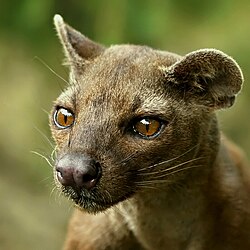
Picture of Cryptoprocta
- Source
- Wikipedia/Commons
- Credit
- nobody named on the record
- Licence
- not stated by the source
- Commercial use
- cannot be read from the licence given — check the record
CT scan
- Source
- MorphoSource
- Licence
- not stated by the source
- Commercial use
- cannot be read from the licence given — check the record
- Specimen
- Cryptoprocta ferox · dpc:6832
The description on this site
- Licence
- CC BY-SA 4.0
This is what the site found, which is not the same as what exists.
Keep going
What may have been alongside itEupleridae through timeFormations of the HoloceneThe world it lived on
Occurrence data from the Paleobiology Database, CC BY 4.0. Bennett 1833