Cryptoplax
Cryptoplax is a genus of polyplacophoran molluscs. The genus consists of the following living species:Cryptoplax burrowi E. A. Smith, 1884 Cryptoplax caledonicus Rochebrune, 1882 Cryptoplax dawydoffi Leloup, 1937 Cryptoplax dimidiata Ang, 1967 Cryptoplax dupuisi Ashby, 1931 Cryptoplax elioti Pilsbry, 1901 Cryptoplax hartmeyeri Thiele, 1911 Cryptoplax iredalei Ashby, 1923 Cryptoplax japonica Pilsbry, 1901 Cryptoplax larvaeformis Burrow, 1815 Cryptoplax mystica Iredale & Hull, 1925 Cryptoplax oculata Quoy & Gaimard, 1835 Cryptoplax plana Ang, 1967 Cryptoplax propior Is. & Iw. Taki, 1930 Cryptoplax royana Iredale & Hull, 1925 Cryptoplax striata Lamarck, 1819 Cryptoplax sykesi Thiele, 1909

Hectonichus · CC BY-SA 3.0 · via Wikipedia/Commons. May be a photograph of a specimen, or an artist’s reconstruction — an interpretation of a skeleton, since colour and soft tissue are almost never preserved.
On record
Recorded, not inferred- Sits inside
- AcanthochitonidaePBDB
- Diet
- grazerPBDB, for Polyplacophora
- Life habit
- epifaunalPBDB, for Polyplacophora
- Motility
- facultatively mobile, attachedPBDB, for Polyplacophora
- Vision
- limitedPBDB, for Polyplacophora
- Environment
- marine,brackishPBDB, for Polyplacophora
Time the record covers
At least 8.7 million years on record.
The record covers at least 15.98 Mya to 7.246 Mya. No occurrence read is dated outside 23.04 Mya to 5.333 Mya.
8 occurrences of Cryptoplax on record, most of them in the Miocene. The Paleobiology Database records this as a living group, and the chart stops with its fossils rather than at the present. Bar height is expected occurrences, not a count: each fossil is spread across the span it is dated to, so a tall narrow bar means tight dating and a low wide one means loose.
When
8 occurrences- Miocene100%
These are dates about fossils, not the animal: the record can only begin after it arose and end before it died out, so either end may reach further. Shares are expected occurrences: a fossil dated to a span is counted partly in each period it straddles. More on what this infers.
Found in
1 formation
Loading coastlines…
The named rock units Cryptoplax has been recovered from, largest first. Drawn where the rock is now, not where it formed. 7 occurrences have no formation on record, which is common for older literature.
Cryptoplax and its relatives
MioceneWhere Cryptoplax and its relatives were recorded in the Miocene.
Found in the same rock
77 taxa- Astralium2 sites
- Anapella1 site
- Astraea (Astralium) waluensis1 site
- Astraea (Vitiastraea) holmesi1 site
- Austrohinnites polyaktinos1 site
- Caecum1 site
- Cantharidus1 site
- Cardita compta1 site
- Charonia1 site
- Cheilea equestris1 site
- Clithon (Clithon) corona1 site
- Collonista1 site
- Conus1 site
- Conus (Lithoconus) litteratus1 site
- Cuna1 site
- Cypraea (Erosaria) helvola1 site
- Cypraea (Lyncina) lynx1 site
- Diastoma1 site
- Dolicholatirus1 site
- Electromactra howchiniana1 site
- Eratoidea1 site
- Erosaria everwijni1 site
- Euchelus (Herpetopoma) instrictus1 site
- Gari1 site
The Paleobiology Database records 2 sites for Cryptoplax, and this reads all of them. The number is how many of those sites it was catalogued from too. The 24 sharing the most are listed.
This is not a list of everything alive at the time. It is only what has come out of the same ground as this animal and been written down.
Entered from
3 references- Chitons and Gastropods (Haliotidae through Adeorbidae) from Western Pacific Islands6
- Devínska Kobyla- a window into the Middle Miocene shallow-water marine environments of the Central Paratethys (Vienna Basin, Slovakia)1
- The molluscan fauna of the Pliocene strata underlying the Adelaide Plains. Part III - Scaphopoda, Polyplacophora, Gastropoda (Haliotidae-Tornidae)1
Each of the 8 occurrences read was entered from one of these publications, ordered by how many each accounts for. This is not a search for papers mentioning the name. Entries link to doi.org where the Paleobiology Database holds an identifier, and to its own record where it does not. Relayed as the Paleobiology Database holds them, not checked against what they resolve to.
Media and terms
Media content1
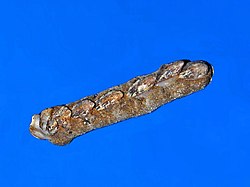
Picture of Cryptoplax
- Source
- Wikipedia/Commons
- Credit
- Hectonichus
- Licence
- CC BY-SA 3.0
- Commercial use
- the licence allows it
No 3D scan of Cryptoplax was found in MorphoSource and Sketchfab.
Smithsonian Open Access was not reached for this taxon, so this list is what the others held rather than everything there is.
The description on this site
- Source
- Wikipedia, “Cryptoplax”
- Licence
- CC BY-SA 4.0
This is what the site found, which is not the same as what exists.
Keep going
What may have been alongside itAcanthochitonidae through timeFormations of the MioceneThe world it lived on
Occurrence data from the Paleobiology Database, CC BY 4.0. Blainville 1818