Cryptobranchidae
The Cryptobranchidae are a family of large salamanders that are fully aquatic. The family includes some of the largest living amphibians. They are native to China, Japan, and the eastern United States. Giant salamanders constitute one of two living families—the other being the Asiatic salamanders belonging to the family Hynobiidae—within the Cryptobranchoidea, one of two main divisions of living salamanders.

V31S70 · CC BY 2.0 · via Wikipedia/Commons. May be a photograph of a specimen, or an artist’s reconstruction — an interpretation of a skeleton, since colour and soft tissue are almost never preserved.
On record
Recorded, not inferred- Also called
- hellbenderPBDB
- Sits inside
- CryptobranchoideaPBDB
- Diet
- carnivorePBDB, for Temnospondyli
- Life habit
- amphibiousPBDB, for Temnospondyli
- Motility
- actively mobilePBDB, for Temnospondyli
- Environment
- brackish,freshwater,terrestrialPBDB, for Tetrapoda
Time the record covers
At least 93 million years on record.
The record covers at least 93.9 Mya to 129 ka. No occurrence read is dated outside 100.5 Mya to 0 Mya.
42 occurrences of Cryptobranchidae on record, most of them in the Miocene. The Paleobiology Database records this as a living group. Bar height is expected occurrences, not a count: each fossil is spread across the span it is dated to, so a tall narrow bar means tight dating and a low wide one means loose.
When
42 occurrences- Late Cretaceous21%
- Paleocene10%
- Oligocene7%
- Miocene43%
- Pliocene3%
- Pleistocene16%
- Holoceneunder 1%
These are dates about fossils, not the animal: the record can only begin after it arose and end before it died out, so either end may reach further. Shares are expected occurrences: a fossil dated to a span is counted partly in each period it straddles. More on what this infers.
Found in
19 formations
- Bissekty Formation4
- Runningwater Formation2
- Brackwater Molasse Formation · Molasse Group2
- Yalovach Formation2
- Naran Bulak Formation2
- Valentine Formation · Ogallala Group1
Loading coastlines…
The named rock units Cryptobranchidae has been recovered from, largest first. Drawn where the rock is now, not where it formed. 16 occurrences have no formation on record, which is common for older literature.
Cryptobranchidae and its relatives
MioceneWhere Cryptobranchidae and its relatives were recorded in the Miocene.
Found in the same rock
1,190 taxa- Andrias scheuchzeri12 sites
- Trionyx9 sites
- Testudo8 sites
- Lacerta7 sites
- Mustelidae7 sites
- Ophisaurus7 sites
- Andrias matthewi6 sites
- Aves5 sites
- Blackia miocaenica5 sites
- Clethrionomys gapperi5 sites
- Colubrinae5 sites
- Crotalus horridus5 sites
- Cyprinidae5 sites
- Microtus pennsylvanicus5 sites
- Neotoma floridana5 sites
- Pelobates5 sites
- Pseudopus5 sites
- Rana pipiens5 sites
- Salamandridae5 sites
- Synaptomys cooperi5 sites
- Blarina brevicauda4 sites
- Bufo4 sites
- Bufo americanus4 sites
- Castor canadensis4 sites
The Paleobiology Database records 38 sites for Cryptobranchidae, and this reads all of them. The number is how many of those sites it was catalogued from too. The 24 sharing the most are listed.
This is not a list of everything alive at the time. It is only what has come out of the same ground as this animal and been written down.
Entered from
28 references- Stratigraphy and mammal faunas of the Brackwassermolasse in the surroundings of Ulm (Southwest Germany)5
- North American fossil cryptobranchid salamanders5
- Drevneishie mlekopitaiushchie SSSR [Ancient mammals of the USSR]4
- Biostratigraphy and paleoecology of continental Tertiary vertebrate faunas in the Lower Rhine Embayment (NW-Germany)2
- Paleocene salamanders from southern Mongolia2
- Cryptobranchid salamanders from the Paleocene and Miocene of Saskatchewan2
- A new Miocene ape and locomotion in the ancestor of great apes and humans1
- Fossil amphibians and reptiles from the Neogene locality of Maramena (Greece), the most diverse European herpetofauna at the Miocene/Pliocene transition boundary1
- Mesozoic and Palaeocene lissamphibian assemblages of North America: a comprehensive review1
- Ectothermic vertebrates (Teleostei, Allocaudata, Urodela, Anura, Testudines, Choristodera, Crocodylia, Squamata) from the Upper Oligocene of Oberleichtersbach (Northern Bavaria, Germany)1
- Melrose Caverns: A Late Pleistocene Vertebrate Locality in Virginia, U.S.A.1
- Paleontology and historic field trip of the John Guilday Cave Preserve (Trout Rock)1
Each of the 42 occurrences read was entered from one of these publications, ordered by how many each accounts for. This is not a search for papers mentioning the name. 16 further references are not listed. Entries link to doi.org where the Paleobiology Database holds an identifier, and to its own record where it does not. Relayed as the Paleobiology Database holds them, not checked against what they resolve to.
Media and terms
Media content1
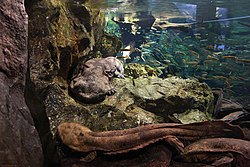
Picture of Cryptobranchidae
- Source
- Wikipedia/Commons
- Credit
- V31S70
- Licence
- CC BY 2.0
- Commercial use
- the licence allows it
No 3D scan of Cryptobranchidae was found in Sketchfab.
Smithsonian Open Access and MorphoSource were not reached for this taxon, so this list is what the others held rather than everything there is.
The description on this site
- Licence
- CC BY-SA 4.0
This is what the site found, which is not the same as what exists.
Keep going
What may have been alongside itCryptobranchoidea through timeFormations of the MioceneThe world it lived on
Occurrence data from the Paleobiology Database, CC BY 4.0. Cope 1889