Coeloceratidae
Coeloceratidae is a family of ammonites belonging to the Eoderoceratoidea that lived during the Early Jurassic. Shells are evolute, tending to be broadly discoidal with depressed whorls bearing primary and secondary ribs that branch from outer lateral tubercles. Most of the included species have coronate inner whorls and outer tubercles only. In general, Coeloceratids resemble the Middle Jurassic Stephanoceras. Once regarded as the subfamily Coeloceratinae in the Eoderoceratidae, these ammonites are now given familial rank.

Jonathan Chen · CC BY-SA 4.0 · via Wikipedia/Commons. May be a photograph of a specimen, or an artist’s reconstruction — an interpretation of a skeleton, since colour and soft tissue are almost never preserved.
On record
Recorded, not inferred- Sits inside
- EoderoceratoideaPBDB
- Diet
- carnivorePBDB, for Ammonoidea
- Life habit
- nektonicPBDB, for Ammonoidea
- Motility
- fast-movingPBDB, for Ammonoidea
- Vision
- well-developedPBDB, for Cephalopoda
- Environment
- marinePBDB, for Cephalopoda
Time the record covers
At least 8.7 million years on record.
The record covers at least 192.9 Mya to 184.2 Mya. No occurrence read is dated outside 201.4 Mya to 161.5 Mya.
215 occurrences of Coeloceratidae on record, most of them in the Early Jurassic. Bar height is expected occurrences, not a count: each fossil is spread across the span it is dated to, so a tall narrow bar means tight dating and a low wide one means loose.
When
215 occurrences- Early Jurassic100%
- Middle Jurassicunder 1%
These are dates about fossils, not the animal: the record can only begin after it arose and end before it died out, so either end may reach further. Shares are expected occurrences: a fossil dated to a span is counted partly in each period it straddles. More on what this infers.
Found in
20 formations
- Ghost Creek Formation · Maude Group28
- Belemnite Marls Formation11
- Oust Formation10
- Tűzkövesárok Limestone Formation9
- Água de Madeiros Formation9
- Isztimér Limestone Formation6
Loading coastlines…
The named rock units Coeloceratidae has been recovered from, largest first. Drawn where the rock is now, not where it formed. 115 occurrences have no formation on record, which is common for older literature.
Coeloceratidae and its relatives
Early JurassicWhere Coeloceratidae and its relatives were recorded in the Early Jurassic.
Found in the same rock
438 taxa- Miltoceras sellae21 sites
- Pseudoskirroceras imlayi16 sites
- Phylloceras14 sites
- Juraphyllites13 sites
- Lytoceras13 sites
- Coeloceras11 sites
- Miltoceras11 sites
- Apoderoceras dunrobinense10 sites
- Meridiceras externum9 sites
- Partschiceras9 sites
- Tropidoceras9 sites
- Bakonyceras evolutum8 sites
- Fuciniceras8 sites
- Tetraspidoceras8 sites
- Tropidoceras erythraeum8 sites
- Tropidoceras flandrini8 sites
- Coeloceras grenouillouxi7 sites
- Meridiceras celericrescens7 sites
- Phricodoceras taylori7 sites
- Galaticeras6 sites
- Andicoeloceras jenseni5 sites
- Apoderoceras5 sites
- Galaticeras aegoceroides5 sites
- Gastropoda5 sites
The Paleobiology Database records 132 sites for Coeloceratidae, and this reads all of them. The number is how many of those sites it was catalogued from too. The 24 sharing the most are listed.
This is not a list of everything alive at the time. It is only what has come out of the same ground as this animal and been written down.
Entered from
36 references- Ammoniten aus dem Pliensbachium (Carixium und Domerium) von Südamerika57
- Pliensbachian (Lower Jurassic) ammonites of the Queen Charlotte Islands, British Columbia28
- Les ammonites du Sinémurien et du Pliensbachien inférieur de la montagne du Bakony (Hongrie)19
- Les ammonites du Pliensbachien du jebel Bou Rharraf (Haut Atlas oriental, Maroc)16
- The Belemnite marls of Charmouth, a series in the Lias of the Dorset Coast11
- Les ammonites du jurassique inférieur et moyen de la dorsal tunisienne10
- Ammonites from the Apoderoceras beds (Early Pliensbachian) in São Pedro de Muel (Lusitanian basin, Portugal)9
- The ammonite biostratigraphy of the Lower Lias "Armatum Bed" (Upper Sinemurian-Lower Pliensbachian) at St Peter's Field, Radstock, Somerset9
- Pseudoskirroceras, a remarkable but poorly known Early Pliensbachian Tethyan ammonite genus: New data from the High Atlas (Morocco)6
- Early Jurassic Bivalvia of western Canada. Part I. Subclasses Palaeotaxodonta, Pteriomorpha, and Isofilibranchia6
- Stratigraphische Kondensation in Adnether Kalken am Rötelstein bei Filzmoos (Salzburger Kalkalpen)4
- Lower Pliensbachian ammonites from the Folded Middle Atlas, south of Taza (Morocco)3
Each of the 215 occurrences read was entered from one of these publications, ordered by how many each accounts for. This is not a search for papers mentioning the name. 24 further references are not listed. Entries link to doi.org where the Paleobiology Database holds an identifier, and to its own record where it does not. Relayed as the Paleobiology Database holds them, not checked against what they resolve to.
Media and terms
Media content1
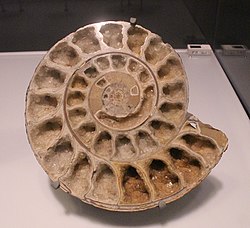
Picture of Coeloceratidae
- Source
- Wikipedia/Commons
- Credit
- Jonathan Chen
- Licence
- CC BY-SA 4.0
- Commercial use
- the licence allows it
No 3D scan of Coeloceratidae was found in MorphoSource and Sketchfab.
Smithsonian Open Access was not reached for this taxon, so this list is what the others held rather than everything there is.
The description on this site
- Licence
- CC BY-SA 4.0
This is what the site found, which is not the same as what exists.
Keep going
What may have been alongside itEoderoceratoidea through timeFormations of the Early JurassicThe world it lived on
Occurrence data from the Paleobiology Database, CC BY 4.0. Haug 1910