Coccyzus erythropthalmus
The black-billed cuckoo is a New World species in the Cuculidae (cuckoo) family. The scientific name is from Ancient Greek. The genus name, kokkuzo, means to call like a common cuckoo, and erythropthalmus is from eruthros, "red" and ophthalmos, "eye".

Wolfgang Wander (colors adjusted by Skiessi) · CC BY-SA 2.5 · via Wikipedia/Commons. May be a photograph of a specimen, or an artist’s reconstruction — an interpretation of a skeleton, since colour and soft tissue are almost never preserved.
On record
Recorded, not inferred- Also called
- black-billed cuckooPBDB
- Sits inside
- CoccyzusPBDB
- Diet
- insectivorePBDB, for Cuculidae
- Life habit
- volantPBDB, for Cuculidae
- Motility
- actively mobilePBDB, for Theropoda
- Environment
- terrestrialPBDB, for Cuculidae
Time the record covers
At most 12 thousand years on record.
The one occurrence read is dated to somewhere between 11.7 ka and 0 Mya, which is a dating window rather than a span.
1 occurrence of Coccyzus erythropthalmus on record, most of them in the Holocene. The Paleobiology Database records this as a living group. Bar height is expected occurrences, not a count: each fossil is spread across the span it is dated to, so a tall narrow bar means tight dating and a low wide one means loose.
When
1 occurrences- Holocene100%
These are dates about fossils, not the animal: the record can only begin after it arose and end before it died out, so either end may reach further. Shares are expected occurrences: a fossil dated to a span is counted partly in each period it straddles. More on what this infers.
Coccyzus erythropthalmus and its relatives
HoloceneWhere Coccyzus erythropthalmus and its relatives were recorded in the Holocene.
Found in the same rock
29 taxa- Asio1 site
- Athene cunicularia1 site
- Calyptophilus frugivorus1 site
- Coccyzus longirostris1 site
- Coccyzus rufigularis1 site
- Columbina passerina1 site
- Contopus1 site
- Crotophaga ani1 site
- Dulus dominicus1 site
- Geotrygon1 site
- Loxigilla violacea1 site
- Melanerpes striatus1 site
- Mimus polyglottos1 site
- Nesoctites micromegas1 site
- Patagioenas leucocephala1 site
- Patagioenas squamosa1 site
- Petrochelidon fulva1 site
- Phaenicophilus palmarum1 site
- Porzana carolina1 site
- Siphonorhis brewsteri1 site
- Tiaris bicolor1 site
- Turdus plumbeus1 site
- Tyrannus caudifasciatus1 site
- Tyrannus dominicensis1 site
The Paleobiology Database records 1 site for Coccyzus erythropthalmus, and this reads all of them. The number is how many of those sites it was catalogued from too. The 24 sharing the most are listed.
This is not a list of everything alive at the time. It is only what has come out of the same ground as this animal and been written down.
Entered from
1 referenceEach of the 1 occurrence read was entered from one of these publications, ordered by how many each accounts for. This is not a search for papers mentioning the name. Each entry links to the Paleobiology Database's own record for the work.
Media and terms
Media content1
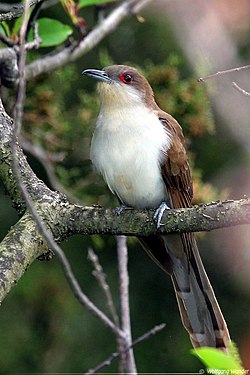
Picture of Coccyzus erythropthalmus
- Source
- Wikipedia/Commons
- Credit
- Wolfgang Wander (colors adjusted by Skiessi)
- Licence
- CC BY-SA 2.5
- Commercial use
- the licence allows it
No 3D scan of Coccyzus erythropthalmus was found in Sketchfab.
Smithsonian Open Access and MorphoSource were not reached for this taxon, so this list is what the others held rather than everything there is.
The description on this site
- Licence
- CC BY-SA 4.0
This is what the site found, which is not the same as what exists.
Keep going
What may have been alongside itCoccyzus through timeFormations of the HoloceneThe world it lived on
Occurrence data from the Paleobiology Database, CC BY 4.0. (Wilson 1811)