Chlamydoselachus
Chlamydoselachus is a genus of sharks and the sole extant member of the family Chlamydoselachidae, in the order Hexanchiformes. It contains two extant and four extinct species. The most widely known species still surviving is the frilled shark. It is known as a living fossil, along with Chlamydoselachus africana, also known as the southern African frilled shark, which is only found along coastal areas of South Africa. The only two extant species of this genus are deep-sea creatures which are typically weakened in areas closer to the surface. While the two extant species are similar in external appearance, they differ internally.

Uncredited · Public Domain · via Wikipedia/Commons. May be a photograph of a specimen, or an artist’s reconstruction — an interpretation of a skeleton, since colour and soft tissue are almost never preserved.
On record
Recorded, not inferred- Sits inside
- ChlamydoselachidaePBDB
- Diet
- carnivorePBDB, for Hexanchiformes
- Life habit
- nektonicPBDB, for Hexanchiformes
- Motility
- actively mobilePBDB, for Hexanchiformes
Time the record covers
At least 83 million years on record.
The record covers at least 85.7 Mya to 1.8 Mya. No occurrence read is dated outside 93.9 Mya to 774 ka.
29 occurrences of Chlamydoselachus on record, most of them in the Late Cretaceous. The Paleobiology Database records this as a living group, and the chart stops with its fossils rather than at the present. Bar height is expected occurrences, not a count: each fossil is spread across the span it is dated to, so a tall narrow bar means tight dating and a low wide one means loose.
When
29 occurrences- Late Cretaceous45%
- Paleocene7%
- Eocene17%
- Oligocene3%
- Miocene7%
- Pliocene7%
- Pleistocene14%
These are dates about fossils, not the animal: the record can only begin after it arose and end before it died out, so either end may reach further. Shares are expected occurrences: a fossil dated to a span is counted partly in each period it straddles. More on what this infers.
Found in
14 formations
- Hinoshima Formation · Hinenoura Group4
- Azenotani Formation3
- Argille Azzurre Formation2
- Northumberland Formation · Nanaimo Group2
- Miretrain Marl Formation1
- Achen Formation1
Loading coastlines…
The named rock units Chlamydoselachus has been recovered from, largest first. Drawn where the rock is now, not where it formed. 8 occurrences have no formation on record, which is common for older literature.
Chlamydoselachus and its relatives
Late CretaceousWhere Chlamydoselachus and its relatives were recorded in the Late Cretaceous.
Found in the same rock
280 taxa- Centrophorus granulosus7 sites
- Elasmobranchii6 sites
- Hexanchus microdon6 sites
- Centrophorus squamosus5 sites
- Dasyatis4 sites
- Galeus melastomus4 sites
- Isistius trituratus4 sites
- Pristiophorus4 sites
- Squatina4 sites
- Alopias3 sites
- Centroscymnus3 sites
- Cretalamna appendiculata3 sites
- Deania3 sites
- Echinorhinus3 sites
- Hexanchiformes3 sites
- Hexanchus3 sites
- Hexanchus agassizi3 sites
- Mitsukurina maslinensis3 sites
- Squaliodalatias3 sites
- Squalus3 sites
- Squalus vondermarcki3 sites
- Acrosqualiolus mirus2 sites
- Aetobatus2 sites
- Alopias exigua2 sites
The Paleobiology Database records 27 sites for Chlamydoselachus, and this reads all of them. The number is how many of those sites it was catalogued from too. The 24 sharing the most are listed.
This is not a list of everything alive at the time. It is only what has come out of the same ground as this animal and been written down.
Entered from
18 references- Tooth remains of chlamydoselachian sharks from Japan and their phylogeny and paleoecology7
- A new bathyal shark fauna from the Pleistocene sediments of Fiumefreddo (Sicily, Italy)4
- A shark fauna from the Campanian of Hornby Island, British Columbia, Canada: an insight into the diversity of Cretaceous deep-water assemblages2
- Features and paleoecological significance of the shark fauna from the Upper Cretaceous Hinoshima Formation, Himenoura Group, southwest Japan2
- Elasmobranch assemblages from a bathyal environment spanning the Cretaceous-Paleogene boundary in Austria1
- An early Eocene fish assemblage associated with a barite deposit in the lower part of the Crescent Formation, Olympic Peninsula, Washington State, USA1
- Frilled sharks (Hexanchiformes, Chlamydoselachidae): new data on their diversity and distribution1
- Shifts in composition of northern Tethyan elasmobranch assemblages during the last millennia of the Cretaceous1
- Sharks, rays and skates (Chondrichthyes, Elasmobranchii) from the Upper Marine Molasse (middle Burdigalian, early Miocene) of the Simssee area (Bavaria, Germany), with comments on palaeogeographic and ecological patterns1
- A new kogiid sperm whale from northern Italy supports psychrospheric conditions in the early Pliocene Mediterranean Sea1
- New selachian assemblages from the Oligocene of Moravia (Czech Republic)1
- Neoselachians from the Danian (Early Paleocene) of Denmark1
Each of the 29 occurrences read was entered from one of these publications, ordered by how many each accounts for. This is not a search for papers mentioning the name. 6 further references are not listed. Entries link to doi.org where the Paleobiology Database holds an identifier, and to its own record where it does not. Relayed as the Paleobiology Database holds them, not checked against what they resolve to.
Media and terms
Media content2
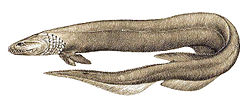
Picture of Chlamydoselachus
- Source
- Wikipedia/Commons
- Credit
- nobody named on the record
- Licence
- Public Domain
- Commercial use
- the licence allows it
CT scan
- Source
- MorphoSource
- Credit
- MCZ Ichthyology
- Licence
- In Copyright
- Commercial use
- cannot be read from the licence given — check the record
- Specimen
- Chlamydoselachus anguineus · MCZ:Ich:34247
Smithsonian Open Access was not reached for this taxon, so this list is what the others held rather than everything there is.
The description on this site
- Licence
- CC BY-SA 4.0
This is what the site found, which is not the same as what exists.
Keep going
What may have been alongside itChlamydoselachidae through timeFormations of the Late CretaceousThe world it lived on
Occurrence data from the Paleobiology Database, CC BY 4.0. Garman 1884