Hexanchus agassizi
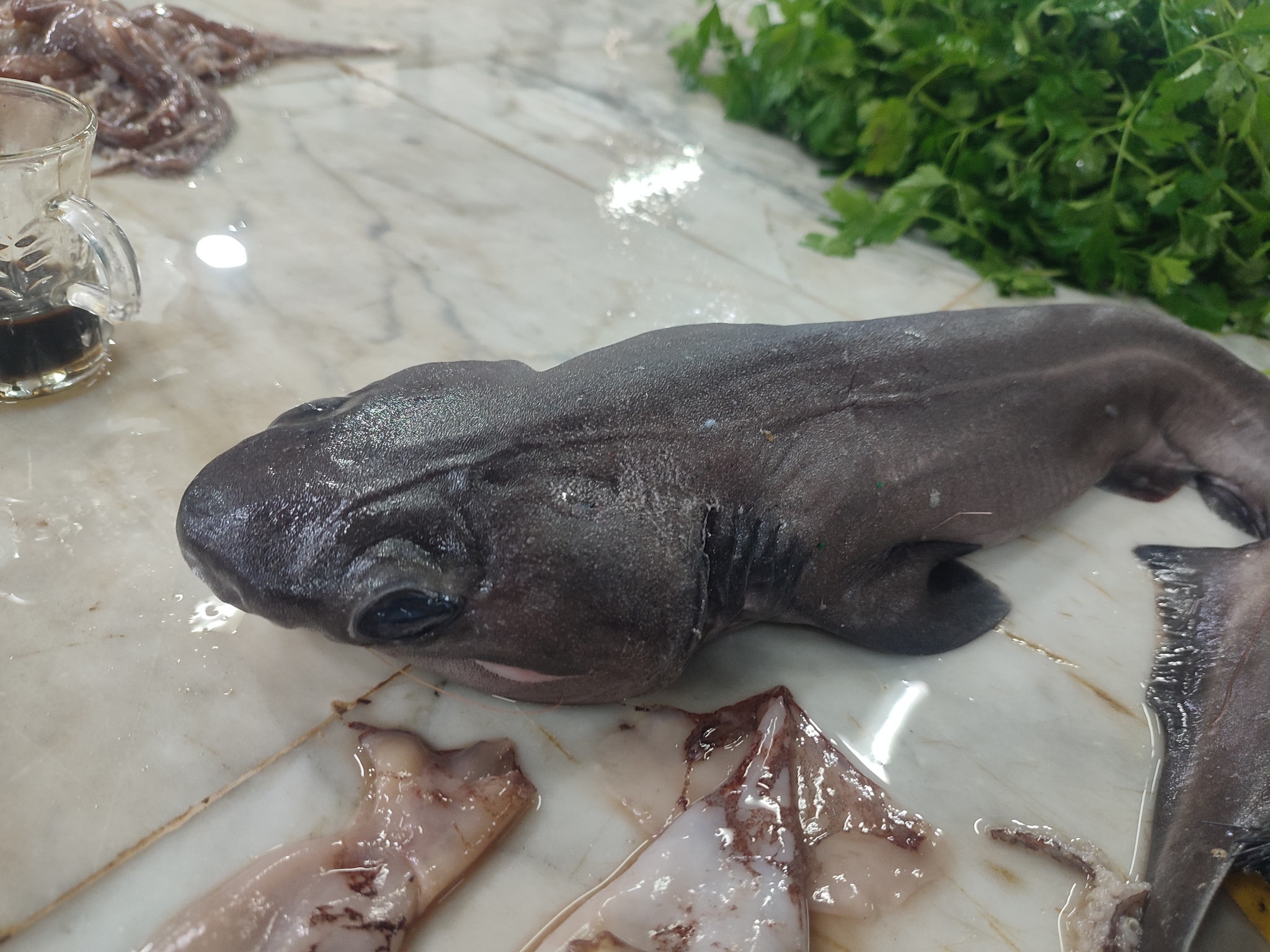
mmissoum · CC BY-NC 4.0 · via GBIF. May be a photograph of a specimen, or an artist’s reconstruction — an interpretation of a skeleton, since colour and soft tissue are almost never preserved.
On record
Recorded, not inferred- Sits inside
- HexanchusPBDB
- Diet
- carnivorePBDB, for Hexanchiformes
- Life habit
- nektonicPBDB, for Hexanchiformes
- Motility
- actively mobilePBDB, for Hexanchiformes
Time the record covers
At least 20 million years on record.
The record covers at least 48.07 Mya to 27.3 Mya. No occurrence read is dated outside 56 Mya to 23.04 Mya.
27 occurrences of Hexanchus agassizi on record, most of them in the Eocene. Bar height is expected occurrences, not a count: each fossil is spread across the span it is dated to, so a tall narrow bar means tight dating and a low wide one means loose.
When
27 occurrencesThese are dates about fossils, not the animal: the record can only begin after it arose and end before it died out, so either end may reach further. Shares are expected occurrences: a fossil dated to a span is counted partly in each period it straddles. More on what this infers.
Found in
16 formations
- Marnes de Donzacq Formation7
- Río Baguales Formation3
- London Clay Formation2
- Lillebælt Clay Formation2
- Ettrick Formation1
- Miretrain Marl Formation1
Loading coastlines…
The named rock units Hexanchus agassizi has been recovered from, largest first. Drawn where the rock is now, not where it formed. 1 occurrence has no formation on record, which is common for older literature.
Hexanchus agassizi and its relatives
EoceneWhere Hexanchus agassizi and its relatives were recorded in the Eocene.
Found in the same rock
257 taxa- Heterodontus vincenti11 sites
- Squatina prima11 sites
- Premontreia (Oxyscyllium) gilberti10 sites
- Dasyatis9 sites
- Eostegostoma angustum9 sites
- Iago9 sites
- Isurolamna inflata9 sites
- Pararhincodon germaini9 sites
- Striatolamia macrota9 sites
- Woellsteinia kozlovi9 sites
- Burnhamia daviesi8 sites
- Galeorhinus8 sites
- Hemiscyllium tailledisensis8 sites
- Heptranchias howellii8 sites
- Otodus (Carcharocles) sokolowi8 sites
- Scyliorhinus woodwardi8 sites
- Anomotodon sheppeyensis7 sites
- Foumtizia poudenxae7 sites
- Physogaleus7 sites
- Raja michauxi7 sites
- Rhinobatos auribatensis7 sites
- Smithraja7 sites
- Torpedo pessanti7 sites
- Carcharias6 sites
The Paleobiology Database records 26 sites for Hexanchus agassizi, and this reads all of them. The number is how many of those sites it was catalogued from too. The 24 sharing the most are listed.
This is not a list of everything alive at the time. It is only what has come out of the same ground as this animal and been written down.
Entered from
15 references- Nouvelle faunes de sélaciens (Elasmobranchii, Neoselachii) de l'Eocène moyen des Landes (Sud-Ouest, France). Implication dans la connaissance des communautés de sélaciens d'eau profondes8
- Neoselachians and Chimaeriformes (Chondrichthyes) from the latest Cretaceous-Paleogene of Sierra Baguales, southernmost Chile. Chronostratigraphic, paleobiogeographic and paleoenvironmental implications3
- Detailed comparisons of the dentitions of extant hexanchid sharks and Tertiary hexanchid teeth from South Australia and Victoria, Australia3
- A study of the sharks and rays from the Lillebælt Clay (Early-Middle Eocene) of Denmark, and their palaeoecology2
- Late Eocene fishes from the Tupelo Bay Formation of South Carolina, USA1
- Middle Eocene chondrichthyan fauna from Antarctic Peninsula housed in the Museo de La Plata, Argentina1
- A mesopelagic selachian fauna from the middle Eocene of St. Pankraz (Austria) reveals homogeneity in deep-marine environments during the warm period in Europe1
- Fossil associations from the middle and upper Eocene strata of the Pamplona Basin and surrounding areas (Navarre, western Pyrenees)1
- Priabonian sharks and rays (Late Eocene: Neoselachii) from Minqar Tabaghbagh in the Western Qattara Depression, Egypt1
- Contribution of Eocene sharks and rays from southern France to the history of deep-sea selachians1
- Fossil shark teeth from the Namigata Formation in Ibara City, Okayama Prefecture, Central Japan and their biostratigraphical significance1
- Review of the Middle Eocene (Lutetian) selachian fauna of Jebal eth Thuleithuwat, east Jordan1
Each of the 27 occurrences read was entered from one of these publications, ordered by how many each accounts for. This is not a search for papers mentioning the name. 3 further references are not listed. Entries link to doi.org where the Paleobiology Database holds an identifier, and to its own record where it does not. Relayed as the Paleobiology Database holds them, not checked against what they resolve to.
Media and terms
Media content1
Picture of Hexanchus agassizi
- Source
- GBIF
- Credit
- mmissoum
- Licence
- CC BY-NC 4.0
- Commercial use
- the licence does not allow it
No 3D scan of Hexanchus agassizi was found in MorphoSource and Sketchfab.
Smithsonian Open Access was not reached for this taxon, so this list is what the others held rather than everything there is.
This is what the site found, which is not the same as what exists.
Keep going
What may have been alongside itHexanchus through timeFormations of the EoceneThe world it lived on
Occurrence data from the Paleobiology Database, CC BY 4.0. Cappetta 1976