Chigutisauridae
Chigutisauridae is an extinct family of large temnospondyls. The only genera recognized as belonging to Chigutisauridae at the current time are all from Gondwana. Chigutisaurids first appeared during the Early Triassic in Australia. During the Late Triassic they became widely distributed in Gondwana, with fossils found in South Africa, India and South America. Koolasuchus from the Early Cretaceous of Australia represents the youngest known temnospondyl genera.

Creator: Dmitry Bogdanov · CC BY 3.0 · via Wikipedia/Commons. May be a photograph of a specimen, or an artist’s reconstruction — an interpretation of a skeleton, since colour and soft tissue are almost never preserved.
On record
Recorded, not inferred- Sits inside
- BrachyopoideaPBDB
- Diet
- carnivorePBDB, for Temnospondyli
- Life habit
- amphibiousPBDB, for Temnospondyli
- Motility
- actively mobilePBDB, for Temnospondyli
- Environment
- brackish,freshwater,terrestrialPBDB, for Tetrapoda
Time the record covers
At least 137 million years on record.
The record covers at least 250.8 Mya to 113.2 Mya. No occurrence read is dated outside 251.902 Mya to 110.1 Mya.
20 occurrences of Chigutisauridae on record, most of them in the Late Triassic. Bar height is expected occurrences, not a count: each fossil is spread across the span it is dated to, so a tall narrow bar means tight dating and a low wide one means loose.
When
20 occurrencesThese are dates about fossils, not the animal: the record can only begin after it arose and end before it died out, so either end may reach further. Shares are expected occurrences: a fossil dated to a span is counted partly in each period it straddles. More on what this infers.
Found in
7 formations
- "Wonthaggi" Formation · Strzelecki Group6
- Elliot Formation · Stormberg Group5
- Cacheuta Formation · Uspallata Group3
- Maleri Formation · Gondwana Group2
- Evergreen Formation1
- Arcadia Formation · Rewan Group1
Loading coastlines…
The named rock units Chigutisauridae has been recovered from, largest first. Drawn where the rock is now, not where it formed. 1 occurrence has no formation on record, which is common for older literature.
Chigutisauridae and its relatives
Late TriassicWhere Chigutisauridae and its relatives were recorded in the Late Triassic.
Found in the same rock
47 taxa- Koolasuchus cleelandi6 sites
- Dinosauria3 sites
- Diplostraca2 sites
- Dipnoi2 sites
- Ornithopoda2 sites
- Plesiosauria2 sites
- Temnospondyli2 sites
- Andescynodon mendozensis1 site
- Arenaerpeton supinatus1 site
- Buriolestes schultzi1 site
- Capulomala arcadiaensis1 site
- Ceratodus1 site
- Compsocerops1 site
- Compsocerops cosgriffi1 site
- Cuyosuchus huenei1 site
- Decorotergum warrenae1 site
- Duckworthia isoeteformis1 site
- Eomurruna yurrgensis1 site
- Helicorhiza duckworthensis1 site
- Ixalerpeton polesinensis1 site
- Keratobrachyops australis1 site
- Kuttycephalus triangularis1 site
- Massospondylus1 site
- Nanolania anatopretia1 site
The Paleobiology Database records 18 sites for Chigutisauridae, and this reads all of them. The number is how many of those sites it was catalogued from too. The 24 sharing the most are listed.
This is not a list of everything alive at the time. It is only what has come out of the same ground as this animal and been written down.
Entered from
9 references- Stereospondyl amphibians from the Elliot Formation of South Africa5
- The last last labyrinthodont?5
- Stereospondyli3
- Chigutisaurid temnospondyls from the Late Triassic of India and a review of the Family Chigutisauridae2
- A new chigutisaurid (Brachyopoidea, Temnospondyli) with soft tissue preservation from the Triassic Sydney Basin, New South Wales, Australia1
- Rich and Vickers-Rich, 20201
- The presence of Compsocerops (Brachyopoidea: Chigutisauridae) (Late Triassic) in southern Brazil with comments on chigutisaurid palaeobiogeography1
- The last labyrinthodont? A new brachyopoid (Amphibia, Temnospondyli) from the Early Jurassic Evergreen Formation of Queensland, Australia1
- A horned member of the labyrinthodont superfamily Brachyopoidea from the Early Triassic of Queenland1
Each of the 20 occurrences read was entered from one of these publications, ordered by how many each accounts for. This is not a search for papers mentioning the name. Entries link to doi.org where the Paleobiology Database holds an identifier, and to its own record where it does not. Relayed as the Paleobiology Database holds them, not checked against what they resolve to.
Media and terms
Media content1
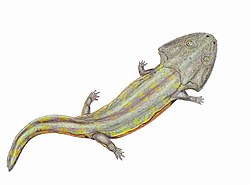
Picture of Chigutisauridae
- Source
- Wikipedia/Commons
- Credit
- Creator: Dmitry Bogdanov
- Licence
- CC BY 3.0
- Commercial use
- the licence allows it
No 3D scan of Chigutisauridae was found in MorphoSource and Sketchfab.
Smithsonian Open Access was not reached for this taxon, so this list is what the others held rather than everything there is.
The description on this site
- Licence
- CC BY-SA 4.0
This is what the site found, which is not the same as what exists.
Keep going
What may have been alongside itBrachyopoidea through timeFormations of the Late TriassicThe world it lived on
Occurrence data from the Paleobiology Database, CC BY 4.0. Rusconi 1951