Charnia
Charnia is an extinct genus of frond-like lifeforms belonging to the Ediacaran biota with segmented, leaf-like ridges branching alternately to the right and left from a zig-zag medial suture. The genus Charnia was named after Charnwood Forest in Leicestershire, England, where the first fossilised specimen was found, and is thus pronounced ; the first species of Charnia described, Charnia masoni, was named after Roger Mason, a schoolboy who was believed to have initially discovered it. Charnia is significant because it was the first Precambrian fossil to be recognized as such.

Smith609 at English Wikipedia · CC BY 2.5 · via Wikipedia/Commons. May be a photograph of a specimen, or an artist’s reconstruction — an interpretation of a skeleton, since colour and soft tissue are almost never preserved.
On record
Recorded, not inferred- Sits inside
- CharniidaePBDB
- Diet
- osmotrophPBDB
- Life habit
- upper-level epifaunalPBDB
- Motility
- stationary, attachedPBDB
- Environment
- outer shelf,marinePBDB
Time the record covers
At most 97 million years on record.
Every occurrence read is dated to somewhere between 635 Mya and 538.8 Mya, and nothing in the dating separates them, so that window is what the record shows rather than a span.
57 occurrences of Charnia on record. Bar height is expected occurrences, not a count: each fossil is spread across the span it is dated to, so a tall narrow bar means tight dating and a low wide one means loose.
When
57 occurrencesThese are dates about fossils, not the animal: the record can only begin after it arose and end before it died out, so either end may reach further. Shares are expected occurrences: a fossil dated to a span is counted partly in each period it straddles. More on what this infers.
Found in
16 formations
- Mistaken Point Formation · Conception Group13
- Bradgate Formation · Maplewell Group7
- Trepassey Formation · St John's Group7
- Fermeuse Formation · St John's Group6
- Drook Formation · Conception Group3
- Rawnsley Quartzite Formation · Wilpena Group3
Loading coastlines…
The named rock units Charnia has been recovered from, largest first. Drawn where the rock is now, not where it formed.
Found in the same rock
143 taxa- Charniodiscus14 sites
- Aspidella13 sites
- Bradgatia linfordensis13 sites
- Primocandelabrum13 sites
- Aspidella terranovica12 sites
- Fractofusus andersoni9 sites
- Ivesheadia lobata7 sites
- Thectardis avalonensis7 sites
- Vinlandia antecedens7 sites
- Beothukis mistakensis6 sites
- Hiemalora stellaris6 sites
- Primocandelabrum hiemaloranum6 sites
- Trepassia wardae6 sites
- Arborea arborea5 sites
- Arborea spinosa5 sites
- Charniodiscus procerus5 sites
- Pectinifrons abyssalis5 sites
- Animalia4 sites
- Culmofrons plumosa4 sites
- Hadrynichorde catalinensis4 sites
- Hadryniscala avalonica4 sites
- Palaeopascichnus4 sites
- Rangeomorpha4 sites
- Albumares3 sites
The Paleobiology Database records 48 sites for Charnia, and this reads all of them. The number is how many of those sites it was catalogued from too. The 24 sharing the most are listed.
This is not a list of everything alive at the time. It is only what has come out of the same ground as this animal and been written down.
Entered from
27 references- Ediacaran biota on Bonavista Peninsula, Newfoundland, Canada11
- Morphology and taphonomy of an Ediacaran frond: Charnia from the Avalon Peninsula of Newfoundland6
- The rangeomorph fossil Charnia from the Ediacaran Shibantan biota in the Yangtze Gorges area, South China5
- Ediacaran endlings from the Avalon Assemblage and the severity of the Kotlin Crisis: First documentation of the Inner Meadow Lagerstätte, Newfoundland, Canada3
- A Chronostratigraphic Framework for the Rise of the Ediacaran Macrobiota: New Constraints from Mistaken Point Ecological Reserve, Newfoundland3
- Ediacaran fossils from the Precambrian (Charnian Supergroup) of Charnwood Forest, Leicestershire, England3
- The Quanjishan Charnia assemblage from the northern Qaidam Basin, Tibetan Plateau, and implications for palaeoecology and taphonomy of Ediacaran fronds2
- Further Precambrian (Ediacaran) fossil discoveries in Charnwood Forest, Leicestershire2
- How well do fossil assemblages of the Ediacara Biota tell time?2
- Life after snowball: The oldest complex Ediacaran fossils2
- Age of Neoproterozoic bilatarian body and trace fossils, White Sea, Russia: implications for metazoan evolution2
- Deep-water Ediacaran fossils from northwestern Canada: Taphonomy, ecology, and evolution1
Each of the 57 occurrences read was entered from one of these publications, ordered by how many each accounts for. This is not a search for papers mentioning the name. 15 further references are not listed. Entries link to doi.org where the Paleobiology Database holds an identifier, and to its own record where it does not. Relayed as the Paleobiology Database holds them, not checked against what they resolve to.
Media and terms
Media content2

Picture of Charnia
- Source
- Wikipedia/Commons
- Credit
- Smith609 at English Wikipedia
- Licence
- CC BY 2.5
- Commercial use
- the licence allows it
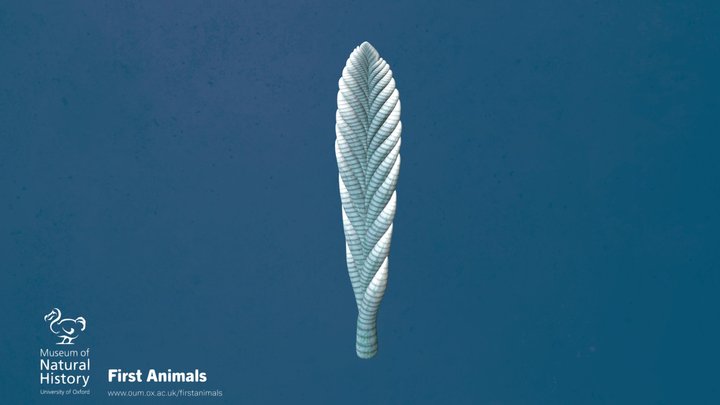
3D model
- Source
- Sketchfab
- Licence
- CC Attribution-NonCommercial
- Commercial use
- the licence does not allow it
Smithsonian Open Access was not reached for this taxon, so this list is what the others held rather than everything there is.
The description on this site
- Source
- Wikipedia, “Charnia”
- Licence
- CC BY-SA 4.0
This is what the site found, which is not the same as what exists.
Keep going
What may have been alongside itCharniidae through time
Occurrence data from the Paleobiology Database, CC BY 4.0. Ford 1958