Aspidella
No picture of Aspidella was found. iDigBio was searched and had none. Wikipedia and Wikidata have a picture filed under this name, but nothing tied it to Aspidella itself, so it was not used. Smithsonian Open Access did not answer, so this is what the others held rather than everything there is. GBIF was asked, and what came back is not recorded: nothing, or a picture this site could not tie to Aspidella, or no answer at all. This entry cannot say which.
On record
Recorded, not inferred- Sits inside
- ProblematicaPBDB
- Diet
- osmotrophPBDB
- Life habit
- low-level epifaunalPBDB
- Motility
- stationary, attachedPBDB
- Environment
- inner shelf,marinePBDB
Time the record covers
At least 114 million years on record.
The record covers at least 635 Mya to 521 Mya. No occurrence read is dated outside 720 Mya to 516 Mya.
139 occurrences of Aspidella on record, most of them in the Cambrian. Bar height is expected occurrences, not a count: each fossil is spread across the span it is dated to, so a tall narrow bar means tight dating and a low wide one means loose.
When
139 occurrences- Cambrian1%
These are dates about fossils, not the animal: the record can only begin after it arose and end before it died out, so either end may reach further. Shares are expected occurrences: a fossil dated to a span is counted partly in each period it straddles. More on what this infers.
Found in
38 formations
- Rawnsley Quartzite Formation · Wilpena Group29
- Fermeuse Formation · St John's Group13
- Mistaken Point Formation · Conception Group11
- Verkhovka Formation · Ust-Pinega Group9
- Sheepbed Formation7
- Trepassey Formation · St John's Group6
Loading coastlines…
The named rock units Aspidella has been recovered from, largest first. Drawn where the rock is now, not where it formed. 14 further formations hold fewer occurrences each and are not listed.
Aspidella and its relatives
CambrianWhere Aspidella and its relatives were recorded in the Cambrian.
Found in the same rock
239 taxa- Charniodiscus24 sites
- Primocandelabrum16 sites
- Charnia masoni15 sites
- Bradgatia linfordensis12 sites
- Dickinsonia costata11 sites
- Hiemalora stellaris11 sites
- Palaeopascichnus11 sites
- Tribrachidium10 sites
- Dickinsonia9 sites
- Ediacaria9 sites
- Ivesheadia lobata9 sites
- Tribrachidium heraldicum9 sites
- Vinlandia antecedens9 sites
- Charnia8 sites
- Dickinsonia tenuis8 sites
- Palaeophragmodictya7 sites
- Parvancorina7 sites
- Parvancorina minchami7 sites
- Rugoconites7 sites
- Arborea arborea6 sites
- Funisia6 sites
- Cephalonega stepanovi5 sites
- Cyanorus singularis5 sites
- Fractofusus andersoni5 sites
The Paleobiology Database records 109 sites for Aspidella, and this reads all of them. The number is how many of those sites it was catalogued from too. The 24 sharing the most are listed.
This is not a list of everything alive at the time. It is only what has come out of the same ground as this animal and been written down.
Entered from
55 references- Ediacaran biota on Bonavista Peninsula, Newfoundland, Canada23
- Patterns of distribution in the Ediacaran biotas: facies versus biogeography and evolution7
- Ediacaran fossils from the Sekwi Brock Area, Mackenzie Mountains, Northwestern Canada7
- The advent of animals: The view from the Ediacaran6
- Structure and depositional history of the Vendian Sylvitsa Group in the Western Flank of the Central Urals6
- How well do fossil assemblages of the Ediacara Biota tell time?5
- Integrated approaches to terminal Proterozoic stratigraphy: an example from the Olenek Uplift, northeastern Siberia5
- Ediacaran biota of the Wernecke Mountains, Yukon, Canada5
- Piecing together the puzzle of the Ediacara Biota: Excavation and reconstruction at the Ediacara National Heritage site Nilpena (South Australia)4
- Paleoecological reconstruction of the Ediacaran benthic macroscopic communities of the White Sea (Russia)4
- Ediacaran body and trace fossils in Miette Group (Windermere Supergroup) near Salient Mountain, British Columbia, Canada4
- Age of Neoproterozoic bilatarian body and trace fossils, White Sea, Russia: implications for metazoan evolution4
Each of the 139 occurrences read was entered from one of these publications, ordered by how many each accounts for. This is not a search for papers mentioning the name. 43 further references are not listed. Entries link to doi.org where the Paleobiology Database holds an identifier, and to its own record where it does not. Relayed as the Paleobiology Database holds them, not checked against what they resolve to.
Media and terms
Media content1
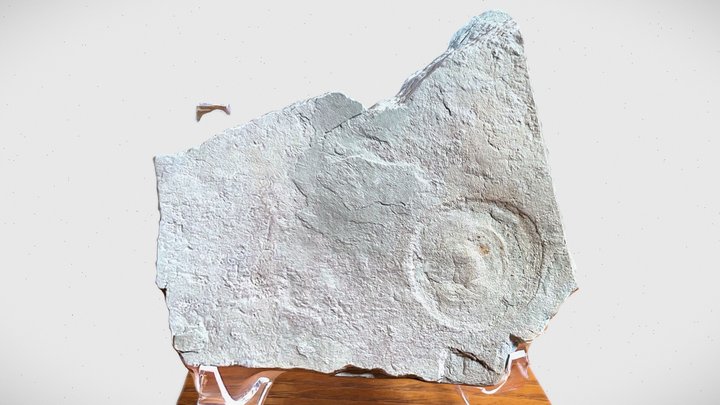
3D model
- Source
- Sketchfab
- Licence
- Free Standard
- Commercial use
- cannot be read from the licence given — check the record
No picture of Aspidella was found. iDigBio was searched and had none.
Wikipedia and Wikidata have a picture filed under this name, but nothing tied it to Aspidella itself, so it was not used.
Smithsonian Open Access did not answer, so this is what the others held rather than everything there is.
GBIF was asked, and what came back is not recorded: nothing, or a picture this site could not tie to Aspidella, or no answer at all. This entry cannot say which.
Smithsonian Open Access and MorphoSource were not reached for this taxon, so this list is what the others held rather than everything there is.
This is what the site found, which is not the same as what exists.
Keep going
What may have been alongside itProblematica through timeFormations of the CambrianThe world it lived on
Occurrence data from the Paleobiology Database, CC BY 4.0. Billings 1872