Chanidae
Chanidae is a family of fishes which has a number of fossil genera and one monotypic extant genus which contains the milkfish.

Bryan Harry (U.S. National Park Service) · Public Domain · via Wikipedia/Commons. May be a photograph of a specimen, or an artist’s reconstruction — an interpretation of a skeleton, since colour and soft tissue are almost never preserved.
On record
Recorded, not inferred- Sits inside
- GonorynchiformesPBDB
- Diet
- carnivorePBDB, for Gonorynchiformes
- Life habit
- nektonicPBDB, for Gonorynchiformes
- Motility
- actively mobilePBDB, for Gonorynchiformes
- Environment
- freshwaterPBDB, for Gonorynchiformes
Time the record covers
At least 98 million years on record.
The record covers at least 121.4 Mya to 23.04 Mya. No occurrence read is dated outside 125.77 Mya to 15.98 Mya.
18 occurrences of Chanidae on record, most of them in the Early Cretaceous. The Paleobiology Database records this as a living group, and the chart stops with its fossils rather than at the present. Bar height is expected occurrences, not a count: each fossil is spread across the span it is dated to, so a tall narrow bar means tight dating and a low wide one means loose.
When
18 occurrences- Early Cretaceous67%
- Late Cretaceous11%
- Eocene11%
- Miocene11%
These are dates about fossils, not the animal: the record can only begin after it arose and end before it died out, so either end may reach further. Shares are expected occurrences: a fossil dated to a span is counted partly in each period it straddles. More on what this infers.
Found in
7 formations
- Romualdo Formation · Santana Group7
- Crato Formation · Santana Group2
- Calcari di Monte San Michele Formation2
- La Huérguina Formation1
- Cabo Formation1
- Codo Formation1
Loading coastlines…
The named rock units Chanidae has been recovered from, largest first. Drawn where the rock is now, not where it formed. 3 occurrences have no formation on record, which is common for older literature.
Chanidae and its relatives
Early CretaceousWhere Chanidae and its relatives were recorded in the Early Cretaceous.
Found in the same rock
275 taxa- Rhacolepis buccalis7 sites
- Tharrhias araripis7 sites
- Vinctifer7 sites
- Cladocyclus gardneri5 sites
- Brannerion4 sites
- Calamopleurus cylindricus4 sites
- Dastilbe crandalli4 sites
- Anguilliformes3 sites
- Mawsonia gigas3 sites
- Notelops3 sites
- Oshunia brevis3 sites
- Paraelops3 sites
- Beryciformes2 sites
- Chanos2 sites
- Clupeiformes2 sites
- Clupeocephala2 sites
- Enchodus2 sites
- Neoproscinetes penalvai2 sites
- Pagiophyllum2 sites
- Polazzodus coronatus2 sites
- Pterosauria2 sites
- Rhynchodercetis2 sites
- Testudinata2 sites
- Ademosynidae1 site
The Paleobiology Database records 17 sites for Chanidae, and this reads all of them. The number is how many of those sites it was catalogued from too. The 24 sharing the most are listed.
This is not a list of everything alive at the time. It is only what has come out of the same ground as this animal and been written down.
Entered from
11 references- New Fossiliferous Sites of the Romualdo Formation, Lower Cretaceous, Araripe Basin, Exu, Pernambuco, Northeast of Brazil6
- The first record of a notosuchian crocodyliform from Italy2
- Ricerche sui Pesci Fossili di Chiavòn (Strati di Sotzka -- Miocene Inferiore)2
- The first fossil record and first New World record for the dragonfly clade Chlorogomphida (Insecta: Odonata: Anisoptera: Araripechlorogomphidae n fam) from the Crato Limestone (Lower Cretaceous, Brazil)1
- The Gonorynchiform fish Dastilbe from the Lower Cretaceous of Brazil1
- The list of marine fishes from Cenozoic (Upper Paleocene-Middle Miocene) localities in Southern European Russia and adjacent countries1
- First records of fossil sergestid decapods and fossil brachyuran crab larvae (Arthropoda, Crustacea) : with remarks on some supposed palaemonid fossils, from the Santana Formation (Aptian-Albian, NE Brazil)1
- Plant and fish megafossils of the Codo Formation, Parnaiba Basin, NE Brasil1
- Clupeiformes e Gonorhynchiformes do Cretaceo Inferior (Aptiano) da Formacao Cabo, nordeste do Brasil. Lower Cretaceous (Aptian) Clupeiformes and Gonorhynchiformes from Cabo Formation, northeastern Brazil1
- An Early Cretaceous faunal and floral continental assemblage: Las Hoyas fossil site (Cuenca, Spain)1
- Cretaceous and Tertiary actinopterygian fishes from Brazil1
Each of the 18 occurrences read was entered from one of these publications, ordered by how many each accounts for. This is not a search for papers mentioning the name. Entries link to doi.org where the Paleobiology Database holds an identifier, and to its own record where it does not. Relayed as the Paleobiology Database holds them, not checked against what they resolve to.
Media and terms
Media content1
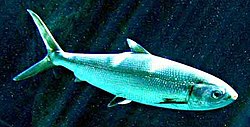
Picture of Chanidae
- Source
- Wikipedia/Commons
- Credit
- Bryan Harry (U.S. National Park Service)
- Licence
- Public Domain
- Commercial use
- the licence allows it
No 3D scan of Chanidae was found in Sketchfab.
Smithsonian Open Access and MorphoSource were not reached for this taxon, so this list is what the others held rather than everything there is.
The description on this site
- Source
- Wikipedia, “Chanidae”
- Licence
- CC BY-SA 4.0
This is what the site found, which is not the same as what exists.
Keep going
What may have been alongside itGonorynchiformes through timeFormations of the Early CretaceousThe world it lived on
Occurrence data from the Paleobiology Database, CC BY 4.0.