Beryciformes
The Beryciformes are a poorly-understood order of carnivorous ray-finned fishes consisting of 7 families, 30 genera, and 161 species. They feed on small fish and invertebrates. Beyond this, little is known about the biology of most member species because of their nocturnal habits and deepwater habitats.

Dr. Ken Sulak · Public Domain · via Wikipedia/Commons. May be a photograph of a specimen, or an artist’s reconstruction — an interpretation of a skeleton, since colour and soft tissue are almost never preserved.
On record
Recorded, not inferred- Sits inside
- BerycimorphaceaePBDB
- Diet
- carnivorePBDB
- Life habit
- nektonicPBDB
- Motility
- actively mobilePBDB
Time the record covers
At least 93 million years on record.
The record covers at least 93.9 Mya to 774 ka. No occurrence read is dated outside 113.2 Mya to 129 ka.
231 occurrences of Beryciformes on record, most of them in the Late Cretaceous. The Paleobiology Database records this as a living group, and the chart stops with its fossils rather than at the present. Bar height is expected occurrences, not a count: each fossil is spread across the span it is dated to, so a tall narrow bar means tight dating and a low wide one means loose.
When
231 occurrences- Early Cretaceousunder 1%
- Late Cretaceous34%
- Paleocene6%
- Eocene32%
- Oligocene7%
- Miocene19%
- Pliocene1%
- Pleistocene1%
These are dates about fossils, not the animal: the record can only begin after it arose and end before it died out, so either end may reach further. Shares are expected occurrences: a fossil dated to a span is counted partly in each period it straddles. More on what this infers.
Found in
76 formations
- Stone City Formation · Claiborne Group10
- Cook Mountain Formation · Claiborne Group7
- Miretrain Marl Formation7
- Niobrara Formation6
- Weches Formation · Claiborne Group5
- Waihao Greensand Formation5
Loading coastlines…
The named rock units Beryciformes has been recovered from, largest first. Drawn where the rock is now, not where it formed. 52 further formations hold fewer occurrences each and are not listed. 72 occurrences have no formation on record, which is common for older literature.
Beryciformes and its relatives
Late CretaceousWhere Beryciformes and its relatives were recorded in the Late Cretaceous.
Found in the same rock
2,760 taxa- Brazosiella kokeni20 sites
- Allomorone burlesonis18 sites
- Conger16 sites
- Diaphus16 sites
- Pterothrissus umbonatus15 sites
- Scopelogadus14 sites
- Bauzaia13 sites
- Bregmaceros13 sites
- Centroberyx13 sites
- Centroberyx worthyi12 sites
- Ekokenia eporrecta12 sites
- Hygophum12 sites
- Jefitchia copelandi12 sites
- Preophidion petropolis12 sites
- Lactarius amplus11 sites
- Myctophum11 sites
- Trachichthodes pulcher11 sites
- Apogon10 sites
- Citharus10 sites
- Diaphus cavallonis10 sites
- Epigonus10 sites
- Hoplopteryx lewesiensis10 sites
- Signata stenzeli10 sites
- Acropoma serrata9 sites
The Paleobiology Database records 172 sites for Beryciformes, and this reads all of them. The number is how many of those sites it was catalogued from too. The 24 sharing the most are listed.
This is not a list of everything alive at the time. It is only what has come out of the same ground as this animal and been written down.
Entered from
80 references- Reconstruction of the fossil marine bony fish fauna (Teleostei) from the Eocene to Pleistocene of New Zealand by means of otoliths. With studies of Recent congroid, morid and trachinoid otoliths27
- The fossil fishes of the English Chalk, Part I13
- Otoliths of some early Cenozoic fishes of the Gulf Coast12
- Middle and late Eocene fish otoliths from the eastern and southern USA8
- Fish otoliths from the Lutetian of the Aquitaine Basin (SW France), a breakthrough in the knowledge of the European Eocene ichthyofauna7
- The fossil fishes of the chalk of Mount Lebanon, in Syria7
- Fossile Fische, Krebse und Pflanzen aus den Plattenkalken der jüngsten Kreide aus Westfalen7
- Fish otoliths from the Paleocene of Denmark6
- Community structure and evaluation of trophic analysis in paleoecology Stone City Formation (Middle Eocene, Texas)6
- Fish otoliths from the Tertiary strata of Victoria, Australia6
- Connectivity controls on the late Miocene eastern Mediterranean fish fauna5
- Tortonian teleost otoliths from northern Italy: taxonomic synthesis and stratigraphic significance5
Each of the 231 occurrences read was entered from one of these publications, ordered by how many each accounts for. This is not a search for papers mentioning the name. 68 further references are not listed. Entries link to doi.org where the Paleobiology Database holds an identifier, and to its own record where it does not. Relayed as the Paleobiology Database holds them, not checked against what they resolve to.
Media and terms
Media content2

Picture of Beryciformes
- Source
- Wikipedia/Commons
- Credit
- Dr. Ken Sulak
- Licence
- Public Domain
- Commercial use
- the licence allows it
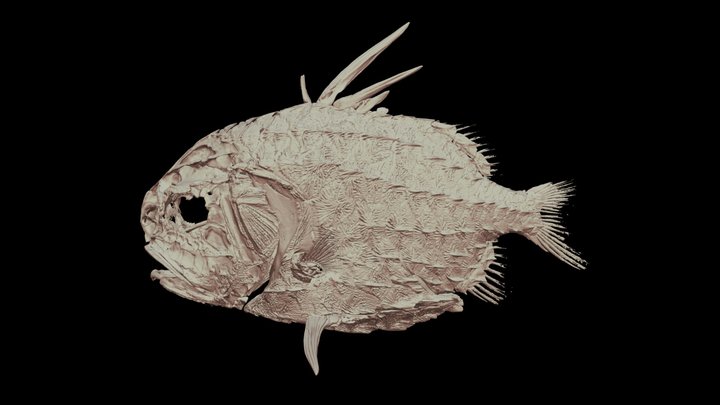
3D model
- Source
- Sketchfab
- Licence
- CC Attribution-NonCommercial-ShareAlike
- Commercial use
- the licence does not allow it
The description on this site
- Licence
- CC BY-SA 4.0
This is what the site found, which is not the same as what exists.
Keep going
What may have been alongside itBerycimorphaceae through timeFormations of the Late CretaceousThe world it lived on
Occurrence data from the Paleobiology Database, CC BY 4.0. Patterson 1964