Cercopithecinae
The Cercopithecinae are a subfamily of the Old World monkeys, which comprises roughly 71 species, including the baboons, the macaques, and the vervet monkeys. Most cercopithecine monkeys are limited to sub-Saharan Africa, although the macaques range from the far eastern parts of Asia through northern Africa, as well as on Gibraltar.

Malene Thyssen · CC BY 2.5 · via Wikipedia/Commons. May be a photograph of a specimen, or an artist’s reconstruction — an interpretation of a skeleton, since colour and soft tissue are almost never preserved.
On record
Recorded, not inferred- Sits inside
- CercopithecidaePBDB
- Diet
- frugivore, folivorePBDB, for Cercopithecidae
- Life habit
- arborealPBDB, for Cercopithecidae
- Motility
- actively mobilePBDB, for Osteichthyes
- Environment
- terrestrialPBDB, for Eutheria
Time the record covers
At least 7.2 million years on record.
The record covers at least 7.246 Mya to 11.7 ka. No occurrence read is dated outside 23.04 Mya to 0 Mya.
488 occurrences of Cercopithecinae on record, most of them in the Pleistocene. The Paleobiology Database records this as a living group. Bar height is expected occurrences, not a count: each fossil is spread across the span it is dated to, so a tall narrow bar means tight dating and a low wide one means loose.
When
488 occurrences- Miocene3%
- Pliocene23%
- Pleistocene67%
- Holocene6%
These are dates about fossils, not the animal: the record can only begin after it arose and end before it died out, so either end may reach further. Shares are expected occurrences: a fossil dated to a span is counted partly in each period it straddles. More on what this infers.
Found in
39 formations
- Shungura Formation · Omo Group86
- Koobi Fora Formation · Omo Group42
- Nachukui Formation · Omo Group23
- Vogel River Series Formation19
- Kromdraai Formation13
- Swartkrans Formation · Transvaal Group10
Loading coastlines…
The named rock units Cercopithecinae has been recovered from, largest first. Drawn where the rock is now, not where it formed. 15 further formations hold fewer occurrences each and are not listed. 188 occurrences have no formation on record, which is common for older literature.
Cercopithecinae and its relatives
PleistoceneWhere Cercopithecinae and its relatives were recorded in the Pleistocene.
Found in the same rock
806 taxa- Palaeoloxodon recki81 sites
- Hipparion73 sites
- Theropithecus (Omopithecus) brumpti69 sites
- Bovidae67 sites
- Theropithecus oswaldi66 sites
- Kolpochoerus limnetes58 sites
- Alcelaphini55 sites
- Ceratotherium simum50 sites
- Cercopithecidae50 sites
- Mammalia48 sites
- Gazella46 sites
- Hominidae46 sites
- Tragelaphus nakuae44 sites
- Equus43 sites
- Hylochoerus euilus40 sites
- Metridiochoerus40 sites
- Tragelaphus38 sites
- Suidae37 sites
- Rhinocerotidae34 sites
- Ceratotherium31 sites
- Crocodylus31 sites
- Hippopotamus31 sites
- Crocuta crocuta30 sites
- Gerontochoerus scotti30 sites
The Paleobiology Database records 385 sites for Cercopithecinae, and this reads 240 of them. The number is how many of those sites it was catalogued from too. The 24 sharing the most are listed.
This is not a list of everything alive at the time. It is only what has come out of the same ground as this animal and been written down.
Entered from
195 references- Extinct large Colobines from the Plio-Pleistocene of Africa31
- Stratigraphy and Paleontology of pliocene and Pleistocene Localities West of Lake Turkana, Kenya19
- Laetoli: a Pliocene Site in Northern Tanzania19
- The Omo Group: Archives of the International Omo Research Expedition19
- Diversity and frequency distributions of Omo Group Cercopithecidae19
- Koobi Fora Research Project The Fossil Ungulates: Proboscidea, Perissodactyla, Suidae14
- Stratigraphic Context of Fossil hominids from the Omo Group Deposits: Northern Turkana Basin, Kenya and Ethiopia10
- Fossil Mammals and Artifacts from the Middle Awash Valley, Ethiopia8
- Lothagam: the dawn of humanity in eastern Africa7
- The Omo Micromammals: Systematics and Paleoecology of Early Man Sites from Ethiopia7
- Pleistocene fossil Primates from Luoding, Guangdong6
- Mandibular postcanine dentition from the Shungura Formation, Ethiopia: Crown morphology, taxonomic allocations and Plio-Pleistocene Hominid Evolution6
Each of the 488 occurrences read was entered from one of these publications, ordered by how many each accounts for. This is not a search for papers mentioning the name. 183 further references are not listed. Entries link to doi.org where the Paleobiology Database holds an identifier, and to its own record where it does not. Relayed as the Paleobiology Database holds them, not checked against what they resolve to.
Media and terms
Media content1
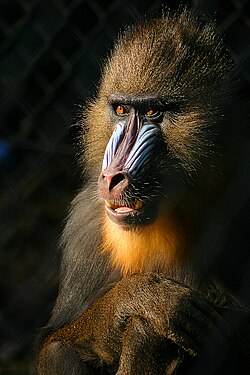
Picture of Cercopithecinae
- Source
- Wikipedia/Commons
- Credit
- Malene Thyssen
- Licence
- CC BY 2.5
- Commercial use
- the licence allows it
No 3D scan of Cercopithecinae was found in Sketchfab.
Smithsonian Open Access and MorphoSource were not reached for this taxon, so this list is what the others held rather than everything there is.
The description on this site
- Licence
- CC BY-SA 4.0
This is what the site found, which is not the same as what exists.
Keep going
What may have been alongside itCercopithecidae through timeFormations of the PleistoceneThe world it lived on
Occurrence data from the Paleobiology Database, CC BY 4.0.