Carneithyris
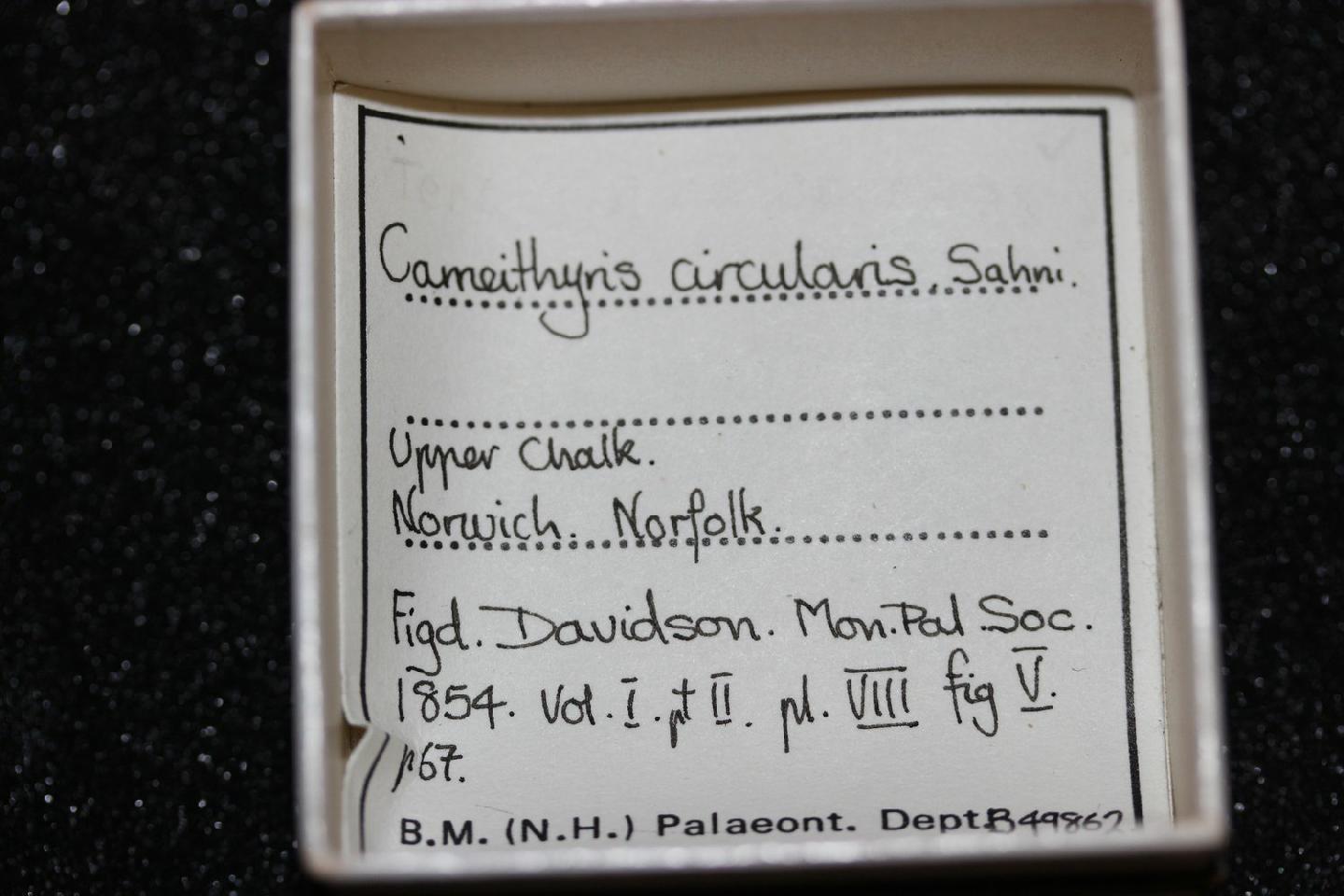
via iDigBio · CC BY · via iDigBio. May be a photograph of a specimen, or an artist’s reconstruction — an interpretation of a skeleton, since colour and soft tissue are almost never preserved.
On record
Recorded, not inferred- Sits inside
- CarneithyridinaePBDB
- Diet
- suspension feederPBDB, for Gibbithyrididae
- Life habit
- low-level epifaunalPBDB, for Gibbithyrididae
- Motility
- stationaryPBDB, for Gibbithyrididae
- Vision
- blindPBDB, for Rhynchonellata
- Environment
- marinePBDB, for Lophophorata
Time the record covers
At least 41 million years on record.
The record covers at least 89.8 Mya to 48.07 Mya. No occurrence read is dated outside 143.1 Mya to 41.03 Mya.
73 occurrences of Carneithyris on record, most of them in the Late Cretaceous. Bar height is expected occurrences, not a count: each fossil is spread across the span it is dated to, so a tall narrow bar means tight dating and a low wide one means loose.
When
73 occurrences- Early Cretaceousunder 1%
- Late Cretaceous55%
- Paleocene15%
- Eocene29%
These are dates about fossils, not the animal: the record can only begin after it arose and end before it died out, so either end may reach further. Shares are expected occurrences: a fossil dated to a span is counted partly in each period it straddles. More on what this infers.
Found in
9 formations
- Gallensis Limestone Formation7
- Gallensis Greensand Formation6
- Ciply-Malogne Phosphatic Chalk Formation3
- Sillakudi Formation · Ariyalur Group2
- Ahlen Formation2
- Gulpen Formation2
Loading coastlines…
The named rock units Carneithyris has been recovered from, largest first. Drawn where the rock is now, not where it formed. 48 occurrences have no formation on record, which is common for older literature.
Carneithyris and its relatives
Late CretaceousWhere Carneithyris and its relatives were recorded in the Late Cretaceous.
Found in the same rock
142 taxa- Terebratulina chrysalis28 sites
- Magas chitoniformis20 sites
- Cretirhynchia18 sites
- Isocrania costata18 sites
- Terebratulina gracilis17 sites
- Rugia tenuicostata14 sites
- Terebratulina faujasii14 sites
- Kingena pentangulata13 sites
- Argyrotheca12 sites
- Argyrotheca bronnii12 sites
- Rhynchonella12 sites
- Terebratulina rigida12 sites
- Leptothyrellopsis polonicus11 sites
- Argyrotheca stevensis10 sites
- Rugia10 sites
- Terebratulina longicollis10 sites
- Argyrotheca hirundo9 sites
- Cryptopora9 sites
- Neoliothyrina9 sites
- Rhynchonellidae9 sites
- Terebratulina9 sites
- Aemula inusitata8 sites
- Rugia acutirostris8 sites
- Terebratulina subtilis8 sites
The Paleobiology Database records 67 sites for Carneithyris, and this reads all of them. The number is how many of those sites it was catalogued from too. The 24 sharing the most are listed.
This is not a list of everything alive at the time. It is only what has come out of the same ground as this animal and been written down.
Entered from
14 references- Taxonomy and palaeoecology of brachiopods from the South-Helvetic zone of the Faneren region (Lutetian, Eocene, NE Switzerland)21
- Brachiopods and the stratigraphy of the Upper Campanian and Lower Maastrichtian Chalk of Norfolk, England17
- End-Cretaceous brachiopod extinctions in the chalk of Denmark14
- Maastrichtian brachiopods from Ciply: palaeoecological and stratigraphical significance3
- Maastrichtian faunas from the Turgay Strait (northern Kazakhstan)3
- Shallow-water Cretaceous Brachiopods from Rockall Bank, North Atlantic3
- New Lower Maastrichtian brachiopods (Gulpen Formation, Vijlen Member) from southern Limburg (The Netherlands)2
- Brachiopodes du Campanien-Maastrichtien à Tercis les Bains (Landes, France)2
- Late Cretaceous (Campanian) brachiopods from southern India2
- Die Großfauna der Mukronatenkreide (unteres Obercampan) im östlichen Münsterland2
- Upper Campanian brachiopods from the Mons Basin (Hainaut, Belgium): the brachiopod assemblage from the Belemnitella mucronata Zone1
- O Nakhodke Ostatkov Gigantskoi Morskoi Yascheritzy-Mosasavra v Verkhnem Melu Karakalpakii. Title Translated: Concerning the Finding of the Remains of a Giant Marine Lizard-Mosasaur in the Upper Limestone of Karakalpakia1
Each of the 73 occurrences read was entered from one of these publications, ordered by how many each accounts for. This is not a search for papers mentioning the name. 2 further references are not listed. Entries link to doi.org where the Paleobiology Database holds an identifier, and to its own record where it does not. Relayed as the Paleobiology Database holds them, not checked against what they resolve to.
Media and terms
Media content1
Picture of Carneithyris
- Source
- iDigBio
- Credit
- via iDigBio
- Licence
- CC BY
- Commercial use
- the licence allows it
No 3D scan of Carneithyris was found in MorphoSource and Sketchfab.
Smithsonian Open Access was not reached for this taxon, so this list is what the others held rather than everything there is.
This is what the site found, which is not the same as what exists.
Keep going
What may have been alongside itCarneithyridinae through timeFormations of the Late CretaceousThe world it lived on
Occurrence data from the Paleobiology Database, CC BY 4.0.