Caridea
The Caridea, commonly known as caridean shrimp or true shrimp (from Ancient Greek καρίς, καρίδος, are an infraorder of shrimp within the order Decapoda. This infraorder contains all species of true shrimp. They are found widely around the world in both fresh and salt water. Many other animals with similar names – such as the mud shrimp of Axiidea and the boxer shrimp of Stenopodidea – are not true shrimp, but many have evolved features similar to true shrimp.

NOAA · Public Domain · via Wikipedia/Commons. May be a photograph of a specimen, or an artist’s reconstruction — an interpretation of a skeleton, since colour and soft tissue are almost never preserved.
On record
Recorded, not inferred- Also called
- shrimpPBDB
- Sits inside
- PleocyemataPBDB
- Diet
- carnivorePBDB, for Decapoda
- Life habit
- epifaunalPBDB, for Decapoda
- Motility
- actively mobilePBDB, for Malacostraca
- Vision
- well-developedPBDB, for Malacostraca
Time the record covers
At least 239 million years on record.
The record covers at least 239.48 Mya to 129 ka. No occurrence read is dated outside 241.464 Mya to 11.7 ka.
73 occurrences of Caridea on record, most of them in the Early Cretaceous. The Paleobiology Database records this as a living group. Bar height is expected occurrences, not a count: each fossil is spread across the span it is dated to, so a tall narrow bar means tight dating and a low wide one means loose.
When
73 occurrences- Middle Triassic1%
- Late Triassic8%
- Late Jurassic11%
- Early Cretaceous23%
- Late Cretaceous22%
- Eocene23%
- Oligocene3%
- Miocene7%
- Pleistocene1%
These are dates about fossils, not the animal: the record can only begin after it arose and end before it died out, so either end may reach further. Shares are expected occurrences: a fossil dated to a span is counted partly in each period it straddles. More on what this infers.
Found in
26 formations
- Headon Hill Formation9
- Fur Formation4
- Crato Formation · Santana Group4
- La Huérguina Formation3
- Maikop Formation3
- Chiusole Formation3
Loading coastlines…
The named rock units Caridea has been recovered from, largest first. Drawn where the rock is now, not where it formed. 2 further formations hold fewer occurrences each and are not listed. 18 occurrences have no formation on record, which is common for older literature.
Caridea and its relatives
Early CretaceousWhere Caridea and its relatives were recorded in the Early Cretaceous.
Found in the same rock
887 taxa- Propalaemon osborniensis5 sites
- Archaeopalinurus levis4 sites
- Beurlenia araripensis4 sites
- Morscrangon acutus4 sites
- Acanthochirana norica3 sites
- Cratoelcana zessini3 sites
- Dusa longipes3 sites
- Penaeidae3 sites
- Protoischnurus axelrodorum3 sites
- Telamonocarcinus gambalatus3 sites
- Teleostei3 sites
- Theropoda3 sites
- Acanthinopus gibbosus2 sites
- Acanthochirana smithwoodwardi2 sites
- Aeger2 sites
- Antrimpos colettoi2 sites
- Astacidea2 sites
- Austropotamobius llopisi2 sites
- Berycopsis germanus2 sites
- Blittersdorffia pleoneura2 sites
- Calappa flammea2 sites
- Carinacaris teruzzii2 sites
- Carpopenaeus callirostris2 sites
- Carpopenaeus septemspinatus2 sites
The Paleobiology Database records 52 sites for Caridea, and this reads all of them. The number is how many of those sites it was catalogued from too. The 24 sharing the most are listed.
This is not a list of everything alive at the time. It is only what has come out of the same ground as this animal and been written down.
Entered from
44 references- On some fossil prawns from the Osborne Beds of the Isle of Wight9
- Morscrangon acutus n. gen. n. sp. (Crustacea, Decapoda, Caridea) from the Fur Formation (Early Eocene) of the Islands of Mors and Fur (Denmark)4
- Late Cretaceous decapod faunas from Lebanon3
- Reborn from the ashes: revision of Beurlenia araripensis Martins-Neto and Mezzalira, 1991 (Crustacea: Decapoda)3
- A new decapod crustacean assemblage from the lower Eocene of Solteri (Trentino-Alto Adige region, northern Italy)3
- Fossil Crustacean of Lebanon3
- Redescription and illustration of caridean shrimp from the Cretaceous (Aptian) of Brazil2
- Im Reich der Meerengel. Der Nusplinger Plattenkalk und seine Fossilien2
- New genera and species of shrimps (Crustacea: Decapoda: Dendrobranchiata, Caridea) from the Upper Jurassic lithographic limestones of S Germany2
- The genera Longitergite nov. and Bannikovia nov. in the Lower Miocene of N Caucasus (Russia) (Crustacea, Decapoda)2
- The macruran decapod crustaceans of the Dolomia di Forni (Norian, Upper Triassic) of Carnia (Udine, NE Italy)2
- The macruran decapod crustaceans of the Upper Cretaceous of Lebanon2
Each of the 73 occurrences read was entered from one of these publications, ordered by how many each accounts for. This is not a search for papers mentioning the name. 32 further references are not listed. Entries link to doi.org where the Paleobiology Database holds an identifier, and to its own record where it does not. Relayed as the Paleobiology Database holds them, not checked against what they resolve to.
Media and terms
Media content1
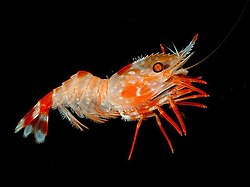
Picture of Caridea
- Source
- Wikipedia/Commons
- Credit
- NOAA
- Licence
- Public Domain
- Commercial use
- the licence allows it
No 3D scan was found. Smithsonian Open Access, MorphoSource and Sketchfab were all searched.
The description on this site
- Source
- Wikipedia, “Caridea”
- Licence
- CC BY-SA 4.0
This is what the site found, which is not the same as what exists.
Keep going
What may have been alongside itPleocyemata through timeFormations of the Early CretaceousThe world it lived on
Occurrence data from the Paleobiology Database, CC BY 4.0. Dana 1852