Carduelis
The genus Carduelis is a group of birds in the finch family Fringillidae.

JJ Harrison ( https://www.jjharrison.com.au/ ) · CC BY-SA 3.0 · via Wikipedia/Commons. May be a photograph of a specimen, or an artist’s reconstruction — an interpretation of a skeleton, since colour and soft tissue are almost never preserved.
On record
Recorded, not inferred- Sits inside
- FringillidaePBDB
- Diet
- granivorePBDB, for Fringillidae
- Life habit
- volantPBDB, for Fringillidae
- Motility
- actively mobilePBDB, for Theropoda
- Environment
- terrestrialPBDB, for Fringillidae
Time the record covers
At least 762 thousand years on record.
The record covers at least 774 ka to 11.7 ka. No occurrence read is dated outside 1.8 Mya to 0 Mya.
16 occurrences of Carduelis on record. The Paleobiology Database records this as a living group. Bar height is expected occurrences, not a count: each fossil is spread across the span it is dated to, so a tall narrow bar means tight dating and a low wide one means loose.
When
16 occurrences- Pleistocene19%
- Holocene81%
These are dates about fossils, not the animal: the record can only begin after it arose and end before it died out, so either end may reach further. Shares are expected occurrences: a fossil dated to a span is counted partly in each period it straddles. More on what this infers.
Found in the same rock
392 taxa- Passer domesticus8 sites
- Sturnus vulgaris8 sites
- Coturnix novaezelandiae7 sites
- Cyanoramphus7 sites
- Chloris chloris6 sites
- Columba livia6 sites
- Rattus exulans6 sites
- Coenocorypha aucklandica5 sites
- Gerygone igata5 sites
- Hoplodactylus maculatus5 sites
- Mus musculus5 sites
- Rhipidura fuliginosa5 sites
- Sphenodon5 sites
- Turdus philomelos5 sites
- Aegotheles novaezealandiae4 sites
- Alauda arvensis4 sites
- Fringilla coelebs4 sites
- Mohoua ochrocephala4 sites
- Ninox novaeseelandiae4 sites
- Oligosoma lineoocellatum4 sites
- Petroica australis4 sites
- Prosthemadera novaeseelandiae4 sites
- Sceloglaux albifacies4 sites
- Turnagra capensis4 sites
The Paleobiology Database records 15 sites for Carduelis, and this reads all of them. The number is how many of those sites it was catalogued from too. The 24 sharing the most are listed.
This is not a list of everything alive at the time. It is only what has come out of the same ground as this animal and been written down.
Entered from
7 references- Quaternary fossil fauna of South Canterbury, South Island, New Zealand8
- Biostratigraphy of amphibians, reptiles, birds and mammals in Corsica and the role of man in the Holocene faunal turnover3
- Une faune tres diversifee du Pleistocene inferieur de la Sierra de Quibas (province de Murcia, Espagne)1
- The Middle Pleistocene avifauna of Spinagallo Cave (Sicily, Italy): preliminary report1
- A remarkable fossil and archaeological avifauna from Marfells Beach, Lake Grassmere, South Island, New Zealand1
- Upper Pleistocene and Holocene fossil avifauna from Moleta cave (Mallorca, Balearic Islands)1
- The late Pleistocene (Rancholabrean) avifauna of Little Box Elder Cave, Wyoming1
Each of the 16 occurrences read was entered from one of these publications, ordered by how many each accounts for. This is not a search for papers mentioning the name. Entries link to doi.org where the Paleobiology Database holds an identifier, and to its own record where it does not. Relayed as the Paleobiology Database holds them, not checked against what they resolve to.
Media and terms
Media content1
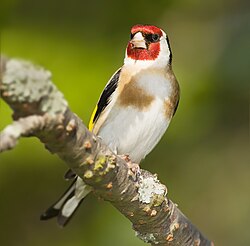
Picture of Carduelis
- Source
- Wikipedia/Commons
- Credit
- JJ Harrison ( https://www.jjharrison.com.au/ )
- Licence
- CC BY-SA 3.0
- Commercial use
- the licence allows it
No 3D scan of Carduelis was found in Sketchfab.
Smithsonian Open Access and MorphoSource were not reached for this taxon, so this list is what the others held rather than everything there is.
The description on this site
- Source
- Wikipedia, “Carduelis”
- Licence
- CC BY-SA 4.0
This is what the site found, which is not the same as what exists.
Keep going
What may have been alongside itFringillidae through timeThe world it lived on
Occurrence data from the Paleobiology Database, CC BY 4.0. Brisson 1760