Cancer
Cancer is a genus of marine crabs in the family Cancridae. It includes eight extant species and three extinct species, including familiar crabs of the littoral zone, such as the European edible crab, the Jonah crab and the red rock crab. It is thought to have evolved from related genera in the Pacific Ocean in the Miocene.

Luis Miguel Bugallo Sánchez ( Lmbuga Commons )( Lmbuga Galipedia ) Publicada por/ Publish by : Luis Miguel Bugallo Sá… · CC BY-SA 3.0 · via Wikipedia/Commons. May be a photograph of a specimen, or an artist’s reconstruction — an interpretation of a skeleton, since colour and soft tissue are almost never preserved.
On record
Recorded, not inferred- Also called
- crabPBDB
- Sits inside
- CancrinaePBDB
- Diet
- carnivorePBDB, for Decapoda
- Life habit
- semi-infaunalPBDB, for Cancridae
- Motility
- actively mobilePBDB, for Malacostraca
- Vision
- well-developedPBDB, for Malacostraca
Time the record covers
At least 93 million years on record.
The record covers at least 93.9 Mya to 11.7 ka. No occurrence read is dated outside 100.5 Mya to 0 Mya.
124 occurrences of Cancer on record, most of them in the Pleistocene. The Paleobiology Database records this as a living group. Bar height is expected occurrences, not a count: each fossil is spread across the span it is dated to, so a tall narrow bar means tight dating and a low wide one means loose.
When
124 occurrences- Late Cretaceous2%
- Eocene3%
- Oligocene2%
- Miocene21%
- Pliocene21%
- Pleistocene49%
- Holocene2%
These are dates about fossils, not the animal: the record can only begin after it arose and end before it died out, so either end may reach further. Shares are expected occurrences: a fossil dated to a span is counted partly in each period it straddles. More on what this infers.
Found in
48 formations
- San Pedro Formation12
- Palos Verdes Sand Formation7
- Etchegoin Formation6
- Timms Point Silt Formation5
- Talbot Formation4
- Fernando Formation4
Loading coastlines…
The named rock units Cancer has been recovered from, largest first. Drawn where the rock is now, not where it formed. 24 further formations hold fewer occurrences each and are not listed. 26 occurrences have no formation on record, which is common for older literature.
Cancer and its relatives
PleistoceneWhere Cancer and its relatives were recorded in the Pleistocene.
Found in the same rock
1,646 taxa- Romaleon branneri15 sites
- Romaleon jordani15 sites
- Metacarcinus gracilis14 sites
- Hirtoscala sawinae12 sites
- Hirtoscala tincta11 sites
- Romaleon antennarium11 sites
- Nitidiscala indianorum10 sites
- Callianax biplicata8 sites
- Cryptomya californica8 sites
- Hirtoscala hindsii8 sites
- Tivela (Pachydesma) stultorum8 sites
- Anomia peruviana7 sites
- Asperiscala minuticosta7 sites
- Caesia perpinguis7 sites
- Dentalium neohexagonum7 sites
- Glossaulax reclusiana7 sites
- Lottia insessa7 sites
- Mitrella tuberosa7 sites
- Myliobatis californica7 sites
- Saccella taphria7 sites
- Turritella cooperi7 sites
- Acteocina culcitella6 sites
- Alia carinata6 sites
- Caesia fossatus6 sites
The Paleobiology Database records 86 sites for Cancer, and this reads all of them. The number is how many of those sites it was catalogued from too. The 24 sharing the most are listed.
This is not a list of everything alive at the time. It is only what has come out of the same ground as this animal and been written down.
Entered from
35 references- The genus Cancer (Crustacea: Brachyura): systematics, biogeography and fossil record59
- The fossil stalk-eyed Crustacea of the Pacific slope of North America12
- Fossil Crustacea of the Atlantic and Gulf Coastal Plain8
- Cenozoic Decapod Crustacea from Southwest Japan4
- Systematics and paleoecology of Miocene brachyuran crabs (Decapoda: Brachyura: Cancroidea, Portunidae) from the St. Marys Formation, Maryland, USA3
- On the reconciliation of biostratigraphy and strontium isotope stratigraphy of three southern Californian Plio-Pleistocene formations2
- Humans and marine resource interaction reappraised: Archaeofauna remains during the late Pleistocene and Holocene in Cantabrian Spain2
- Piacenzian (Pliocene) decapod crustacean faunules from northwest Belgium2
- Decapod crustaceans from the Miocene Mizunami Group, central Japan. Part 2. Section Oxyrhyncha, Cancridea and Brachyrhyncha2
- The Pleistocene marine fauna of Wailes Bluff and Langley Bluff, Maryland2
- Pleistocene Brachyura from the Los Angeles area: Cancridae2
- Stratigraphy and fauna of the Tejon Eocene of California2
Each of the 124 occurrences read was entered from one of these publications, ordered by how many each accounts for. This is not a search for papers mentioning the name. 23 further references are not listed. Entries link to doi.org where the Paleobiology Database holds an identifier, and to its own record where it does not. Relayed as the Paleobiology Database holds them, not checked against what they resolve to.
Media and terms
Media content2
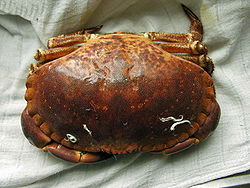
Picture of Cancer
- Source
- Wikipedia/Commons
- Credit
- Luis Miguel Bugallo Sánchez ( Lmbuga Commons )( Lmbuga Galipedia ) Publicada por/ Publish by : Luis Miguel Bugallo Sá…
- Licence
- CC BY-SA 3.0
- Commercial use
- the licence allows it
3D model
- Source
- Sketchfab
- Credit
- Adriano.Fontoura.Fraga
- Licence
- CC Attribution
- Commercial use
- cannot be read from the licence given — check the record
The description on this site
- Licence
- CC BY-SA 4.0
This is what the site found, which is not the same as what exists.
Keep going
What may have been alongside itCancrinae through timeFormations of the PleistoceneThe world it lived on
Occurrence data from the Paleobiology Database, CC BY 4.0. Linnaeus 1758