Calymene blumenbachii
Calymene blumenbachii, sometimes erroneously spelled blumenbachi, is a species of trilobite discovered in the limestone quarries of the Wren's Nest in Dudley, England. Nicknamed the Dudley Bug or Dudley Locust by 18th-century quarrymen it became a symbol of the town and featured on the Dudley County Borough Council coat-of-arms. Calymene blumenbachii is commonly found in Silurian rocks and is thought to have lived in the shallow waters of the Silurian, in low-energy reefs. This particular species of Calymene is unique to the Wenlock series in England, and comes from the Wenlock Limestone Formation in Much Wenlock and the Wren's Nest in Dudley. These sites seem to yield trilobites more readily than any other areas on the Wenlock Edge, and the rock here is dark grey as opposed to yellowish or whitish as it appears on other parts of the Edge, just a few miles away, in Church Stretton and elsewhere. This suggests local changes in the environment in which the rock was deposited.

James St. John · CC BY 2.0 · via Wikipedia/Commons. May be a photograph of a specimen, or an artist’s reconstruction — an interpretation of a skeleton, since colour and soft tissue are almost never preserved.
On record
Recorded, not inferred- Sits inside
- CalymenePBDB
- Diet
- carnivorePBDB, for Calymenidae
- Life habit
- nektobenthicPBDB, for Calymenidae
- Motility
- actively mobilePBDB, for Calymenidae
- Vision
- well-developedPBDB, for Calymenidae
- Environment
- marinePBDB, for Trilobita
Time the record covers
At least 2.3 million years on record.
The record covers at least 432.9 Mya to 430.6 Mya. No occurrence read is dated outside 443.1 Mya to 426.7 Mya.
16 occurrences of Calymene blumenbachii on record, most of them in the Silurian. Bar height is expected occurrences, not a count: each fossil is spread across the span it is dated to, so a tall narrow bar means tight dating and a low wide one means loose.
When
16 occurrences- Silurian100%
These are dates about fossils, not the animal: the record can only begin after it arose and end before it died out, so either end may reach further. Shares are expected occurrences: a fossil dated to a span is counted partly in each period it straddles. More on what this infers.
Found in
8 formations
- Jaani Formation4
- Much Wenlock Formation2
- Restevo Subsuite Formation1
- Demshin Subsuite Formation1
- Ternava Suite Formation1
- Jocionys Formation1
Loading coastlines…
The named rock units Calymene blumenbachii has been recovered from, largest first. Drawn where the rock is now, not where it formed. 4 occurrences have no formation on record, which is common for older literature.
Calymene blumenbachii and its relatives
SilurianWhere Calymene blumenbachii and its relatives were recorded in the Silurian.
Found in the same rock
168 taxa- Encrinurus punctatus8 sites
- Bumastus5 sites
- Thecia5 sites
- Bumastus barriensis4 sites
- Proetus concinnus4 sites
- Atrypa reticularis3 sites
- Conochitina3 sites
- Dalejina hybrida3 sites
- Dalmanites caudatus3 sites
- Dolerorthis3 sites
- Favosites gothlandicus3 sites
- Harpidella3 sites
- Leangella (Leangella) segmentum3 sites
- Resserella canalis3 sites
- Warburgella stokesii3 sites
- Dolerorthis rustica2 sites
- Eoplectodonta duvalii2 sites
- Eospirifer radiatus2 sites
- Estonirhynchia2 sites
- Favosites desolatus2 sites
- Flexicalymene2 sites
- Gypidula galeata2 sites
- Heliolites2 sites
- Howellella2 sites
The Paleobiology Database records 14 sites for Calymene blumenbachii, and this reads all of them. The number is how many of those sites it was catalogued from too. The 24 sharing the most are listed.
This is not a list of everything alive at the time. It is only what has come out of the same ground as this animal and been written down.
Entered from
12 references- Animal and plant communities of Podolia4
- Grounding of the Stratigraphy of Silurian shallow - water marine and lagoonal rocks in East Lithuania2
- Earliest encrusting calcareous Foraminifera from the Sheinwoodian (lower Silurian) of Saaremaa Island, Estonia1
- Late Silurian trilobite palaeobiology and biodiversity1
- Carbonate depositional environments, sequence stratigraphy and exceptional skeletal preservation in the Much Wenlock Limestone Formation (Silurian) of Dudley, England1
- Selected brachiopod and trilobite communities of the East Baltic Silurian1
- Silurian trilobites from southwestern Alaska1
- Locality 5:2 Pulli Cliff1
- Locality 5:3 Paramaja Cliff1
- Locality 6:1 Panga Cliff1
- Razrez ordovika i silura reki Moiero, Sibirskaya platforma (Ordovician and Silurian sequence of the Moiero River, Siberian platform)1
- Facies and faunas at the Wenlock/Ludlow boundary of Wenlock Edge, Shropshire1
Each of the 16 occurrences read was entered from one of these publications, ordered by how many each accounts for. This is not a search for papers mentioning the name. Entries link to doi.org where the Paleobiology Database holds an identifier, and to its own record where it does not. Relayed as the Paleobiology Database holds them, not checked against what they resolve to.
Media and terms
Media content2

Picture of Calymene blumenbachii
- Source
- Wikipedia/Commons
- Credit
- James St. John
- Licence
- CC BY 2.0
- Commercial use
- the licence allows it
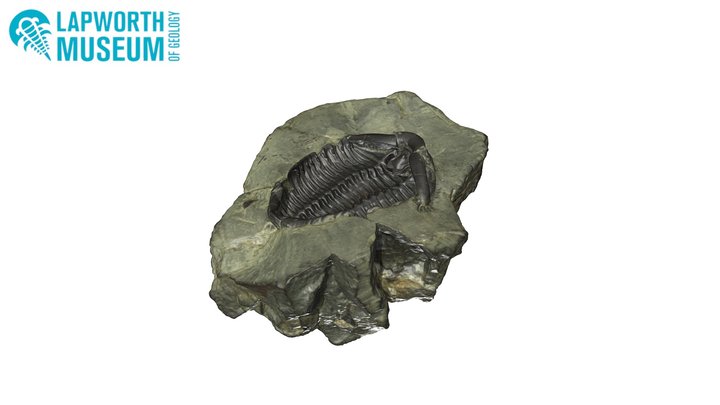
3D model
- Source
- Sketchfab
- Licence
- CC Attribution-NonCommercial
- Commercial use
- the licence does not allow it
Smithsonian Open Access and MorphoSource were not reached for this taxon, so this list is what the others held rather than everything there is.
The description on this site
- Licence
- CC BY-SA 4.0
This is what the site found, which is not the same as what exists.
Keep going
What may have been alongside itCalymene through timeFormations of the SilurianThe world it lived on
Occurrence data from the Paleobiology Database, CC BY 4.0. Brongniart 1822