Caiman latirostris
The broad-snouted caiman is a crocodilian in the family Alligatoridae found in eastern and central South America, including the Pantanal habitat of Bolivia, Southeast Brazil, and Paraguay, as well as northern Argentina and Uruguay. Behind the black caiman, it is the second-largest caiman species; it is the third-largest alligatorid behind the American alligator and the aforementioned black caiman. Primarily, the species inhabits freshwater wetlands, including floodplains, marshes, swamps, and some mangrove forests, as well as various streams, rivers, lakes or ponds, preferring bodies of rather still or slower-moving water. They will often use man-made cow ponds, disused stock tanks, and canals and ditches, as well.

Miguelrangeljr · CC BY 3.0 · via Wikipedia/Commons. May be a photograph of a specimen, or an artist’s reconstruction — an interpretation of a skeleton, since colour and soft tissue are almost never preserved.
On record
Recorded, not inferred- Also called
- broud-snouted caimanPBDB
- Sits inside
- CaimanPBDB
- Diet
- carnivorePBDB, for Crocodylia
- Motility
- actively mobilePBDB, for Osteichthyes
- Environment
- marinePBDB, for Mesoeucrocodylia
Time the record covers
At least 5.2 million years on record.
The record covers at least 5.333 Mya to 129 ka. No occurrence read is dated outside 11.63 Mya to 0 Mya.
6 occurrences of Caiman latirostris on record. The Paleobiology Database records this as a living group. Bar height is expected occurrences, not a count: each fossil is spread across the span it is dated to, so a tall narrow bar means tight dating and a low wide one means loose.
When
6 occurrences- Miocene48%
- Pliocene12%
- Pleistocene40%
These are dates about fossils, not the animal: the record can only begin after it arose and end before it died out, so either end may reach further. Shares are expected occurrences: a fossil dated to a span is counted partly in each period it straddles. More on what this infers.
Found in
5 formations
- Ituzaingo Formation1
- Chaco Formation1
- Palo Pintado Formation · Payogastilla Group1
- Piquete Formation · Orán Group1
- Urumaco Formation1
Loading coastlines…
The named rock units Caiman latirostris has been recovered from, largest first. Drawn where the rock is now, not where it formed. 1 occurrence has no formation on record, which is common for older literature.
Found in the same rock
183 taxa- Kraglievichia paranense2 sites
- Adinotherium1 site
- Amphiocnus paranense1 site
- Anatochoerus1 site
- Andalgalornis1 site
- Bairdemys venezuelensis1 site
- Berroia1 site
- Brachytherium cuspidatum1 site
- Brachytherium gradatum1 site
- Briaromys1 site
- Briaromys trouessartianus1 site
- Caiman australis1 site
- Caiman yacare1 site
- Camelinae1 site
- Cantracavia1 site
- Cardiatherium1 site
- Cardiatherium paranense1 site
- Cardiomys1 site
- Carlesia1 site
- Caviodon1 site
- Chasicotatus spinozai1 site
- Cheloniidae1 site
- Chironectes1 site
- Chlamyphractus1 site
The Paleobiology Database records 6 sites for Caiman latirostris, and this reads all of them. The number is how many of those sites it was catalogued from too. The 24 sharing the most are listed.
This is not a list of everything alive at the time. It is only what has come out of the same ground as this animal and been written down.
Entered from
6 references- The late Miocene caimanine fauna (Crocodylia: Alligatoroidea) of the Urumaco Formation, Venezuela1
- Caiman cf. latirostris (Alligatoridae, Caimaninae) in the Late Miocene Palo Pintado Formation, Salta Province, Argentina: Paleogeographic and Paleoenvironmental considerations1
- Radiocarbon dating and stable isotopes analyses of Caiman latirostris (Daudin, 1801) (Crocodylia, Alligatoridae) from the late Pleistocene of Northeastern Brazil, with comments on spatial distribution of the species1
- Presencia de Caiman latirostris (Daudin, 1802) (Crocodylia, Alligatoridae) en la Formación Piquete (Plioceno–Pleistoceno temprano) de la Provincia de Salta, Argentina implicancias paleoambientales y sistemáticas1
- Miocene vertebrates from Entre Rios province, eastern Argentina1
- Caiman latirostris from the Pleistocene of Argentina, and a Summary of South American Cenozoic Crocodilia1
Each of the 6 occurrences read was entered from one of these publications, ordered by how many each accounts for. This is not a search for papers mentioning the name. Entries link to doi.org where the Paleobiology Database holds an identifier, and to its own record where it does not. Relayed as the Paleobiology Database holds them, not checked against what they resolve to.
Media and terms
Media content2
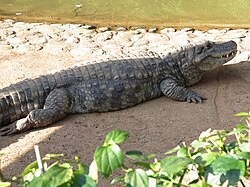
Picture of Caiman latirostris
- Source
- Wikipedia/Commons
- Credit
- Miguelrangeljr
- Licence
- CC BY 3.0
- Commercial use
- the licence allows it
CT scan
- Source
- MorphoSource
- Licence
- In Copyright
- Commercial use
- cannot be read from the licence given — check the record
- Specimen
- CAIMAN LATIROSTRIS · UMMZ:Herps:155287
The description on this site
- Licence
- CC BY-SA 4.0
This is what the site found, which is not the same as what exists.
Keep going
What may have been alongside itCaiman through timeThe world it lived on
Occurrence data from the Paleobiology Database, CC BY 4.0. Daudin 1801