Bruguiera
Bruguiera is a plant genus in the family Rhizophoraceae. It is a small genus of five mangrove species and three hybrids of the Indian and west Pacific Ocean region, its range extending from East Africa and Madagascar through coastal India, Sri Lanka and Southeast Asia to northern Australia, Melanesia and Polynesia. It is characterised by calyces with 8-16 lanceolate, pointed lobes, 16-32 stamens, explosive release of pollen, and viviparous propagules. It is named in honour of French explorer and biologist Jean Guillaume Bruguière (1750–1798). Recently, the eighth taxa of Bruguiera, B. × dungarra was recognised as occurring in northern Australia.

Frederick Polydore Nodder fl,c1770-1800 - "Endeavour" expedition · Public Domain · via Wikipedia/Commons. May be a photograph of a specimen, or an artist’s reconstruction — an interpretation of a skeleton, since colour and soft tissue are almost never preserved.
On record
Recorded, not inferred- Also called
- mangrovePBDB
- Sits inside
- RhizophoraceaePBDB
- Diet
- "photoautotroph"PBDB, for Angiospermae
Time the record covers
At least 12 million years on record.
The record covers at least 12.8 Mya to 11.7 ka. No occurrence read is dated outside 23.04 Mya to 0 Mya.
4 occurrences of Bruguiera on record, most of them in the Miocene. The Paleobiology Database records this as a living group. Bar height is expected occurrences, not a count: each fossil is spread across the span it is dated to, so a tall narrow bar means tight dating and a low wide one means loose.
When
4 occurrencesThese are dates about fossils, not the animal: the record can only begin after it arose and end before it died out, so either end may reach further. Shares are expected occurrences: a fossil dated to a span is counted partly in each period it straddles. More on what this infers.
Found in
1 formation
Loading coastlines…
The named rock units Bruguiera has been recovered from, largest first. Drawn where the rock is now, not where it formed. 3 occurrences have no formation on record, which is common for older literature.
Bruguiera and its relatives
MioceneWhere Bruguiera and its relatives were recorded in the Miocene.
Found in the same rock
95 taxa- Acrostichum aureum2 sites
- Ceriops2 sites
- Heritiera2 sites
- Poaceae2 sites
- Sonneratia2 sites
- Abra antwerpiensis1 site
- Acanthus1 site
- Acteon1 site
- Aequipecten1 site
- Alangium1 site
- Amyclina1 site
- Angulus1 site
- Aplysina sp.1 site
- Aporrhais dingdenensis1 site
- Arcoperna sericea1 site
- Arctica islandica1 site
- Asteraceae1 site
- Avicennia1 site
- Balanus1 site
- Ceramaster polonicus1 site
- Cerealia1 site
- cf. Amphitrites sp.1 site
- cf. Polycirrus sp.1 site
- cf. Sabella sp.1 site
The Paleobiology Database records 4 sites for Bruguiera, and this reads all of them. The number is how many of those sites it was catalogued from too. The 24 sharing the most are listed.
This is not a list of everything alive at the time. It is only what has come out of the same ground as this animal and been written down.
Entered from
3 references- A Catalogue of Fossil Plants from India Part 6: Cenozoic (Quaternary) Palynology and Palaeobotany2
- Observations paléontologiques réalisées dans les terrains néogènes belges de 1971 à 2004 entre Kallo et Doël, Port d'Anvers, rive gauche (Flandre-Orientale, Belgique). Le Miocène du Deurgangkdok à Doël1
- A Catalogue of Fossil Plants from India Part 4: Cenozoic (Tertiary) Megafossils1
Each of the 4 occurrences read was entered from one of these publications, ordered by how many each accounts for. This is not a search for papers mentioning the name. Each entry links to the Paleobiology Database's own record for the work.
Media and terms
Media content2

Picture of Bruguiera
- Source
- Wikipedia/Commons
- Credit
- Frederick Polydore Nodder fl,c1770-1800 - "Endeavour" expedition
- Licence
- Public Domain
- Commercial use
- the licence allows it
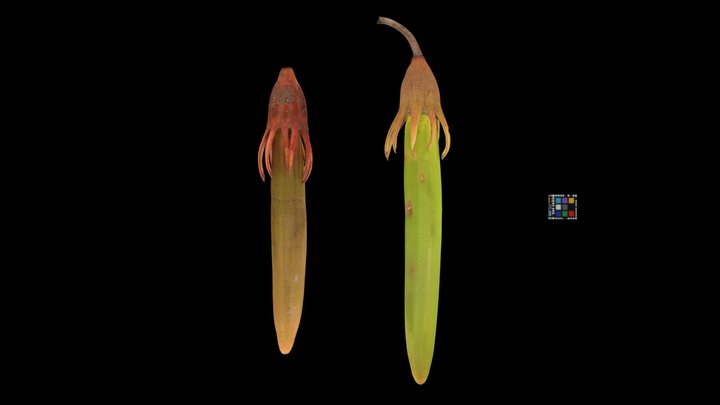
3D model
- Source
- Sketchfab
- Licence
- CC0 Public Domain
- Commercial use
- the licence allows it
Smithsonian Open Access and MorphoSource were not reached for this taxon, so this list is what the others held rather than everything there is.
The description on this site
- Source
- Wikipedia, “Bruguiera”
- Licence
- CC BY-SA 4.0
This is what the site found, which is not the same as what exists.
Keep going
What may have been alongside itRhizophoraceae through timeFormations of the MioceneThe world it lived on
Occurrence data from the Paleobiology Database, CC BY 4.0. Savigny 1798