Blattulidae
Blattulidae is an extinct family of cockroaches known from the Triassic to the Late Cretaceous. Their distinguishing characteristics include "forewing has long Sc, regular venation with distinct intercalaries and hindwing has simple CuP, branched A1." Due to the poor ability of forewing venation to correctly classify modern cockroaches as a result of extensive homoplasy, the value of this family as a taxonomic unit has been strongly questioned, with some authors considering the family a nomen dubium.

Peter Vršanský ,Thomas van de Kamp, Dany Azar,Alexander Prokin,L'ubomír Vidlička, Patrik Vagovič · CC BY 3.0 · via Wikipedia/Commons. May be a photograph of a specimen, or an artist’s reconstruction — an interpretation of a skeleton, since colour and soft tissue are almost never preserved.
On record
Recorded, not inferred- Sits inside
- BlattuloideaPBDB
- Motility
- actively mobilePBDB, for Arthropoda
- Environment
- terrestrialPBDB, for Insecta
Time the record covers
At least 153 million years on record.
The record covers at least 237 Mya to 83.6 Mya. No occurrence read is dated outside 239.48 Mya to 72.2 Mya.
297 occurrences of Blattulidae on record, most of them in the Late Jurassic. Bar height is expected occurrences, not a count: each fossil is spread across the span it is dated to, so a tall narrow bar means tight dating and a low wide one means loose.
When
297 occurrences- Middle Triassicunder 1%
- Late Triassic2%
- Early Jurassic19%
- Middle Jurassic7%
- Late Jurassic34%
- Early Cretaceous34%
- Late Cretaceous3%
These are dates about fossils, not the animal: the record can only begin after it arose and end before it died out, so either end may reach further. Shares are expected occurrences: a fossil dated to a span is counted partly in each period it straddles. More on what this infers.
Found in
43 formations
- Karabastau Formation73
- Dzun-Bain Formation · Bon Tsaagan Group29
- Sharteg Formation17
- Jinju Formation · Shindong Group16
- Bakhar Formation14
- Crato Formation · Santana Group13
Loading coastlines…
The named rock units Blattulidae has been recovered from, largest first. Drawn where the rock is now, not where it formed. 19 further formations hold fewer occurrences each and are not listed. 61 occurrences have no formation on record, which is common for older literature.
Blattulidae and its relatives
Late JurassicWhere Blattulidae and its relatives were recorded in the Late Jurassic.
Found in the same rock
4,092 taxa- Blattodea17 sites
- Elisama parallela14 sites
- Elisama tsaganica12 sites
- Nuurcala popovi11 sites
- Praeblattella ponomarenkoi10 sites
- Falcatusiblatta casovec9 sites
- Procramptonomyia kovalevi9 sites
- Cretophotina mongolica8 sites
- Decomposita triocella8 sites
- Falcatusiblatta disrupta8 sites
- Olzmasg zi8 sites
- Perlucipecta liangiae8 sites
- Ampliceps furcitibia7 sites
- Archirhyphus asiaticus7 sites
- Blattula langfeldti7 sites
- Blattula vidlickai7 sites
- Coleoptera7 sites
- Falcatusiblatta storozhenkoi7 sites
- Oxycorynoides (Oxycorynoides) similis7 sites
- Protoscelis jurassica7 sites
- Protoscelis longicornis7 sites
- Rhipidoblattina dmitrievi7 sites
- Syntemna tele7 sites
- Ampliceps dubius6 sites
The Paleobiology Database records 129 sites for Blattulidae, and this reads all of them. Of that, one read hit the database's own return limit, so every count below is a floor rather than a total. The number is how many of those sites it was catalogued from too. The 24 sharing the most are listed.
This is not a list of everything alive at the time. It is only what has come out of the same ground as this animal and been written down.
Entered from
69 references- Late Mesozoic cockroaches s.l. from the Karabastau Formation in Kazakhstan69
- Unique assemblage of Dictyoptera (Insecta - Blattaria, Mantodea, Isoptera) from the Lower Cretaceous of Bon Tsagaan Nuur in Mongolia29
- Transitional Jurassic/Cretaceous Cockroach assemblage (Insecta, Blattaria) from the Shar-Teg in Mongolia17
- Vršanský, 202015
- Neue Untersuchungen über die fossilen Insekten mit Ergänzungen und Nachträgen sowie Ausblicken auf phylogenetische, palaeogeographische und allgemein biologische Probleme. II Teil15
- Jurassic cockroaches of the new family Blattulidae from Siberia10
- Early Mesozoic fossil insects from South China9
- Die Fossilen Insekten und die Phylogenie der Rezenten Formen, parts I-IV9
- Jinju cockroaches8
- A single common ancestor for praying mantids, termites, cave roaches and umenocoleoids5
- Novas baratas (Insecta, Blattodea, Blattidae) da Formação Santana, Cretáceo Inferior, nordeste do Brasil5
- Lower Jurassic cockroaches (Insecta: Blattaria ) from Germany and England5
Each of the 297 occurrences read was entered from one of these publications, ordered by how many each accounts for. This is not a search for papers mentioning the name. 57 further references are not listed. Entries link to doi.org where the Paleobiology Database holds an identifier, and to its own record where it does not. Relayed as the Paleobiology Database holds them, not checked against what they resolve to.
Media and terms
Media content1
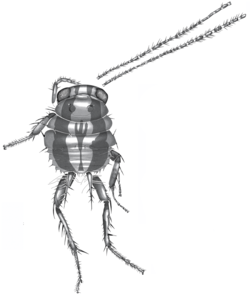
Picture of Blattulidae
- Source
- Wikipedia/Commons
- Credit
- Peter Vršanský ,Thomas van de Kamp, Dany Azar,Alexander Prokin,L'ubomír Vidlička, Patrik Vagovič
- Licence
- CC BY 3.0
- Commercial use
- the licence allows it
No 3D scan of Blattulidae was found in MorphoSource and Sketchfab.
Smithsonian Open Access was not reached for this taxon, so this list is what the others held rather than everything there is.
The description on this site
- Source
- Wikipedia, “Blattulidae”
- Licence
- CC BY-SA 4.0
This is what the site found, which is not the same as what exists.
Keep going
What may have been alongside itBlattuloidea through timeFormations of the Late JurassicThe world it lived on
Occurrence data from the Paleobiology Database, CC BY 4.0. Vishnyakova 1982