Asteroceras
Asteroceras is an extinct genus of cephalopod belonging to the Ammonite subclass. These fast-moving nektonic carnivores lived during the Triassic and Jurassic periods.

Dlloyd · CC BY-SA 3.0 · via Wikipedia/Commons. May be a photograph of a specimen, or an artist’s reconstruction — an interpretation of a skeleton, since colour and soft tissue are almost never preserved.
On record
Recorded, not inferred- Sits inside
- AsteroceratidaePBDB
- Diet
- carnivorePBDB, for Ammonoidea
- Life habit
- nektonicPBDB, for Ammonoidea
- Motility
- fast-movingPBDB, for Ammonoidea
- Vision
- well-developedPBDB, for Cephalopoda
- Environment
- marinePBDB, for Cephalopoda
Time the record covers
At most 27 million years on record.
Every occurrence read is dated to somewhere between 201.4 Mya and 174.7 Mya, and nothing in the dating separates them, so that window is what the record shows rather than a span.
91 occurrences of Asteroceras on record, most of them in the Early Jurassic. Bar height is expected occurrences, not a count: each fossil is spread across the span it is dated to, so a tall narrow bar means tight dating and a low wide one means loose.
When
91 occurrences- Early Jurassic100%
These are dates about fossils, not the animal: the record can only begin after it arose and end before it died out, so either end may reach further. Shares are expected occurrences: a fossil dated to a span is counted partly in each period it straddles. More on what this infers.
Found in
18 formations
- Isztimér Limestone Formation5
- Lower Lias Formation · Lias Group5
- Telkwa Formation · Hazelton Group4
- Allgäu Formation4
- Inklin Formation · Laberge Group4
- Sunrise Formation4
Loading coastlines…
The named rock units Asteroceras has been recovered from, largest first. Drawn where the rock is now, not where it formed. 40 occurrences have no formation on record, which is common for older literature.
Asteroceras and its relatives
Early JurassicWhere Asteroceras and its relatives were recorded in the Early Jurassic.
Found in the same rock
246 taxa- Arnioceras9 sites
- Lytoceras8 sites
- Phylloceras6 sites
- Promicroceras planicosta6 sites
- Arnioceras rejectum5 sites
- Juraphyllites5 sites
- Xipheroceras4 sites
- Zetoceras oenotrium4 sites
- Angulaticeras3 sites
- Anningella3 sites
- Arietites3 sites
- Calliphylloceras bicicolae3 sites
- Coroniceras3 sites
- Echioceras quenstedti3 sites
- Eparietites3 sites
- Eparietites denotatus3 sites
- Gastropoda3 sites
- Geyeroceras cylindricum3 sites
- Lucina3 sites
- Partschiceras striatocostatum3 sites
- Phylloceras hebertinum3 sites
- Xipheroceras ziphus3 sites
- Agassiceras2 sites
- Angulaticeras boucaultianum2 sites
The Paleobiology Database records 48 sites for Asteroceras, and this reads all of them. The number is how many of those sites it was catalogued from too. The 24 sharing the most are listed.
This is not a list of everything alive at the time. It is only what has come out of the same ground as this animal and been written down.
Entered from
31 references- Ammonites sinémuriennes du Haut-Atlas marocain13
- Les ammonites du Sinémurien et du Pliensbachien inférieur de la montagne du Bakony (Hongrie)9
- Austroalpine Liassic ammonites from Vorarlberg (Austria, Northern Calcareous Alps)7
- Hettangian and Sinemurian ammonoid zonation for the western Cordillera of North America7
- Monographie der Ammoniten des Obersinemuriums (Lotharingium, Lias) der Lienzer Dolomiten (Österreich): Biostratigraphie, Systematik und Paläobiogeographie5
- The Liassic Ammonite Faunas of the Stowell Park Borehole5
- A systematic account of the ammonite faunas of the Obtusum Zone (Sinemurian Stage, Lower Jurassic) from Marston Magna, Somerset, UK4
- Early Jurassic Bivalvia of western Canada. Part I. Subclasses Palaeotaxodonta, Pteriomorpha, and Isofilibranchia4
- First record of the Early Jurassic Lupherella fauna (Bivalvia) in eastern Guangdong, southeast China3
- Liassic ammonites from the central and eastern Pontides (Ankara and Kelkit areas, Turkey)3
- Les ammonites du Sinémurien de Mandelot (Côte-D'or, France). Approches biostratigraphique, morphologique et ontogénétique [The ammonites from the Sinemurian of Mandelot (Côte-d'Or, France). Biostratigraphic, morphologic and ontogenetic approaches]3
- Unlocking the secrets of the Early Jurassic of North Africa: first record of pseudoplanktonic crinoid Seirocrinus (Crinoidea, Pentacrinidae) from Morocco and Algeria2
Each of the 91 occurrences read was entered from one of these publications, ordered by how many each accounts for. This is not a search for papers mentioning the name. 19 further references are not listed. Entries link to doi.org where the Paleobiology Database holds an identifier, and to its own record where it does not. Relayed as the Paleobiology Database holds them, not checked against what they resolve to.
Media and terms
Media content2

Picture of Asteroceras
- Source
- Wikipedia/Commons
- Credit
- Dlloyd
- Licence
- CC BY-SA 3.0
- Commercial use
- the licence allows it
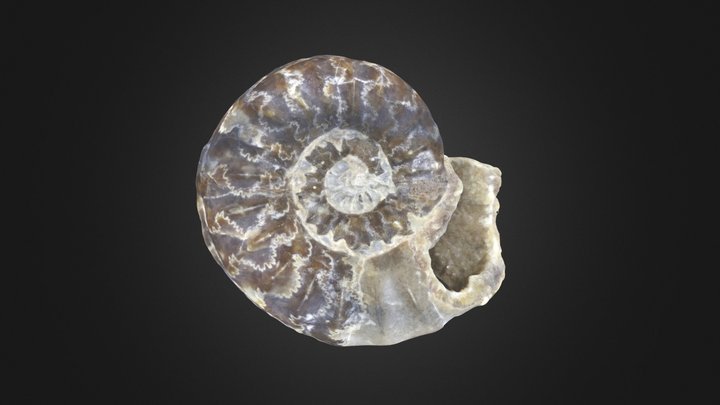
3D model
- Source
- Sketchfab
- Licence
- CC0 Public Domain
- Commercial use
- the licence allows it
Smithsonian Open Access and MorphoSource were not reached for this taxon, so this list is what the others held rather than everything there is.
The description on this site
- Source
- Wikipedia, “Asteroceras”
- Licence
- CC BY-SA 4.0
This is what the site found, which is not the same as what exists.
Keep going
What may have been alongside itAsteroceratidae through timeFormations of the Early JurassicThe world it lived on
Occurrence data from the Paleobiology Database, CC BY 4.0. Hyatt 1867