Archaeomanta
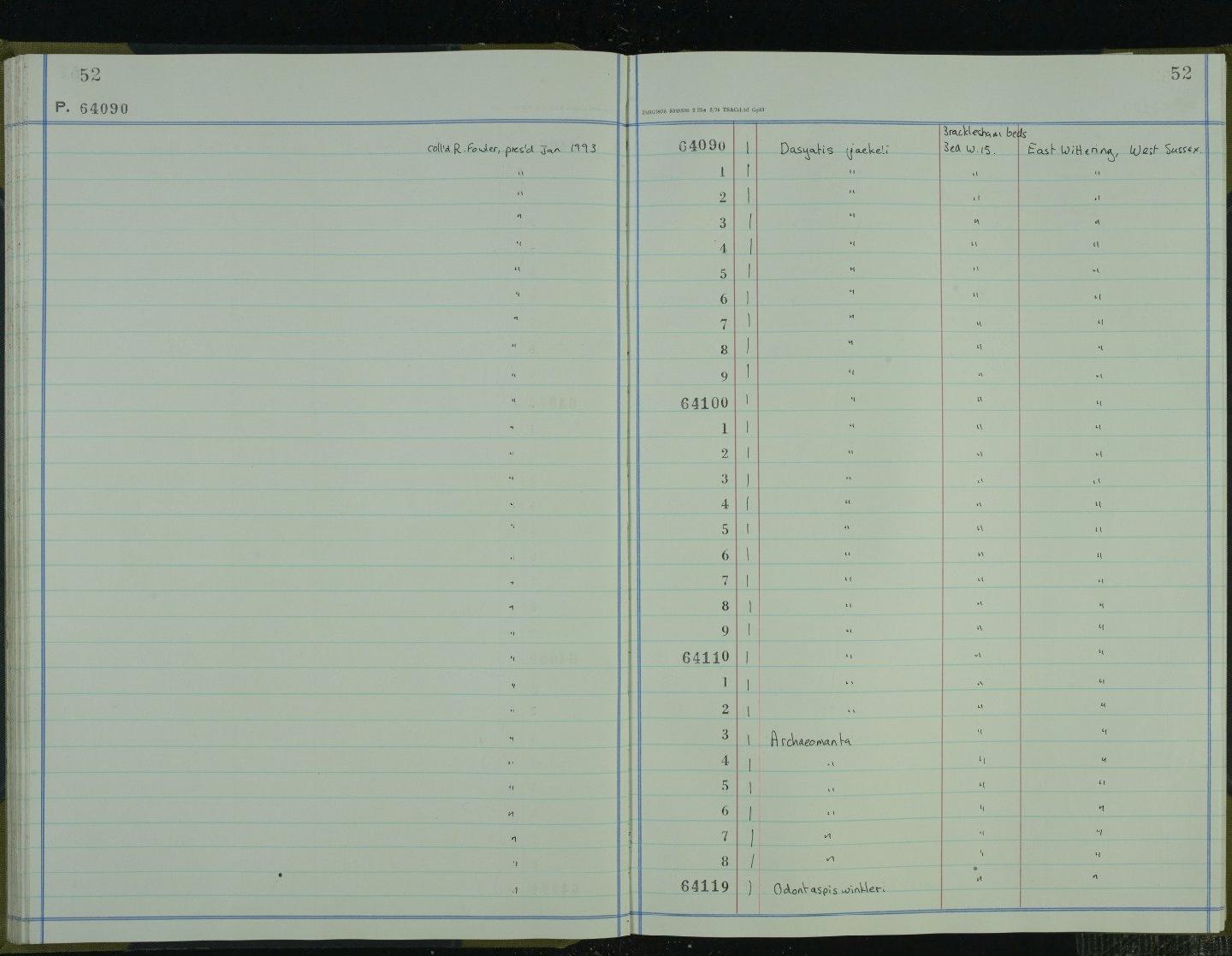
R Fowler · CC0 · via GBIF. May be a photograph of a specimen, or an artist’s reconstruction — an interpretation of a skeleton, since colour and soft tissue are almost never preserved.
On record
Recorded, not inferred- Sits inside
- MobulidaePBDB
- Diet
- carnivorePBDB, for Myliobatiformes
- Life habit
- nektobenthicPBDB, for Myliobatiformes
- Motility
- actively mobilePBDB, for Myliobatiformes
Time the record covers
At least 23 million years on record.
The record covers at least 61.66 Mya to 37.71 Mya. No occurrence read is dated outside 66 Mya to 33.9 Mya.
38 occurrences of Archaeomanta on record, most of them in the Eocene. Bar height is expected occurrences, not a count: each fossil is spread across the span it is dated to, so a tall narrow bar means tight dating and a low wide one means loose.
When
38 occurrencesThese are dates about fossils, not the animal: the record can only begin after it arose and end before it died out, so either end may reach further. Shares are expected occurrences: a fossil dated to a span is counted partly in each period it straddles. More on what this infers.
Found in
13 formations
- Couche II Formation3
- Elmore Formation · Bracklesham Group2
- Selsey Formation · Bracklesham Group2
- Qasr el-Sagha Formation2
- Birket Qarun Formation2
- Rishtan Formation1
Loading coastlines…
The named rock units Archaeomanta has been recovered from, largest first. Drawn where the rock is now, not where it formed. 19 occurrences have no formation on record, which is common for older literature.
Archaeomanta and its relatives
EoceneWhere Archaeomanta and its relatives were recorded in the Eocene.
Found in the same rock
511 taxa- Burnhamia13 sites
- Abdounia beaugei11 sites
- Dasyatis11 sites
- Physogaleus secundus11 sites
- Squatina prima10 sites
- Aetomylaeus dixoni9 sites
- Isurus praecursor9 sites
- Odontaspis winkleri9 sites
- Rhizoprionodon ganntourensis9 sites
- Scyliorhinus9 sites
- Striatolamia macrota9 sites
- Brachycarcharias lerichei8 sites
- Burnhamia daviesi8 sites
- Galeorhinus8 sites
- Jaekelotodus trigonalis8 sites
- Myliobatis8 sites
- Nebrius obliquus8 sites
- Premontreia (Oxyscyllium) subulidens8 sites
- Rhynchobatus vincenti8 sites
- Aetobatus irregularis7 sites
- Arechia arambourgi7 sites
- Coupatezia boujoi7 sites
- Galeorhinus minutissimus7 sites
- Galeorhinus ypresiensis7 sites
The Paleobiology Database records 33 sites for Archaeomanta, and this reads all of them. The number is how many of those sites it was catalogued from too. The 24 sharing the most are listed.
This is not a list of everything alive at the time. It is only what has come out of the same ground as this animal and been written down.
Entered from
18 references- Les Orectolobiformes, Carcharhiniformes et Myliobatiformes (Elasmobranchii, Neoselachii) des bassins à phosphate du Maroc (Maastrichtien-Lutétien basal). Systématique, biostratigraphie, évolution et dynamique des faunes14
- Shark and ray faunas in the Middle and Late Eocene of the Fayum Area, Egypt5
- The Selsey Division (Bracklesham Group) at Lee-on-the-Solent, Gosport, (Hants)3
- Structure and ichthyofauna of the upper part of Eocene sediments in Belogorsk area (Crimea)2
- A new Palaeogene elasmobranch fauna (Tebessa region, eastern Algeria) and the importance of Algerian-Tunisian phosphates for the North African fossil record1
- Diversity and renewal of tropical elasmobranchs around the Middle Eocene Climatic Optimum (MECO) in North Africa: New data from the lagoonal deposits of Djebel el Kébar, Central Tunisia1
- Elasmobranchs from the upper Paleocene of Togo1
- A Middle–Late Eocene vertebrate fauna (marine fish and mammals) from southwestern Morocco; preliminary report: age and palaeobiogeographical implications1
- Late Eocene scyliorhinid sharks from the Trans−Urals, Russia1
- A new large mammal from the Ypresian of Morocco: evidence of surprising diversity of early proboscideans1
- New biostratigraphical data on the marine Upper Cretaceous and Palaeogene of Jordan1
- Part 3: Rays from the Fisher/Sullivan Site1
Each of the 38 occurrences read was entered from one of these publications, ordered by how many each accounts for. This is not a search for papers mentioning the name. 6 further references are not listed. Entries link to doi.org where the Paleobiology Database holds an identifier, and to its own record where it does not. Relayed as the Paleobiology Database holds them, not checked against what they resolve to.
Media and terms
Media content1
Picture of Archaeomanta
- Source
- GBIF
- Credit
- R Fowler
- Licence
- CC0
- Commercial use
- the licence allows it
No 3D scan of Archaeomanta was found in MorphoSource and Sketchfab.
Smithsonian Open Access was not reached for this taxon, so this list is what the others held rather than everything there is.
This is what the site found, which is not the same as what exists.
Keep going
What may have been alongside itMobulidae through timeFormations of the EoceneThe world it lived on
Occurrence data from the Paleobiology Database, CC BY 4.0. Herman 1979