Archaeognatha
The Archaeognatha are an order of apterygotes, commonly known as bristletails. Among extant insect taxa they are some of the most evolutionarily primitive; they appeared in the Middle Devonian period at about the same time as the arachnids. Specimens that closely resemble extant species have been found as both body and trace fossils in strata from the remainder of the Paleozoic Era and more recent periods. For historical reasons an alternative name for the order is Microcoryphia.

Bruce Marlin · CC BY-SA 3.0 · via Wikipedia/Commons. May be a photograph of a specimen, or an artist’s reconstruction — an interpretation of a skeleton, since colour and soft tissue are almost never preserved.
On record
Recorded, not inferred- Also called
- jumping bristletailsPBDB
- Sits inside
- InsectaPBDB
- Motility
- actively mobilePBDB, for Arthropoda
- Environment
- terrestrialPBDB, for Insecta
Time the record covers
At least 382 million years on record.
The record covers at least 382.31 Mya to 11.7 ka. No occurrence read is dated outside 387.95 Mya to 0 Mya.
82 occurrences of Archaeognatha on record, most of them in the Eocene. The Paleobiology Database records this as a living group. Bar height is expected occurrences, not a count: each fossil is spread across the span it is dated to, so a tall narrow bar means tight dating and a low wide one means loose.
When
82 occurrences- Devonian1%
- Carboniferous5%
- Permian13%
- Middle Triassic4%
- Early Cretaceous6%
- Late Cretaceous9%
- Eocene45%
- Miocene13%
- Pliocene1%
- Pleistocene1%
- Holocene1%
These are dates about fossils, not the animal: the record can only begin after it arose and end before it died out, so either end may reach further. Shares are expected occurrences: a fossil dated to a span is counted partly in each period it straddles. More on what this infers.
Found in
11 formations
- Mitina Formation5
- Bursum Formation3
- Meride Formation2
- Carbondale Formation · Kewanee Group2
- Wellington Formation2
- Commentry Shales Formation2
Loading coastlines…
The named rock units Archaeognatha has been recovered from, largest first. Drawn where the rock is now, not where it formed. 61 occurrences have no formation on record, which is common for older literature.
Archaeognatha and its relatives
EoceneWhere Archaeognatha and its relatives were recorded in the Eocene.
Found in the same rock
4,088 taxa- Neomachilellus (Praeneomachilellus) ezetaelenensis6 sites
- Yantaromyrmex geinitzi6 sites
- Araneae5 sites
- Dasyleptus brongniarti5 sites
- Plagiolepis klinsmanni5 sites
- Prenolepis henschei5 sites
- Tetraponera simplex5 sites
- Brachypogon (Isohelea) prominulus4 sites
- Ctenobethylus goepperti4 sites
- Dasyleptus4 sites
- Eocamponotus mengei4 sites
- Forcipomyia4 sites
- Formica flori4 sites
- Gesomyrmex hoernesi4 sites
- Gnamptogenys europaea4 sites
- Holocentropus atratus4 sites
- Hypoponera atavia4 sites
- Lasius schiefferdeckeri4 sites
- Liomopterella vulgaris4 sites
- Lype sericea4 sites
- Matsucoccus pinnatus4 sites
- Monogedania clunipes4 sites
- Neomachilellus (Praeneomachilellus) dominicanus4 sites
- Nylanderia pygmaea4 sites
The Paleobiology Database records 45 sites for Archaeognatha, and this reads all of them. The number is how many of those sites it was catalogued from too. The 24 sharing the most are listed.
This is not a list of everything alive at the time. It is only what has come out of the same ground as this animal and been written down.
Entered from
33 references- Die "Ur-Insecten" (Thysanura und Collembola im Bernstein)14
- Die im Bernstein befindlichen Crustaceen, Myriapoden, Arachniden und Apteren der Vorwelt8
- Fossil jumping-bristletail from the Chiapas amber: Neomachilellus (Praeneomachilellus) ezetaelenensis sp. nov. (Microcoryphia: Meinertellidae)6
- Die Thysanuren des baltischen Bernsteins6
- Jumping bristeltails (Insecta, Archaeognatha) from the Lower Cretaceous amber of Lebanon4
- Phylogenetic analyses with four new Cretaceous bristletails reveal inter-relationships of Archaeognatha and Gondwana origin of Meinertellidae4
- A new Neomachilellus species from Miocene amber of the Dominican Republic and its phylogenetic relationships (Archaeognatha: Meinertellidae)4
- Svoeobraznye paleozoyskie beskrylye nasekomye novogo otryada Monura (Insecta, Apterygota)4
- Important new insect fossils from Carrizo Arroyo and the Permo-Carboniferous faunal boundary3
- Footnotes and taxonomic names, in Die im Bernstein befindlichen Crustaceen, Myriapoden, Arachniden und Apteren der Vorwelt3
- First eggs of fossil bristletails (Meinertellidae: Microcoryphia) from Burmese amber2
- New data on fossil Archaeognatha from Baltic amber and the origin of the insect ovipositor2
Each of the 82 occurrences read was entered from one of these publications, ordered by how many each accounts for. This is not a search for papers mentioning the name. 21 further references are not listed. Entries link to doi.org where the Paleobiology Database holds an identifier, and to its own record where it does not. Relayed as the Paleobiology Database holds them, not checked against what they resolve to.
Media and terms
Media content1
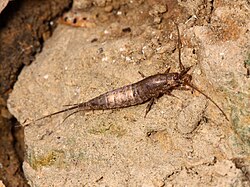
Picture of Archaeognatha
- Source
- Wikipedia/Commons
- Credit
- Bruce Marlin
- Licence
- CC BY-SA 3.0
- Commercial use
- the licence allows it
No 3D scan of Archaeognatha was found in Sketchfab.
Smithsonian Open Access and MorphoSource were not reached for this taxon, so this list is what the others held rather than everything there is.
The description on this site
- Licence
- CC BY-SA 4.0
This is what the site found, which is not the same as what exists.
Keep going
What may have been alongside itInsecta through timeFormations of the EoceneThe world it lived on
Occurrence data from the Paleobiology Database, CC BY 4.0. (Börner 1904)