Anyphaenidae
Anyphaenidae is a family of araneomorph spiders, sometimes called anyphaenid sac spiders or ghost spiders. They are distinguished from the sac spiders of the family Clubionidae and other spiders by having the abdominal spiracle placed one third to one half of the way anterior to the spinnerets toward the epigastric furrow on the underside of the abdomen. In most spiders the spiracle is just anterior to the spinnerets.

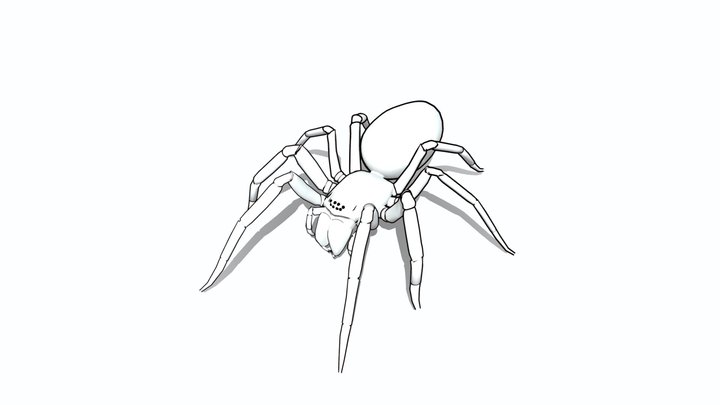
Junkyardsparkle · CC0 · via Wikipedia/Commons. May be a photograph of a specimen, or an artist’s reconstruction — an interpretation of a skeleton, since colour and soft tissue are almost never preserved.
On record
Recorded, not inferred- Sits inside
- DionychaPBDB
- Life habit
- solitaryPBDB, for Arachnida
- Motility
- actively mobilePBDB, for Arachnida
- Environment
- terrestrialPBDB, for Arachnida
Time the record covers
At least 13 million years on record.
The record covers at least 33.9 Mya to 20.45 Mya. No occurrence read is dated outside 37.71 Mya to 13.82 Mya.
7 occurrences of Anyphaenidae on record, most of them in the Miocene. The Paleobiology Database records this as a living group, and the chart stops with its fossils rather than at the present. Bar height is expected occurrences, not a count: each fossil is spread across the span it is dated to, so a tall narrow bar means tight dating and a low wide one means loose.
When
7 occurrencesThese are dates about fossils, not the animal: the record can only begin after it arose and end before it died out, so either end may reach further. Shares are expected occurrences: a fossil dated to a span is counted partly in each period it straddles. More on what this infers.
Found in
1 formation
- Mazantic Shale Formation · Simojovel Group1
Loading coastlines…
The named rock units Anyphaenidae has been recovered from, largest first. Drawn where the rock is now, not where it formed. 6 occurrences have no formation on record, which is common for older literature.
Anyphaenidae and its relatives
MioceneWhere Anyphaenidae and its relatives were recorded in the Miocene.
Found in the same rock
920 taxa- Anyphaena fuscata3 sites
- Araneae3 sites
- Episinus longimanus3 sites
- Gorgopsina frenata3 sites
- Termopsis bremii3 sites
- Ablator triguttatus2 sites
- Adorator hispidus2 sites
- Allacrotelsa dubia2 sites
- Archaea paradoxa2 sites
- Caddo dentipalpus2 sites
- Cataglyphoides constricta2 sites
- Clostes priscus2 sites
- Clubiona microphthalma2 sites
- Clubiona pubescens2 sites
- Clubiona tomentosa2 sites
- Clya lugubris2 sites
- Clya obscura2 sites
- Cronicus anomalus2 sites
- Cryptoplanus sericatus2 sites
- Ctenobethylus goepperti2 sites
- Custodela oblonga2 sites
- Dicranopalpus ramiger2 sites
- Dolichoderus balticus2 sites
- Dolichoderus cornutus2 sites
The Paleobiology Database records 5 sites for Anyphaenidae, and this reads all of them. The number is how many of those sites it was catalogued from too. The 24 sharing the most are listed.
This is not a list of everything alive at the time. It is only what has come out of the same ground as this animal and been written down.
Entered from
5 references- Die fossilen Spinnen im dominikanischen Bernstein3
- Systematic, palaeoecology, and palaeobiogeography of the insect fauna from Mexican amber1
- Fossil Spiders in the Collection of the American Museum of Natural History1
- Die im Bernstein befindlichen Crustaceen, Myriapoden, Arachniden und Apteren der Vorwelt1
- Footnotes and taxonomic names, in Die im Bernstein befindlichen Crustaceen, Myriapoden, Arachniden und Apteren der Vorwelt1
Each of the 7 occurrences read was entered from one of these publications, ordered by how many each accounts for. This is not a search for papers mentioning the name. Each entry links to the Paleobiology Database's own record for the work.
Media and terms
Media content2

Picture of Anyphaenidae
- Source
- Wikipedia/Commons
- Credit
- Junkyardsparkle
- Licence
- CC0
- Commercial use
- the licence allows it
Smithsonian Open Access was not reached for this taxon, so this list is what the others held rather than everything there is.
The description on this site
- Licence
- CC BY-SA 4.0
This is what the site found, which is not the same as what exists.
Keep going
What may have been alongside itDionycha through timeFormations of the MioceneThe world it lived on
Occurrence data from the Paleobiology Database, CC BY 4.0. Bertkau 1878