Amyzon
Amyzon is an extinct genus of cypriniform fish in the sucker family Catostomidae first described in 1872 by E. D. Cope. There are six valid species in the genus. Amyzon are found in North American fossil sites dated from the Early Eocene in Montana and Washington USA, as well as the British Columbian sites at McAbee Fossil Beds, Driftwood Canyon, and the "Horsefly shales", as well as Early Oligocene sites in Nevada USA. One Middle Eocene species is known from the Xiawanpu Formation of China. The Ypresian species A. brevipinne of the Allenby Formation was redescribed in 2021 and moved to a separate monotypic genus Wilsonium.

Kevmin · CC BY-SA 3.0 · via Wikipedia/Commons. May be a photograph of a specimen, or an artist’s reconstruction — an interpretation of a skeleton, since colour and soft tissue are almost never preserved.
On record
Recorded, not inferred- Sits inside
- CatostomidaePBDB
- Diet
- omnivorePBDB, for Cypriniformes
- Life habit
- nektonicPBDB, for Cypriniformes
- Motility
- actively mobilePBDB, for Cypriniformes
- Environment
- freshwaterPBDB, for Cypriniformes
Time the record covers
At least 14 million years on record.
The record covers at least 48.07 Mya to 33.9 Mya. No occurrence read is dated outside 56 Mya to 23.04 Mya.
15 occurrences of Amyzon on record, most of them in the Eocene. Bar height is expected occurrences, not a count: each fossil is spread across the span it is dated to, so a tall narrow bar means tight dating and a low wide one means loose.
When
15 occurrencesThese are dates about fossils, not the animal: the record can only begin after it arose and end before it died out, so either end may reach further. Shares are expected occurrences: a fossil dated to a span is counted partly in each period it straddles. More on what this infers.
Found in
7 formations
- Green River Formation4
- Florissant Formation3
- Allenby Formation · Princeton Group2
- Renova Formation · Ruby River Basin Group1
- Clarno Formation1
- Klondike Mountain Formation1
Loading coastlines…
The named rock units Amyzon has been recovered from, largest first. Drawn where the rock is now, not where it formed. 2 occurrences have no formation on record, which is common for older literature.
Amyzon and its relatives
EoceneWhere Amyzon and its relatives were recorded in the Eocene.
Found in the same rock
227 taxa- Amiidae2 sites
- Aves2 sites
- Diplomystus altus2 sites
- Equisetum2 sites
- Libotonius blakeburnensis2 sites
- Pimelodus antiquus2 sites
- Ulmus2 sites
- Acer glabroides1 site
- Agabus florissantensis1 site
- Aleocharopsis caseyi1 site
- Aleocharopsis secunda1 site
- Alligator1 site
- Alnus1 site
- Amara powellii1 site
- Amara veterata1 site
- Amauropilio lacoei1 site
- Amia1 site
- Amia hesperia1 site
- Amia scutata1 site
- Amphicyrta inhaesa1 site
- Anatis resurgens1 site
- Andrena lagopus1 site
- Anisotoma sibylla1 site
- Annelida1 site
The Paleobiology Database records 13 sites for Amyzon, and this reads all of them. The number is how many of those sites it was catalogued from too. The 24 sharing the most are listed.
This is not a list of everything alive at the time. It is only what has come out of the same ground as this animal and been written down.
Entered from
9 references- Middle Eocene Freshwater Fishes from British Columbia3
- On the fishes of the Tertiary shales of the South Park3
- Paleontology of the Green River Formation, with a review of the fish fauna2
- Amyzon gosiutensis, a New Catostomid Fish from the Green River Formation2
- Discovery of Cyclurus (Amiinae, Amiidae, Amiiformes, Pisces) from China1
- A new species of the fish Amia from the middle Eocene of British Columbia1
- A Second Species of Libotonius (Pisces: Percopsidae) from the Eocene of Washington State1
- The York Ranch Flora of the Upper Ruby River Basin, Southwestern Montana1
- Freshwater fish remains from the Clarno Formation Ochoco Mountains of north-central Oregon1
Each of the 15 occurrences read was entered from one of these publications, ordered by how many each accounts for. This is not a search for papers mentioning the name. Entries link to doi.org where the Paleobiology Database holds an identifier, and to its own record where it does not. Relayed as the Paleobiology Database holds them, not checked against what they resolve to.
Media and terms
Media content2

Picture of Amyzon
- Source
- Wikipedia/Commons
- Credit
- Kevmin
- Licence
- CC BY-SA 3.0
- Commercial use
- the licence allows it
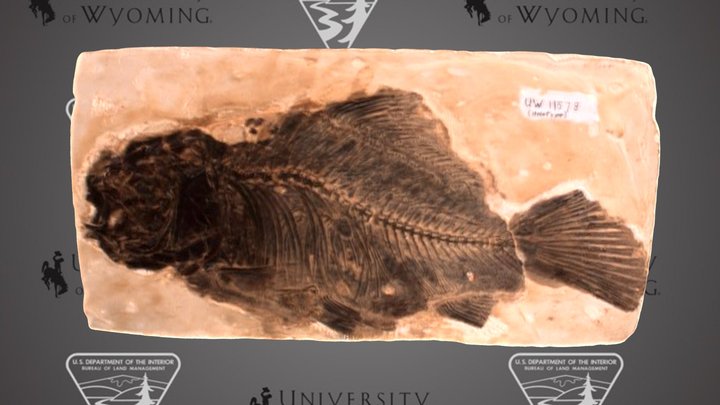
3D model
- Source
- Sketchfab
- Licence
- CC Attribution-NonCommercial
- Commercial use
- the licence does not allow it
Smithsonian Open Access and MorphoSource were not reached for this taxon, so this list is what the others held rather than everything there is.
The description on this site
- Licence
- CC BY-SA 4.0
This is what the site found, which is not the same as what exists.
Keep going
What may have been alongside itCatostomidae through timeFormations of the EoceneThe world it lived on
Occurrence data from the Paleobiology Database, CC BY 4.0. Cope 1872