Aglyptorhynchus
Aglyptorhynchus is an extinct genus of marine billfish that was distributed worldwide from the early Eocene to the early Miocene. Fossils are primarily known from the Northern Hemisphere, but one species is also known to have inhabited the waters off New Zealand.
No picture of Aglyptorhynchus was found. Wikipedia, Wikidata, iDigBio and Smithsonian Open Access were searched and had none. GBIF was asked, and what came back is not recorded: nothing, or a picture this site could not tie to Aglyptorhynchus, or no answer at all. This entry cannot say which.
On record
Recorded, not inferred- Sits inside
- PalaeorhynchidaePBDB
- Motility
- actively mobilePBDB, for Osteichthyes
Time the record covers
At least 25 million years on record.
The record covers at least 48.07 Mya to 23.04 Mya. No occurrence read is dated outside 56 Mya to 20.45 Mya.
19 occurrences of Aglyptorhynchus on record, most of them in the Eocene. Bar height is expected occurrences, not a count: each fossil is spread across the span it is dated to, so a tall narrow bar means tight dating and a low wide one means loose.
When
19 occurrencesThese are dates about fossils, not the animal: the record can only begin after it arose and end before it died out, so either end may reach further. Shares are expected occurrences: a fossil dated to a span is counted partly in each period it straddles. More on what this infers.
Found in
9 formations
- London Clay Formation · Thames Group7
- Selsey Formation · Bracklesham Group3
- Lincoln Creek Formation2
- Melker Sand Formation1
- Chandler Bridge Formation1
- Nanjemoy Formation1
Loading coastlines…
The named rock units Aglyptorhynchus has been recovered from, largest first. Drawn where the rock is now, not where it formed. 1 occurrence has no formation on record, which is common for older literature.
Aglyptorhynchus and its relatives
EoceneWhere Aglyptorhynchus and its relatives were recorded in the Eocene.
Found in the same rock
496 taxa- Trichiurides sagittidens8 sites
- Cylindracanthus rectus7 sites
- Albula oweni6 sites
- Odontaspis winkleri6 sites
- Palaeocybium proosti6 sites
- Squatina prima6 sites
- Aetobatus irregularis5 sites
- Aetomylaeus dixoni5 sites
- Brachycarcharias lerichei5 sites
- Heterodontus5 sites
- Heterodontus vincenti5 sites
- Hypotodus verticalis5 sites
- Isistius trituratus5 sites
- Jaekelotodus trigonalis5 sites
- Myliobatis latidens5 sites
- Premontreia (Oxyscyllium) gilberti5 sites
- Scyliorhinus5 sites
- Abdounia recticona4 sites
- Acipenser toliapicus4 sites
- Aetomylaeus striatus4 sites
- Anoxypristis4 sites
- Aves4 sites
- Burnhamia daviesi4 sites
- Carcharias4 sites
The Paleobiology Database records 15 sites for Aglyptorhynchus, and this reads all of them. The number is how many of those sites it was catalogued from too. The 24 sharing the most are listed.
This is not a list of everything alive at the time. It is only what has come out of the same ground as this animal and been written down.
Entered from
11 references- The English Chalk and London Clay: two remarkable British bony fish Lagerstatten4
- The Selsey Division (Bracklesham Group) at Lee-on-the-Solent, Gosport, (Hants)3
- Casier, 19663
- A New Aglyptorhynchus (Perciformes: Scombroidei) from the Lincoln Creek Formation (Late Oligocene, Washington, U.S.A.)2
- New records of the dolphin Albertocetus meffordorum (Odontoceti: Xenorophidae) from the lower Oligocene of South Carolina: Encephalization, sensory anatomy, postcranial morphology, and ontogeny of early odontocetes1
- Upper Oligocene marine fishes from nearshore deposits of the Central Paratethys (Máriahalom, Hungary)1
- A New Billfish (Perciformes, Xiphioidei) from the Late Oligocene of New Zealand1
- Late Oligocene sharks and rays from the Chandler Bridge Formation, Dorchester County, South Carolina, USA1
- Part 4. Actinopterygian Fishes from the Fisher/Sullivan Site1
- Wirbeltierfunde aus der palaogenen Molasse Osterreichs und ihre stratigraphische Bedeutung1
- La faune ichthyologique de l'Ypresien de la Belgique1
Each of the 19 occurrences read was entered from one of these publications, ordered by how many each accounts for. This is not a search for papers mentioning the name. Entries link to doi.org where the Paleobiology Database holds an identifier, and to its own record where it does not. Relayed as the Paleobiology Database holds them, not checked against what they resolve to.
Media and terms
Media content1
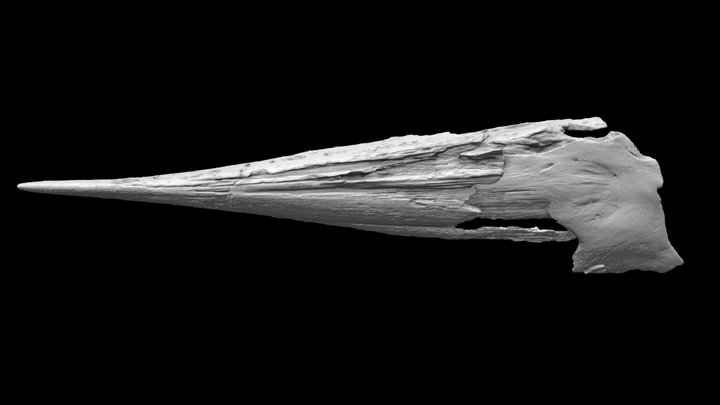
No picture of Aglyptorhynchus was found. Wikipedia, Wikidata, iDigBio and Smithsonian Open Access were searched and had none.
GBIF was asked, and what came back is not recorded: nothing, or a picture this site could not tie to Aglyptorhynchus, or no answer at all. This entry cannot say which.
The description on this site
- Licence
- CC BY-SA 4.0
This is what the site found, which is not the same as what exists.
Keep going
What may have been alongside itPalaeorhynchidae through timeFormations of the EoceneThe world it lived on
Occurrence data from the Paleobiology Database, CC BY 4.0. Casier 1966