Agaricales
The Agaricales are an order of fungi in the division Basidiomycota. As originally conceived, the order contained all the agarics, but subsequent research has shown that not all agarics are closely related and some belong in other orders, such as the Russulales and Boletales. Conversely, DNA research has also shown that many non-agarics, including some of the clavarioid fungi and gasteroid fungi belong within the Agaricales. The order has 46 extant families, more than 400 genera, and over 25,000 described species, along with six extinct genera known only from the fossil record. Species in the Agaricales range from the familiar Agaricus bisporus and the deadly Amanita virosa to the coral-like Clavaria zollingeri and bracket-like Fistulina hepatica.

Uncredited · CC BY-SA 3.0 · via Wikipedia/Commons. May be a photograph of a specimen, or an artist’s reconstruction — an interpretation of a skeleton, since colour and soft tissue are almost never preserved.
On record
Recorded, not inferred- Also called
- gilled mushroomPBDB
- Sits inside
- AgaricomycetesPBDB
Time the record covers
At least 92 million years on record.
The record covers at least 113.2 Mya to 20.45 Mya. No occurrence read is dated outside 119.57 Mya to 13.82 Mya.
14 occurrences of Agaricales on record, most of them in the Late Cretaceous. The Paleobiology Database records this as a living group, and the chart stops with its fossils rather than at the present. Bar height is expected occurrences, not a count: each fossil is spread across the span it is dated to, so a tall narrow bar means tight dating and a low wide one means loose.
When
14 occurrences- Early Cretaceous7%
- Late Cretaceous57%
- Eocene14%
- Miocene21%
These are dates about fossils, not the animal: the record can only begin after it arose and end before it died out, so either end may reach further. Shares are expected occurrences: a fossil dated to a span is counted partly in each period it straddles. More on what this infers.
Found in
4 formations
- La Toca Formation1
- Raritan Formation · Potomac Group1
- Yanigua Formation1
- Crato Formation · Santana Group1
Loading coastlines…
The named rock units Agaricales has been recovered from, largest first. Drawn where the rock is now, not where it formed. 10 occurrences have no formation on record, which is common for older literature.
Agaricales and its relatives
Late CretaceousWhere Agaricales and its relatives were recorded in the Late Cretaceous.
Found in the same rock
818 taxa- Vetuformosa buckleyi2 sites
- Acalyptomerus thayerae1 site
- Acalyptopygus astriatus1 site
- Acalyptopygus brevicornis1 site
- Acalyptopygus elongatus1 site
- Acalyptopygus lingziae1 site
- Acanthochrysa langae1 site
- Acanthocorona1 site
- Acanthocorona skalskii1 site
- Acanthocorona spinifera1 site
- Acanthocorona wichardi1 site
- Acanthomantispa grandis1 site
- Achlyoconis heptatrichia1 site
- Agathiphagama perdita1 site
- Alienopteridae1 site
- Alienopterix ocularis1 site
- Allobaissoptera oligophlebia1 site
- Alloterocucus atratus1 site
- Ambermantis wozniaki1 site
- Amberotridactylus cheni1 site
- Amecephala micra1 site
- Anaxipha dominica1 site
- Angarosphecidae1 site
- Angimordella burmitina1 site
The Paleobiology Database records 10 sites for Agaricales, and this reads all of them. The number is how many of those sites it was catalogued from too. The 24 sharing the most are listed.
This is not a list of everything alive at the time. It is only what has come out of the same ground as this animal and been written down.
Entered from
9 references- Mycophagous rove beetles highlight diverse mushrooms in the Cretaceous4
- Two new species of suspected mushrooms of the suborder Marasmiineae from mid-Cretaceous Burmese amber (Basidiomycota, Agaricales)2
- Fossil mushrooms from Miocene and Cretaceous ambers and the evolution of Homobasidiomycetes2
- The oldest fossil mushroom1
- A gilled mushroom, Gerontomyces lepidotus gen. et sp. nov. (Basidiomycota: Agaricales), in Baltic amber1
- Evidence of mycoparasitism and hypermycoparasitism in Early Cretaceous amber1
- Another fossil agaric from Dominican amber1
- Palaeocybe striata, ein neuer fossiler Pilz in Bernstein des Tertiär1
- Upper Eocene gilled mushroom from the Dominican Republic1
Each of the 14 occurrences read was entered from one of these publications, ordered by how many each accounts for. This is not a search for papers mentioning the name. Entries link to doi.org where the Paleobiology Database holds an identifier, and to its own record where it does not. Relayed as the Paleobiology Database holds them, not checked against what they resolve to.
Media and terms
Media content1
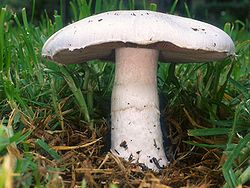
Picture of Agaricales
- Source
- Wikipedia/Commons
- Credit
- nobody named on the record
- Licence
- CC BY-SA 3.0
- Commercial use
- the licence allows it
No 3D scan of Agaricales was found in Sketchfab.
Smithsonian Open Access and MorphoSource were not reached for this taxon, so this list is what the others held rather than everything there is.
The description on this site
- Source
- Wikipedia, “Agaricales”
- Licence
- CC BY-SA 4.0
This is what the site found, which is not the same as what exists.
Keep going
What may have been alongside itAgaricomycetes through timeFormations of the Late CretaceousThe world it lived on
Occurrence data from the Paleobiology Database, CC BY 4.0. Underwood 1899