Aeolosaurus
Aeolosaurus is a genus of titanosaurian sauropod dinosaur from the Late Cretaceous Period of what is now South America. Like most sauropods, it would have been a quadrupedal herbivore with a long neck and tail. Aeolosaurus is well known for a titanosaur, as it is represented by the remains of several individuals belonging to at least two species. However, like most titanosaurs, no remains of the skull are known. The holotype of Aeolosaurus rionegrinus consists of a series of seven tail vertebrae, as well as parts of both forelimbs and the right hindlimb. It was discovered in the Angostura Colorada Formation in Argentina, which dates from the Campanian stage of the Late Cretaceous, about 83 to 74 million years ago. The species A. maximus was transferred over to the new genus Arrudatitan in 2021.

Ornithopsis · CC BY 4.0 · via Wikipedia/Commons. May be a photograph of a specimen, or an artist’s reconstruction — an interpretation of a skeleton, since colour and soft tissue are almost never preserved.
On record
Recorded, not inferred- Sits inside
- AeolosauriniPBDB
- Diet
- herbivorePBDB, for Sauropoda
- Life habit
- ground dwelling, gregariousPBDB, for Sauropoda
- Motility
- actively mobilePBDB, for Sauropoda
- Environment
- terrestrialPBDB, for Sauropoda
Time the record covers
At most 18 million years on record.
Every occurrence read is dated to somewhere between 83.6 Mya and 66 Mya, and nothing in the dating separates them, so that window is what the record shows rather than a span.
6 occurrences of Aeolosaurus on record, most of them in the Late Cretaceous. Bar height is expected occurrences, not a count: each fossil is spread across the span it is dated to, so a tall narrow bar means tight dating and a low wide one means loose.
When
6 occurrences- Late Cretaceous100%
These are dates about fossils, not the animal: the record can only begin after it arose and end before it died out, so either end may reach further. Shares are expected occurrences: a fossil dated to a span is counted partly in each period it straddles. More on what this infers.
Found in
6 formations
- Allen Formation · Malargüe Group1
- Lago Colhué Huapi Formation · Chubut Group1
- Angostura Colorada Formation1
- Serra da Galga Formation · Bauru Group1
- Marília Formation · Bauru Group1
- Asencio Formation1
Loading coastlines…
The named rock units Aeolosaurus has been recovered from, largest first. Drawn where the rock is now, not where it formed.
Aeolosaurus and its relatives
Late CretaceousWhere Aeolosaurus and its relatives were recorded in the Late Cretaceous.
Found in the same rock
27 taxa- Abelisauridae2 sites
- Titanosauria2 sites
- Titanosauridae2 sites
- Baurutitan britoi1 site
- Bivalvia1 site
- Bonapartesaurus rionegrensis1 site
- Carcharodontosauridae1 site
- Charadriiformes1 site
- Colhuehuapisuchus lunai1 site
- Deinonychosauria1 site
- Dinosauria1 site
- Fusioolithus baghensis1 site
- Gastropoda1 site
- Hadrosauridae1 site
- Limenavis patagonica1 site
- Megaloolithidae1 site
- Megaraptoridae1 site
- Mesoeucrocodylia1 site
- Metaceratodus kaopen1 site
- Patagopelta cristata1 site
- Plantae1 site
- Rocasaurus1 site
- Rocasaurus muniozi1 site
- Sektensaurus sanjuanboscoi1 site
The Paleobiology Database records 6 sites for Aeolosaurus, and this reads all of them. The number is how many of those sites it was catalogued from too. The 24 sharing the most are listed.
This is not a list of everything alive at the time. It is only what has come out of the same ground as this animal and been written down.
Entered from
6 references- Sauropod (Dinosauria: Saurischia) remains from the Mercedes and Asencio formations (sensu Bossi, 1966), Upper Cretaceous of Uruguay1
- A new sauropod (Macronaria, Titanosauria) from the Adamantina Formation, Bauru Group, Upper Cretaceous of Brazil and the phylogenetic relationships of Aeolosaurini1
- Record of the genus Aeolosaurus (Sauropoda, Titanosauria) in the Late Cretaceous of South America: paleogeographic implications1
- Aeolosaurus colhuehuapensis sp. nov. (Sauropoda, Titanosauria) de la Formación Bajo Barreal, Cretácico Superior de Argentina [Aeolosaurus colhuehuapensis sp. nov. (Sauropoda, Titanosauria) from the Bajo Barreal Formation, Upper Cretaceous of Argentina]1
- El genero Aeolosaurus (Sauropoda, Titanosauridae) en la Formacion Allen (Campaniano-Maastrichtiano) de la Provincia de Rio Negro, Argentina [The genus Aeolosaurus (Sauropoda, Titanosauridae) in the Allen Formation (Campanian-Maastrichtian) of Rio Negro Province, Argentina]1
- The Late Cretaceous fauna of Los Alamitos, Patagonia, Argentina part VI—the titanosaurids1
Each of the 6 occurrences read was entered from one of these publications, ordered by how many each accounts for. This is not a search for papers mentioning the name. Entries link to doi.org where the Paleobiology Database holds an identifier, and to its own record where it does not. Relayed as the Paleobiology Database holds them, not checked against what they resolve to.
Media and terms
Media content1
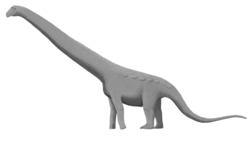
Picture of Aeolosaurus
- Source
- Wikipedia/Commons
- Credit
- Ornithopsis
- Licence
- CC BY 4.0
- Commercial use
- the licence allows it
No 3D scan was found. Smithsonian Open Access, MorphoSource and Sketchfab were all searched.
The description on this site
- Source
- Wikipedia, “Aeolosaurus”
- Licence
- CC BY-SA 4.0
This is what the site found, which is not the same as what exists.
Keep going
What may have been alongside itAeolosaurini through timeFormations of the Late CretaceousThe world it lived on
Occurrence data from the Paleobiology Database, CC BY 4.0. Powell 1987