Adelophthalmus
Adelophthalmus is a genus of eurypterid, an extinct group of aquatic arthropods. Fossils of Adelophthalmus have been discovered in deposits ranging in age from the Early Devonian to the Early Permian, which makes it the longest lived of all known eurypterid genera, with a total temporal range of over 120 million years. Adelopththalmus was the final genus of the Eurypterina suborder of eurypterids and consisted the only known genus of swimming eurypterids from the Middle Devonian until its extinction during the Permian, after which the few surviving eurypterids were all walking forms of the suborder Stylonurina.

textbook: John Mason Clarke (1857-1925) and Rudolf Ruedemann (1864-1956) illustrator: James Hall (1811-1898) · Public Domain · via Wikipedia/Commons. May be a photograph of a specimen, or an artist’s reconstruction — an interpretation of a skeleton, since colour and soft tissue are almost never preserved.
On record
Recorded, not inferred- Sits inside
- AdelophthalmidaePBDB
- Diet
- carnivorePBDB, for Eurypterida
- Life habit
- nektobenthicPBDB, for Eurypterida
- Motility
- actively mobilePBDB, for Eurypterida
- Vision
- well-developedPBDB, for Eurypterida
Time the record covers
At least 109 million years on record.
The record covers at least 399.5 Mya to 290.1 Mya. No occurrence read is dated outside 410.62 Mya to 283.3 Mya.
52 occurrences of Adelophthalmus on record, most of them in the Carboniferous. Bar height is expected occurrences, not a count: each fossil is spread across the span it is dated to, so a tall narrow bar means tight dating and a low wide one means loose.
When
52 occurrences- Devonian15%
- Carboniferous78%
- Permian7%
These are dates about fossils, not the animal: the record can only begin after it arose and end before it died out, so either end may reach further. Shares are expected occurrences: a fossil dated to a span is counted partly in each period it straddles. More on what this infers.
Found in
38 formations
- Charleroi Formation · Belgian Coal Measure Group4
- Wellington Formation · Sumner Group2
- Catskill Formation1
- Lancaster Formation1
- Saarbrucken’schen Kohlengebirges Formation1
- Karviná beds Formation1
Loading coastlines…
The named rock units Adelophthalmus has been recovered from, largest first. Drawn where the rock is now, not where it formed. 14 further formations hold fewer occurrences each and are not listed. 10 occurrences have no formation on record, which is common for older literature.
Adelophthalmus and its relatives
CarboniferousWhere Adelophthalmus and its relatives were recorded in the Carboniferous.
Found in the same rock
285 taxa- Spirorbis4 sites
- Calamites3 sites
- Cordaites3 sites
- Neuropteris3 sites
- Pecopteris3 sites
- Pecopteris (Alethopteris)3 sites
- Anthracomya2 sites
- Asterophyllites2 sites
- Jaekelopterus rhenaniae2 sites
- Naiadites2 sites
- Parahughmilleria hefteri2 sites
- Sphenophyllum2 sites
- Sphenopteris2 sites
- Acanthodes nitidus1 site
- Acrolepis ortholepis1 site
- Aedoeophasma acadica1 site
- Alkenia mirabilis1 site
- Alkenopterus brevitelson1 site
- Alloiopteris1 site
- Althansia sahneri1 site
- Amphipeltis paradoxus1 site
- Anagesthes affinis1 site
- Annularia1 site
- Anormochorista oligoclada1 site
The Paleobiology Database records 51 sites for Adelophthalmus, and this reads all of them. The number is how many of those sites it was catalogued from too. The 24 sharing the most are listed.
This is not a list of everything alive at the time. It is only what has come out of the same ground as this animal and been written down.
Entered from
43 references- Contribution à la connaissance du genre Adelophthalmus Jordan et Meyer, 18543
- Devonian Eurypterids from Indiana and Pennsylvania2
- New data on eurypterids (Eurypterida, Chelicerata) of the upper Carboniferous of the Donets Basin2
- New species of the genus Adelophthalmus (Eurypterida, Chelicerata) found in the Middle Devonian of Khakassia2
- The Scottish Carboniferous Eurypterida2
- Matériaux pour la faune du Houiller de Belgique2
- La faune continentale du terrain houiller de la Belgique2
- Contribution to Paleontology from the Museum of the Second Geological Survey of Pennsylvania2
- First eurypterid from Italy: a new species of Adelophthalmus (Chelocerata: Eurypterida) from the upper Carboniferous of the Carnic Alps (Friuli, NE Italy)1
- Štamberg and Zajíc, 20081
- On the Emsian (Lower Devonian) arthropods of the Rhenish Slate Mountains: 5. Rare and poorly known eurypterids from Willwerath, Germany1
- A redescription of the Late Carboniferous eurypterids Adelophthalmus granosus von Meyer, 1853 and A. zadrai Pribyl, 19521
Each of the 52 occurrences read was entered from one of these publications, ordered by how many each accounts for. This is not a search for papers mentioning the name. 31 further references are not listed. Entries link to doi.org where the Paleobiology Database holds an identifier, and to its own record where it does not. Relayed as the Paleobiology Database holds them, not checked against what they resolve to.
Media and terms
Media content2

Picture of Adelophthalmus
- Source
- Wikipedia/Commons
- Credit
- textbook: John Mason Clarke (1857-1925) and Rudolf Ruedemann (1864-1956) illustrator: James Hall (1811-1898)
- Licence
- Public Domain
- Commercial use
- the licence allows it
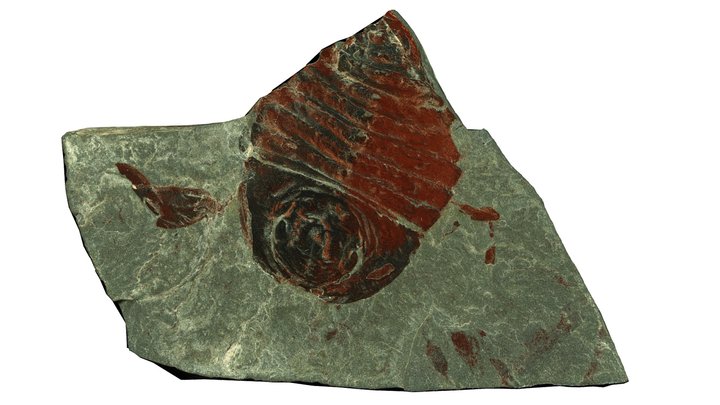
3D model
- Source
- Sketchfab
- Licence
- CC Attribution
- Commercial use
- cannot be read from the licence given — check the record
Smithsonian Open Access and MorphoSource were not reached for this taxon, so this list is what the others held rather than everything there is.
The description on this site
- Licence
- CC BY-SA 4.0
This is what the site found, which is not the same as what exists.
Keep going
What may have been alongside itAdelophthalmidae through timeFormations of the CarboniferousThe world it lived on
Occurrence data from the Paleobiology Database, CC BY 4.0. Jordan and von Mayer 1854