Urolophus
Urolophus is a genus of round rays mostly native to the western Pacific Ocean and the Indian Ocean, though one species occurs in the Pacific waters of the Mexican coast. Müller and Henle erected Urolophus in an 1837 issue of Bericht Akademie der Wissenschaften zu Berlin. The name is derived from the Greek oura, meaning "tail", and lophos, meaning "crest". In Urolophus, the outer rims of the nostrils are not enlarged into lobes, but may form a small knob at the back.

Nick Long · CC BY-SA 2.0 · via Wikipedia/Commons. May be a photograph of a specimen, or an artist’s reconstruction — an interpretation of a skeleton, since colour and soft tissue are almost never preserved.
On record
Recorded, not inferred- Sits inside
- UrolophidaePBDB
- Diet
- carnivorePBDB, for Myliobatiformes
- Life habit
- nektobenthicPBDB, for Myliobatiformes
- Motility
- actively mobilePBDB, for Myliobatiformes
Time the record covers
At least 47 million years on record.
The record covers at least 48.07 Mya to 129 ka. No occurrence read is dated outside 56 Mya to 11.7 ka.
12 occurrences of Urolophus on record, most of them in the Pleistocene. The Paleobiology Database records this as a living group. Bar height is expected occurrences, not a count: each fossil is spread across the span it is dated to, so a tall narrow bar means tight dating and a low wide one means loose.
When
12 occurrences- Eocene25%
- Oligocene8%
- Pliocene8%
- Pleistocene58%
These are dates about fossils, not the animal: the record can only begin after it arose and end before it died out, so either end may reach further. Shares are expected occurrences: a fossil dated to a span is counted partly in each period it straddles. More on what this infers.
Found in
2 formations
Loading coastlines…
The named rock units Urolophus has been recovered from, largest first. Drawn where the rock is now, not where it formed. 5 occurrences have no formation on record, which is common for older literature.
Urolophus and its relatives
PleistoceneWhere Urolophus and its relatives were recorded in the Pleistocene.
Found in the same rock
784 taxa- Genyonemus lineatus5 sites
- Carcharhinus4 sites
- Carcharodon carcharias4 sites
- Galeorhinus galeus4 sites
- Myliobatis californica4 sites
- Ophidion scrippsae4 sites
- Cetacea3 sites
- Chilara taylori3 sites
- Cymatogaster aggregata3 sites
- Engraulis mordax3 sites
- Equus3 sites
- Heterodontus francisci3 sites
- Hirtoscala tincta3 sites
- Lepidogobius lepidus3 sites
- Paralichthys californicus3 sites
- Platyrhina bolcensis3 sites
- Plesiozanobatus egertoni3 sites
- Porichthys myriaster3 sites
- Porichthys notatus3 sites
- Promyliobatis gazolai3 sites
- Semicossyphus pulcher3 sites
- Seriphus politus3 sites
- Squatina californica3 sites
- Torpedo gigantea3 sites
The Paleobiology Database records 11 sites for Urolophus, and this reads all of them. The number is how many of those sites it was catalogued from too. The 24 sharing the most are listed.
This is not a list of everything alive at the time. It is only what has come out of the same ground as this animal and been written down.
Entered from
10 references- Marine studies of San Pedro Bay, California2
- Fish remains, mostly otoliths and teeth, from the Palos Verdes Sand (Late Pleistocene) of California2
- Revision of Eocene electric rays (Torpediniformes, Batomorphii) from the Bolca Konservat- Lagerstätte, Italy, reveals the first fossil embryo in situ in marine batoids and provides new insights into the origin of trophic novelties in coral reef fishes1
- The Pesciara-Monte Postale Fossil-Lagerstätte: 2. Fishes and other vertebrates1
- Das Sternberger Gestein un seine Artenzahl - Stand 19941
- Preliminary List of the Marine Fishes and Other Vertebrate Remains from the Late Pleistocene Palos Verdes Sand Formation at Costa Mesa, Orange County, California1
- Pleistocene vertebrates of the Los Angeles basin and vicinity:(exclusive of Rancho La Brea)1
- Otoliths and other fish remains from a Long Beach, California, Pliocene deposit1
- The Paleontology and Stratigraphy of the Marine Pliocene and Pleistocene of San Pedro, California1
- Jaekel, 18941
Each of the 12 occurrences read was entered from one of these publications, ordered by how many each accounts for. This is not a search for papers mentioning the name. Entries link to doi.org where the Paleobiology Database holds an identifier, and to its own record where it does not. Relayed as the Paleobiology Database holds them, not checked against what they resolve to.
Media and terms
Media content1
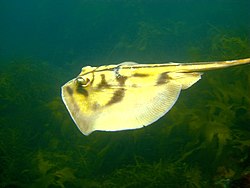
Picture of Urolophus
- Source
- Wikipedia/Commons
- Credit
- Nick Long
- Licence
- CC BY-SA 2.0
- Commercial use
- the licence allows it
No 3D scan of Urolophus was found in Sketchfab.
Smithsonian Open Access and MorphoSource were not reached for this taxon, so this list is what the others held rather than everything there is.
The description on this site
- Source
- Wikipedia, “Urolophus”
- Licence
- CC BY-SA 4.0
This is what the site found, which is not the same as what exists.
Keep going
What may have been alongside itUrolophidae through timeFormations of the PleistoceneThe world it lived on
Occurrence data from the Paleobiology Database, CC BY 4.0.