Upogebia
Upogebia is a genus of mud shrimp, in the family Upogebiidae, containing the following species:

Hans Hillewaert · CC BY-SA 4.0 · via Wikipedia/Commons. May be a photograph of a specimen, or an artist’s reconstruction — an interpretation of a skeleton, since colour and soft tissue are almost never preserved.
On record
Recorded, not inferred- Sits inside
- UpogebiidaePBDB
- Diet
- detritivorePBDB, for Gebiidea
- Life habit
- infaunalPBDB, for Gebiidea
- Motility
- actively mobilePBDB, for Malacostraca
- Vision
- well-developedPBDB, for Malacostraca
Time the record covers
At least 245 million years on record.
The record covers at least 245.19 Mya to 129 ka. No occurrence read is dated outside 247 Mya to 11.7 ka.
30 occurrences of Upogebia on record, most of them in the Miocene. The Paleobiology Database records this as a living group. Bar height is expected occurrences, not a count: each fossil is spread across the span it is dated to, so a tall narrow bar means tight dating and a low wide one means loose.
When
30 occurrences- Middle Triassic3%
- Middle Jurassic3%
- Early Cretaceous10%
- Paleocene4%
- Eocene2%
- Oligocene4%
- Miocene67%
- Pliocene3%
- Pleistocene3%
These are dates about fossils, not the animal: the record can only begin after it arose and end before it died out, so either end may reach further. Shares are expected occurrences: a fossil dated to a span is counted partly in each period it straddles. More on what this infers.
Found in
5 formations
- Calcaire à Spatangues Formation3
- Kowai Formation1
- Yoshino Formation · Katsuta Group1
- Pysht Formation1
- Grès à Voltzia Formation1
Loading coastlines…
The named rock units Upogebia has been recovered from, largest first. Drawn where the rock is now, not where it formed. 23 occurrences have no formation on record, which is common for older literature.
Upogebia and its relatives
MioceneWhere Upogebia and its relatives were recorded in the Miocene.
Found in the same rock
194 taxa- Ebalia hungarica4 sites
- Pilumnus mediterraneus4 sites
- Galathea weinfurteri3 sites
- Pachygrapsus hungaricus3 sites
- Parthenope szaboi3 sites
- Pisa oroszyi3 sites
- Actumnus telegdii2 sites
- Brachynotus februarius2 sites
- Calappa heberti2 sites
- Callianassa2 sites
- Callianassa kerepesiensis2 sites
- Callianassa munieri2 sites
- Liocarcinus rakosensis2 sites
- Lucanthonisia eotvoesi2 sites
- Matuta brocchii2 sites
- Miopipus pygmeus2 sites
- Mursia lienharti2 sites
- Parthenope loczyi2 sites
- Parthenope tetenyensis2 sites
- Petrochirus priscus2 sites
- Tarbellastraea2 sites
- Thalamita2 sites
- Trachypirimela grippi2 sites
- Xantho incisus2 sites
The Paleobiology Database records 15 sites for Upogebia, and this reads all of them. The number is how many of those sites it was catalogued from too. The 24 sharing the most are listed.
This is not a list of everything alive at the time. It is only what has come out of the same ground as this animal and been written down.
Entered from
14 references- Decapod crustaceans from the Miocene Kukinaga Group, Tanegashima Island, Kyushu, Japan11
- Decapoda (Crustacea) fauna a budapesti miocénből (2)3
- Mémoire sur les Crustacés du terrain néocomien de St. Sauveur-en-Puisaye3
- Two new Paleogene species of mud shrimp (Crustacea, Decapoda, Upogebiidae) from Europe and North America2
- Decapod crustacea of the Badenian2
- Resurrection of Eumorphia von Meyer, 1847 and some taxonomical considerations of other mecochirid lobsters (Crustacea, Decapoda, Mecochiridae)1
- Upogebia miocenica n. sp. (Crustacea, Thalassinidea, Upogebiidae) from the Miocene of Catalonia (Spain)1
- Fossil isopod and decapod crustaceans from the Kowai Formation (Pliocene) near Makikihi, South Canterbury, New Zealand1
- Two new species of decapod crustaceans from the middle Miocene Katsuta Group, Japan1
- Cenozoic Molluscs and Echinoids of Barrow Island, Western Australia1
- Cenozoic Decapod Crustacea from Southwest Japan1
- Les formations recifales coralliennes du Miocene superieur d'Algerie et du Maroc [Upper Miocene coral reef formations from Algeria and Morocco]1
Each of the 30 occurrences read was entered from one of these publications, ordered by how many each accounts for. This is not a search for papers mentioning the name. 2 further references are not listed. Entries link to doi.org where the Paleobiology Database holds an identifier, and to its own record where it does not. Relayed as the Paleobiology Database holds them, not checked against what they resolve to.
Media and terms
Media content2

Picture of Upogebia
- Source
- Wikipedia/Commons
- Credit
- Hans Hillewaert
- Licence
- CC BY-SA 4.0
- Commercial use
- the licence allows it
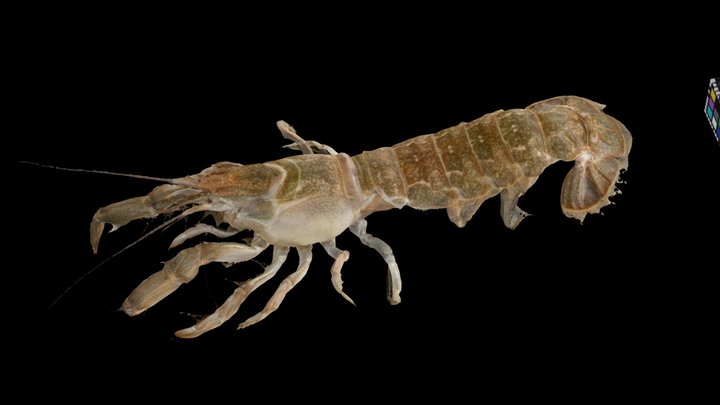
3D model
- Source
- Sketchfab
- Licence
- CC0 Public Domain
- Commercial use
- the licence allows it
Smithsonian Open Access was not reached for this taxon, so this list is what the others held rather than everything there is.
The description on this site
- Source
- Wikipedia, “Upogebia”
- Licence
- CC BY-SA 4.0
This is what the site found, which is not the same as what exists.
Keep going
What may have been alongside itUpogebiidae through timeFormations of the MioceneThe world it lived on
Occurrence data from the Paleobiology Database, CC BY 4.0. Leach 1814