Trematoceras
Trematoceras, from Ancient Greek τρῆμα (trêma), meaning "perforation", and κέρας (kéras), meaning "horn", is an orthoconic nautiloid cephalopod from the Upper Triassic of Europe and Asia named by Eichwald in 1851.
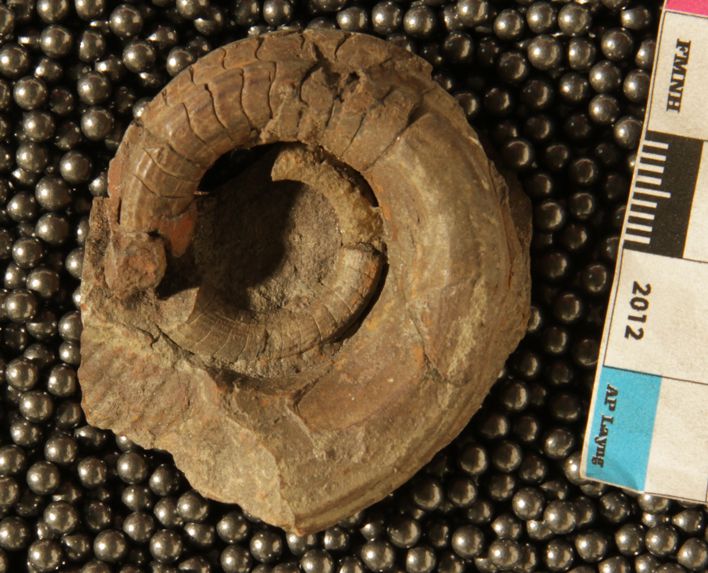
via iDigBio · via iDigBio. May be a photograph of a specimen, or an artist’s reconstruction — an interpretation of a skeleton, since colour and soft tissue are almost never preserved.
On record
Recorded, not inferred- Sits inside
- TrematoceratidaePBDB
- Diet
- carnivorePBDB, for Cephalopoda
- Life habit
- nektonicPBDB, for Cephalopoda
- Motility
- fast-movingPBDB, for Cephalopoda
- Vision
- well-developedPBDB, for Cephalopoda
- Environment
- marinePBDB, for Cephalopoda
Time the record covers
At least 33 million years on record.
The record covers at least 248.6 Mya to 215.38 Mya. No occurrence read is dated outside 250.8 Mya to 211.18 Mya.
115 occurrences of Trematoceras on record, most of them in the Middle Triassic. Bar height is expected occurrences, not a count: each fossil is spread across the span it is dated to, so a tall narrow bar means tight dating and a low wide one means loose.
When
115 occurrencesThese are dates about fossils, not the animal: the record can only begin after it arose and end before it died out, so either end may reach further. Shares are expected occurrences: a fossil dated to a span is counted partly in each period it straddles. More on what this infers.
Found in
27 formations
- Besano Formation17
- Prida Formation · Star Peak Group13
- Halstatt Formation9
- Zhitkov Formation4
- Tartalinskaya Formation4
- Ulakhan-Krest Formation4
Loading coastlines…
The named rock units Trematoceras has been recovered from, largest first. Drawn where the rock is now, not where it formed. 3 further formations hold fewer occurrences each and are not listed. 25 occurrences have no formation on record, which is common for older literature.
Trematoceras and its relatives
Middle TriassicWhere Trematoceras and its relatives were recorded in the Middle Triassic.
Found in the same rock
1,144 taxa- Monophyllites wengensis17 sites
- Atractites15 sites
- Orthoceratoidea15 sites
- Flexoptychites acutus14 sites
- Longobardites zsigmondyi13 sites
- Flexoptychites flexuosus10 sites
- Megaphyllites jarbas9 sites
- Gymnites incultus8 sites
- Sturia sansovinii8 sites
- Discoptychites megalodiscus7 sites
- Eutomoceras laubei7 sites
- Joannites cymbiformis7 sites
- Sageceras walteri7 sites
- Aplococeras parvus6 sites
- Arcestes6 sites
- Daonella moussoni6 sites
- Dinarites6 sites
- Gastropoda6 sites
- Longobardites parvus6 sites
- Mojsvarites agenor6 sites
- Pleuronautilus6 sites
- Procladiscites griesbachi6 sites
- Ptychites oppeli6 sites
- Sageceras haidingeri6 sites
The Paleobiology Database records 107 sites for Trematoceras, and this reads all of them. The number is how many of those sites it was catalogued from too. The 24 sharing the most are listed.
This is not a list of everything alive at the time. It is only what has come out of the same ground as this animal and been written down.
Entered from
36 references- Middle Triassic Molluscan Fossils of Biostratigraphic Significance from the Humboldt Range, Northwestern Nevada13
- Orthoceratoid and coleoid cephalopods from the Middle Triassic of Switzerland with an updated taxonomic framework for Triassic Orthoceratoidea12
- Die Cephalopoden der Mediterranen Triasprovinz8
- Examples of Late Olenekian invertebrate successions: Paper 1. Western Tethys (Dolnapa, Mangyshlak)7
- Das Gebirge um Hallstatt. Eine geologisch-paläontologische Studie aus den Alpen. 1 Teil, Die Mollusken-Faunen der Zlambach- und Hallstätter-Schichten7
- The Global Boundary Stratotype Section and Point (GSSP) for the base of the Anisian Stage: Deşli Caira Hill, North Dobrogea, Romania6
- Die Triasfauna der Tessiner Kalkalpen: XXII. Cephalopoden aus der Grenzbitumenzone (Mittlere Trias) des Monte San Giorgio (Kanton Tessin, Schweiz)5
- Geologie der Umgebung von Sarajevo5
- Ammonoids and nautiloids from the earliest Spathian Paris Biota and other early Spathian localities in southeastern Idaho, USA4
- Detailed biostratigraphy of Triassic deposits in the Lena lower reaches(northern Yakutia)4
- Das Grödener-, Fassa- und Enneberggebiet in den Südtiroler Dolomiten: Geologische Beschreibung mit besonderer Berücksichtigung der Überschiebungserscheinungen. Teil III. Paläontologie4
- The Fauna of the Himalayan Muschelkalk4
Each of the 115 occurrences read was entered from one of these publications, ordered by how many each accounts for. This is not a search for papers mentioning the name. 24 further references are not listed. Entries link to doi.org where the Paleobiology Database holds an identifier, and to its own record where it does not. Relayed as the Paleobiology Database holds them, not checked against what they resolve to.
Media and terms
Media content1
Picture of Trematoceras
- Source
- iDigBio
- Credit
- via iDigBio
- Licence
- not stated by the source
- Commercial use
- cannot be read from the licence given — check the record
No 3D scan of Trematoceras was found in MorphoSource and Sketchfab.
Smithsonian Open Access was not reached for this taxon, so this list is what the others held rather than everything there is.
The description on this site
- Licence
- CC BY-SA 4.0
This is what the site found, which is not the same as what exists.
Keep going
What may have been alongside itTrematoceratidae through timeFormations of the Middle TriassicThe world it lived on
Occurrence data from the Paleobiology Database, CC BY 4.0. Eichwald 1851