Tonna pennata
Tonna pennata is a large species of sea snail, a marine gastropod mollusc in the family Tonnidae, the tun shells. Commonly known as the Atlantic partridge tun, the species is a predator of animals much larger than itself, particularly sea cucumbers.

H. Zell · CC BY-SA 3.0 · via Wikipedia/Commons. May be a photograph of a specimen, or an artist’s reconstruction — an interpretation of a skeleton, since colour and soft tissue are almost never preserved.
On record
Recorded, not inferred- Sits inside
- TonnaPBDB
- Diet
- carnivorePBDB, for Tonnidae
- Life habit
- epifaunalPBDB, for Tonnidae
- Motility
- actively mobilePBDB, for Tonnidae
- Vision
- limitedPBDB, for Gastropoda
Time the record covers
At least 2.7 million years on record.
The record covers at least 5.333 Mya to 2.58 Mya. No occurrence read is dated outside 7.246 Mya to 11.7 ka.
9 occurrences of Tonna pennata on record, most of them in the Pliocene. The Paleobiology Database records this as a living group. Bar height is expected occurrences, not a count: each fossil is spread across the span it is dated to, so a tall narrow bar means tight dating and a low wide one means loose.
When
9 occurrences- Miocene17%
- Pliocene72%
- Pleistocene11%
These are dates about fossils, not the animal: the record can only begin after it arose and end before it died out, so either end may reach further. Shares are expected occurrences: a fossil dated to a span is counted partly in each period it straddles. More on what this infers.
Found in
6 formations
- Gurabo Formation3
- Cayo Agua Formation · Bocas del Toro Group2
- Playa Grande Formation · Cabo Blanco Group1
- Araya Formation1
- Mare Formation1
- La Isabella Formation1
Loading coastlines…
The named rock units Tonna pennata has been recovered from, largest first. Drawn where the rock is now, not where it formed.
Tonna pennata and its relatives
PlioceneWhere Tonna pennata and its relatives were recorded in the Pliocene.
Found in the same rock
30 taxa- Alabina1 site
- Argopecten eccentricus1 site
- Cancellaria (Cancellaria) harrisi1 site
- Cerithiidae1 site
- Erosaria spurca1 site
- Fusinus henekeni1 site
- Hypterita1 site
- Julia1 site
- Lindapecten plurinominis1 site
- Lobatus dominator1 site
- Lobatus haitensis1 site
- Lucinidae1 site
- Malea elliptica1 site
- Manicina grandis1 site
- Manicina jungi1 site
- Marginella maoensis1 site
- Melongena1 site
- Monoplex cercadicus1 site
- Natica1 site
- Pachycrommium1 site
- Panamicorbula1 site
- Panamicorbula canae1 site
- Polinices1 site
- Porites convivatoris1 site
The Paleobiology Database records 1 site for Tonna pennata, and this reads all of them. The number is how many of those sites it was catalogued from too. The 24 sharing the most are listed.
This is not a list of everything alive at the time. It is only what has come out of the same ground as this animal and been written down.
Entered from
3 references- Neogene Tonnoidean Gastropods of Tropical and South America; contributions to the Dominican Republic and Panama Paleontology Projects and Uplift of the Central American Isthmus6
- Unpublished notes on Caribbean collection of Jack and Winifred Gibson-Smith, Naturhistorisches Museum Basel2
- Late Cenozoic gastropods from northern Venezuela1
Each of the 9 occurrences read was entered from one of these publications, ordered by how many each accounts for. This is not a search for papers mentioning the name. Each entry links to the Paleobiology Database's own record for the work.
Media and terms
Media content1
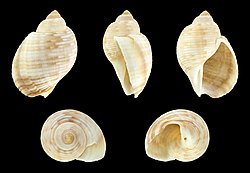
Picture of Tonna pennata
- Source
- Wikipedia/Commons
- Credit
- H. Zell
- Licence
- CC BY-SA 3.0
- Commercial use
- the licence allows it
No 3D scan of Tonna pennata was found in Sketchfab.
Smithsonian Open Access and MorphoSource were not reached for this taxon, so this list is what the others held rather than everything there is.
The description on this site
- Licence
- CC BY-SA 4.0
This is what the site found, which is not the same as what exists.
Keep going
What may have been alongside itTonna through timeFormations of the PlioceneThe world it lived on
Occurrence data from the Paleobiology Database, CC BY 4.0. (Mörch 1853)