Thunnus
Thunnus is a genus of ocean-dwelling, ray-finned bony fish from the mackerel family, Scombridae. More specifically, Thunnus is one of five genera which make up the tribe Thunnini – a tribe that is collectively known as the tunas. Also called the true tunas or real tunas, Thunnus consists of eight species of tuna, divided into two subgenera.

OAR/National Undersea Research Program (NURP) · Public Domain · via Wikipedia/Commons. May be a photograph of a specimen, or an artist’s reconstruction — an interpretation of a skeleton, since colour and soft tissue are almost never preserved.
On record
Recorded, not inferred- Sits inside
- ThunniniPBDB
- Motility
- actively mobilePBDB, for Osteichthyes
Time the record covers
At least 48 million years on record.
The record covers at least 48.07 Mya to 11.7 ka. No occurrence read is dated outside 56 Mya to 0 Mya.
29 occurrences of Thunnus on record, most of them in the Miocene. The Paleobiology Database records this as a living group. Bar height is expected occurrences, not a count: each fossil is spread across the span it is dated to, so a tall narrow bar means tight dating and a low wide one means loose.
When
29 occurrencesThese are dates about fossils, not the animal: the record can only begin after it arose and end before it died out, so either end may reach further. Shares are expected occurrences: a fossil dated to a span is counted partly in each period it straddles. More on what this infers.
Found in
16 formations
- Yorktown Formation · Chesapeake Group2
- Monterey Formation2
- Rosarito Beach Formation2
- Pungo River Formation1
- Bahía Inglesa Formation1
- Cromer Forest Bed Formation1
Loading coastlines…
The named rock units Thunnus has been recovered from, largest first. Drawn where the rock is now, not where it formed. 10 occurrences have no formation on record, which is common for older literature.
Thunnus and its relatives
MioceneWhere Thunnus and its relatives were recorded in the Miocene.
Found in the same rock
1,096 taxa- Carcharodon hastalis7 sites
- Otodus megalodon6 sites
- Hemipristis serra5 sites
- Mysticeti5 sites
- Aetobatus4 sites
- Aves4 sites
- Carcharias4 sites
- Isurus oxyrinchus4 sites
- Kentriodontidae4 sites
- Odontoceti4 sites
- Physeteridae4 sites
- Squatina4 sites
- Ziphiidae4 sites
- Aluterus3 sites
- Carcharhinidae3 sites
- Carcharhinus3 sites
- Carcharhinus brachyurus3 sites
- Carcharhinus leucas3 sites
- Cetacea3 sites
- Cetotheriidae3 sites
- Galeocerdo3 sites
- Kentriodon3 sites
- Mobula3 sites
- Morus3 sites
The Paleobiology Database records 25 sites for Thunnus, and this reads all of them. The number is how many of those sites it was catalogued from too. The 24 sharing the most are listed.
This is not a list of everything alive at the time. It is only what has come out of the same ground as this animal and been written down.
Entered from
24 references- New taxonomic synopses and revision of the scombroid fishes (Scombroidei, Perciformes), including billfishes, from the Cenozoic of territories of the former USSR2
- The Neogene sharks, rays, and bony fishes from Lee Creek Mine, Aurora, North Carolina2
- Late Miocene and Early Pliocene fish assemblages from the north central coast of Chile2
- Woodward, 19012
- Agassiz, 18432
- The Jortveit farm wetland: A Neolithic fishing site on the Skagerrak coast, Norway1
- Taphonomy and palaeoecology of the lower Miocene marine vertebrate assemblage of Ullujaya (Chilcatay Formation, East Pisco Basin, southernPeru)1
- Fossil-collecting from the middle Miocene Carmel Church Quarry marine ecosystem in Caroline County, Virginia1
- Distribution of fossil marine vertebrates in Cerro Colorado, the type locality of the giant raptorial sperm whale Livyatan melvillei (Miocene, Pisco Formation, Peru)1
- A new marine vertebrate assemblage from the Late Neogene Purisima Formation in Central California, Part I: Fossil sharks, bony fish, birds, and implications for the age of the Purisimia Formation west of the San Gregorio Fault1
- On the evolution of diet and landscape during the Upper Paleolithic through Mesolithic at Franchthi Cave (Peloponnese, Greece)1
- Fauna local La Mision, Mioceno Medio, Baja California, Mexico1
Each of the 29 occurrences read was entered from one of these publications, ordered by how many each accounts for. This is not a search for papers mentioning the name. 12 further references are not listed. Entries link to doi.org where the Paleobiology Database holds an identifier, and to its own record where it does not. Relayed as the Paleobiology Database holds them, not checked against what they resolve to.
Media and terms
Media content3

Picture of Thunnus
- Source
- Wikipedia/Commons
- Credit
- OAR/National Undersea Research Program (NURP)
- Licence
- Public Domain
- Commercial use
- the licence allows it
Photogrammetry
- Source
- MorphoSource
- Licence
- not stated by the source
- Commercial use
- cannot be read from the licence given — check the record
- Specimen
- Thunnus atlanticus · UF:EAComp:8033
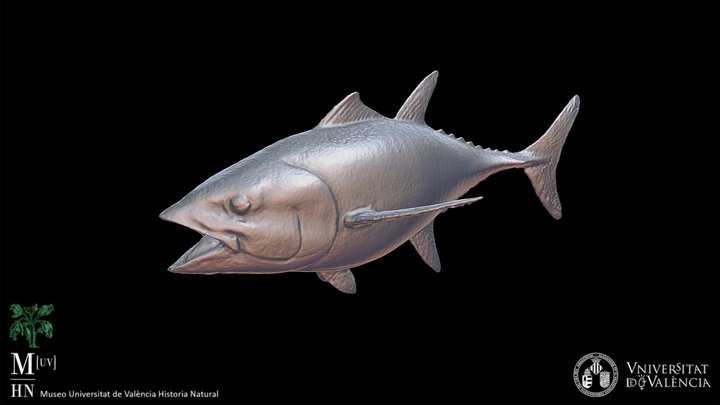
3D model
- Source
- Sketchfab
- Licence
- CC Attribution
- Commercial use
- cannot be read from the licence given — check the record
Smithsonian Open Access was not reached for this taxon, so this list is what the others held rather than everything there is.
The description on this site
- Source
- Wikipedia, “Thunnus”
- Licence
- CC BY-SA 4.0
This is what the site found, which is not the same as what exists.
Keep going
What may have been alongside itThunnini through timeFormations of the MioceneThe world it lived on
Occurrence data from the Paleobiology Database, CC BY 4.0. South 1845