Sula dactylatra
The masked booby, also called the masked gannet or the blue-faced booby, is a large seabird of the booby and gannet family, Sulidae. First described by the French naturalist René-Primevère Lesson in 1831, the masked booby is one of six species of booby in the genus Sula. It has a typical sulid body shape, with a long pointed yellowish bill, long neck, aerodynamic body, long slender wings and pointed tail. The adult is bright white with black wings, a black tail and a dark face mask; at 75–85 cm (30–33 in) long, it is the largest species of booby. The sexes have similar plumage. This species ranges across tropical oceans, except in the eastern Atlantic and eastern Pacific. In the latter, it is replaced by the Nazca booby, which was formerly regarded as a subspecies of masked booby.

Forest & Kim Starr · CC BY 3.0 · via Wikipedia/Commons. May be a photograph of a specimen, or an artist’s reconstruction — an interpretation of a skeleton, since colour and soft tissue are almost never preserved.
On record
Recorded, not inferred- Also called
- masked boobyPBDB
- Sits inside
- SulaPBDB
- Diet
- carnivorePBDB, for Coelurosauria
- Life habit
- ground dwelling, solitaryPBDB, for Theropoda
- Motility
- actively mobilePBDB, for Theropoda
- Environment
- terrestrialPBDB, for Theropoda
Time the record covers
At most 12 thousand years on record.
Every occurrence read is dated to somewhere between 11.7 ka and 0 Mya, and nothing in the dating separates them, so that window is what the record shows rather than a span.
26 occurrences of Sula dactylatra on record, most of them in the Holocene. The Paleobiology Database records this as a living group. Bar height is expected occurrences, not a count: each fossil is spread across the span it is dated to, so a tall narrow bar means tight dating and a low wide one means loose.
When
26 occurrences- Holocene100%
These are dates about fossils, not the animal: the record can only begin after it arose and end before it died out, so either end may reach further. Shares are expected occurrences: a fossil dated to a span is counted partly in each period it straddles. More on what this infers.
Sula dactylatra and its relatives
HoloceneWhere Sula dactylatra and its relatives were recorded in the Holocene.
Found in the same rock
93 taxa- Gygis alba9 sites
- Onychoprion fuscatus7 sites
- Fregata minor6 sites
- Pluvialis fulva6 sites
- Hemiphaga spadicea5 sites
- Procellariidae5 sites
- Pterodroma pycrofti5 sites
- Sula sula5 sites
- Acrocephalus taiti4 sites
- Anous4 sites
- Anous ceruleus4 sites
- Gallicolumba leonpascoi4 sites
- Limosa lapponica4 sites
- Nestor productus4 sites
- Numenius tahitiensis4 sites
- Oceanodroma castro4 sites
- Passeriformes4 sites
- Phaethon aethereus4 sites
- Phaethon rubricauda4 sites
- Prosobonia sauli4 sites
- Pterodroma4 sites
- Ptilinopus insularis4 sites
- Puffinus nativitatis4 sites
- Zapornia atra4 sites
The Paleobiology Database records 26 sites for Sula dactylatra, and this reads all of them. The number is how many of those sites it was catalogued from too. The 24 sharing the most are listed.
This is not a list of everything alive at the time. It is only what has come out of the same ground as this animal and been written down.
Entered from
9 references- Osteological differences between Sula and Morus, and a description of an extinct new species of Sula from Lord Howe and Norfolk Islands, Tasman Sea6
- Avifauna from the Emily Bay settlement site, Norfolk Island: a preliminary account5
- The fossil birds of Henderson Island, Pitcairn Group: natural turnover and human impact, a synopsis4
- Additional notes on subfossil bird remains from Ascension Island3
- Paleornithology of St. Helena Island, South Atlantic Ocean3
- Subfossil bird remains on Ascension Island2
- Biogeography and prehistoric exploitation of birds from Fais Island, Yap State, Federated States of Micronesia1
- Extinction, biogeography, and human exploitation of birds on Tikopia and Anuta, Polynesian outliers in the Solomon Islands1
- Ancient records of birds from the island of St. Croix with observations on extinct and living birds of Puerto Rico1
Each of the 26 occurrences read was entered from one of these publications, ordered by how many each accounts for. This is not a search for papers mentioning the name. Entries link to doi.org where the Paleobiology Database holds an identifier, and to its own record where it does not. Relayed as the Paleobiology Database holds them, not checked against what they resolve to.
Media and terms
Media content2
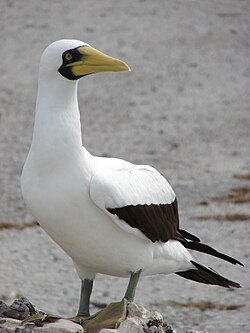
Picture of Sula dactylatra
- Source
- Wikipedia/Commons
- Credit
- Forest & Kim Starr
- Licence
- CC BY 3.0
- Commercial use
- the licence allows it
Structured light scan
- Source
- MorphoSource
- Credit
- CAS Ornithology (ORN)
- Licence
- In Copyright
- Commercial use
- cannot be read from the licence given — check the record
- Specimen
- Sula dactylatra granti · CAS:ORN:72756
The description on this site
- Licence
- CC BY-SA 4.0
This is what the site found, which is not the same as what exists.
Keep going
What may have been alongside itSula through timeFormations of the HoloceneThe world it lived on
Occurrence data from the Paleobiology Database, CC BY 4.0. Lesson 1831