Stenophlebiidae
The Stenophlebiidae is an extinct family of medium-sized to large fossil odonates from the Upper Jurassic and Cretaceous period that belongs to the damsel-dragonfly grade ("anisozygopteres") within the stem group of Anisoptera. They are characterized by their long and slender wings, and the transverse shape of the discoidal triangles in their wing venation.

Dr. Günter Bechly · CC BY-SA 3.0 · via Wikipedia/Commons. May be a photograph of a specimen, or an artist’s reconstruction — an interpretation of a skeleton, since colour and soft tissue are almost never preserved.
On record
Recorded, not inferred- Sits inside
- StenophlebioideaPBDB
- Diet
- carnivore, insectivorePBDB, for Odonata
- Life habit
- volantPBDB, for Odonata
- Motility
- fast-movingPBDB, for Odonata
- Vision
- well-developedPBDB, for Odonata
- Environment
- freshwater,terrestrialPBDB, for Odonata
Time the record covers
At least 48 million years on record.
The record covers at least 149.2 Mya to 100.5 Mya. No occurrence read is dated outside 154.8 Mya to 93.9 Mya.
38 occurrences of Stenophlebiidae on record, most of them in the Late Jurassic. Bar height is expected occurrences, not a count: each fossil is spread across the span it is dated to, so a tall narrow bar means tight dating and a low wide one means loose.
When
38 occurrencesThese are dates about fossils, not the animal: the record can only begin after it arose and end before it died out, so either end may reach further. Shares are expected occurrences: a fossil dated to a span is counted partly in each period it straddles. More on what this infers.
Found in
11 formations
- Solnhofen Formation22
- Karabastau Formation3
- Yixian Formation · Jehol Group3
- Crato Formation · Santana Group1
- La Huérguina Formation1
- Lulworth Formation · Purbeck Group1
Loading coastlines…
The named rock units Stenophlebiidae has been recovered from, largest first. Drawn where the rock is now, not where it formed. 2 occurrences have no formation on record, which is common for older literature.
Stenophlebiidae and its relatives
Late JurassicWhere Stenophlebiidae and its relatives were recorded in the Late Jurassic.
Found in the same rock
1,643 taxa- Cymatophlebia longialata10 sites
- Isophlebia aspasia8 sites
- Mesuropetala muensteri7 sites
- Stenophlebia latreillei7 sites
- Aeschnogomphus intermedius6 sites
- Chresmoda obscura6 sites
- Ditomoptera dubia6 sites
- Hexagenites cellulosus6 sites
- Lithoblatta lithophila6 sites
- Mesonepa primordialis6 sites
- Myrmicium schroeteri6 sites
- Prolystra lithographica6 sites
- Pseudohydrophilus avitus6 sites
- Pycnophlebia speciosa6 sites
- Scarabaeides deperditus6 sites
- Tarsophlebia eximia6 sites
- Actea sphinx5 sites
- Archipsyche eichstattensis5 sites
- Elcana lithophila5 sites
- Eumorbaeschna jurassica5 sites
- Mesephemera procera5 sites
- Protolindenia antiqua5 sites
- Aeschnogomphus buchi4 sites
- Gigantotermes excelsus4 sites
The Paleobiology Database records 27 sites for Stenophlebiidae, and this reads all of them. The number is how many of those sites it was catalogued from too. The 24 sharing the most are listed.
This is not a list of everything alive at the time. It is only what has come out of the same ground as this animal and been written down.
Entered from
21 references- Phylogeny and classification of the Stenophlebioptera (Odonata: Epiproctophora)9
- Strekozy Karatau (Odonata)3
- Jurassic insects from Solenhofen in the Carnegie Museum and the Museum of Comparative Zoology3
- New fossil Odonata from the Upper Jurassic of Bavaria with a new fossil calibration point for Zygoptera2
- Fossil insects from the Tithonian "Solnhofener Plattenkalke" in the Museum of Natural History, Vienna2
- Revue critique de quelques insectes fossiles du Musée Teyler2
- Die Neuroptera des lithographischen Schiefers in Bayern. Pars 1: Tarsophlebia, Isophlebia, Stenophlebia, Anax2
- Ueber die Neuropteren aus dem lithographischen Schiefer in Bayern2
- A new odonatan (Stenophlebiidae) from the Lower Cretaceous Sinuiju Formation of North Phyongan Province, the Democratic People’s Republic of Korea1
- The first amber stenophlebiid damsel-dragonfly (Odonata, Epiproctophora, Stenophlebiidae) from mid-Cretaceous amber of northern Myanmar1
- A new species of damsel-dragonfly (Odonata: Stenophlebiidae: Cretastenophlebia) from the Lower Cretaceous of the Jiuquan Basin, northwestern China1
- The first Early Cretaceous damsel-dragonfly (Odonata: Stenophlebiidae: Stenophlebia) from western Liaoning, China1
Each of the 38 occurrences read was entered from one of these publications, ordered by how many each accounts for. This is not a search for papers mentioning the name. 9 further references are not listed. Entries link to doi.org where the Paleobiology Database holds an identifier, and to its own record where it does not. Relayed as the Paleobiology Database holds them, not checked against what they resolve to.
Media and terms
Media content1
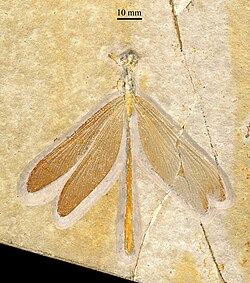
Picture of Stenophlebiidae
- Source
- Wikipedia/Commons
- Credit
- Dr. Günter Bechly
- Licence
- CC BY-SA 3.0
- Commercial use
- the licence allows it
No 3D scan of Stenophlebiidae was found in Sketchfab.
Smithsonian Open Access and MorphoSource were not reached for this taxon, so this list is what the others held rather than everything there is.
The description on this site
- Licence
- CC BY-SA 4.0
This is what the site found, which is not the same as what exists.
Keep going
What may have been alongside itStenophlebioidea through timeFormations of the Late JurassicThe world it lived on
Occurrence data from the Paleobiology Database, CC BY 4.0. (Needham 1903)