Sphenacanthus
Sphenacanthus is an extinct genus of a chondrichtyan xenacanthiform that belongs to the Sphenacanthidae family and lived from the Late Devonian, through Carboniferous until the Late Permian period in Scotland, Spain, Russia and Brazil. It lived 359 million years ago, and probably it was one of the first member of the elasmobranchians, the lineage that leads to the modern sharks. Sphenacanthus probably hunted small fishes and, unlike their modern-day relatives, it inhabited fresh water lagoons. Sphenacanthus had seven fins, two in the upper part and five in the underside, and it had a heterodont dentition and mandibles relatively long and deeper. Sphenacanthus serrulatus is still only known from incomplete neurocranial remains and associated dermal material. These suggest that it was a relatively large shark, probably well over one meter in length when fully grown. Its body form was probably similar to that of other phalacanthous sharks.

Creator: Dmitry Bogdanov · CC BY 3.0 · via Wikipedia/Commons. May be a photograph of a specimen, or an artist’s reconstruction — an interpretation of a skeleton, since colour and soft tissue are almost never preserved.
On record
Recorded, not inferred- Sits inside
- SphenacanthidaePBDB
- Diet
- carnivorePBDB, for Chondrichthyes
- Life habit
- nektonicPBDB, for Chondrichthyes
- Motility
- actively mobilePBDB, for Chondrichthyes
Time the record covers
At least 94 million years on record.
The record covers at least 358.86 Mya to 264.28 Mya. No occurrence read is dated outside 372.15 Mya to 259.857 Mya.
11 occurrences of Sphenacanthus on record, most of them in the Permian. Bar height is expected occurrences, not a count: each fossil is spread across the span it is dated to, so a tall narrow bar means tight dating and a low wide one means loose.
When
11 occurrences- Devonian9%
- Carboniferous36%
- Permian55%
These are dates about fossils, not the animal: the record can only begin after it arose and end before it died out, so either end may reach further. Shares are expected occurrences: a fossil dated to a span is counted partly in each period it straddles. More on what this infers.
Found in
5 formations
- Cutoff Formation3
- Irati Formation1
- Glencartholm Volcanic Beds Formation · Upper Border Group1
- Rio do Rasto Formation1
- Mattoon Formation1
Loading coastlines…
The named rock units Sphenacanthus has been recovered from, largest first. Drawn where the rock is now, not where it formed. 4 occurrences have no formation on record, which is common for older literature.
Sphenacanthus and its relatives
PermianWhere Sphenacanthus and its relatives were recorded in the Permian.
Found in the same rock
101 taxa- Cooleyella amazonensis4 sites
- Alilepis texasensis3 sites
- Isacrodus marthae3 sites
- Stethacanthulus decorus3 sites
- Actinopterygii2 sites
- Adamantina foliacea2 sites
- Antliodus2 sites
- Cooleyella2 sites
- Glikmanius myachkovensis2 sites
- Kungurodus2 sites
- Platysomidae2 sites
- Reifella lata2 sites
- Stethacanthus2 sites
- Strepsodus sauroides2 sites
- Symmoriiformes2 sites
- Acanthodes nitidus1 site
- Acanthodiformes1 site
- Acrolepididae1 site
- Acrolepis ortholepis1 site
- Adelophthalmus perornatus1 site
- Amniota indet.1 site
- Amphicentrum1 site
- Batrachiderpeton lineatum1 site
- Bransonella lingulata1 site
The Paleobiology Database records 11 sites for Sphenacanthus, and this reads all of them. The number is how many of those sites it was catalogued from too. The 24 sharing the most are listed.
This is not a list of everything alive at the time. It is only what has come out of the same ground as this animal and been written down.
Entered from
9 references- Fish microremains, Cutoff Formation (Roadian, Middle Permian) Guadalupe Mountains, West Texas, USA3
- Late Pennsylvanian fishes from the Finis Shales of North-Central Texas (USA)1
- Chondrichthyans from the Lower Permian of Mechetlino, south Urals, Russia1
- A new species of sphenacanthid (Chondrichthyes, Elasmobranchii) from the Rio do Rasto Formation (Paraná basin), southern Brazil1
- Fishes and tetrapods in the upper Pennsylvanian (Kasimovian) Cohn Coal Member of the Mattoon formation of Illinois, United States: systematics, paleoecology, and paleoenvironments1
- Chondrichthyans from the base of the Irati Formation (Early Permian, Paraná Basin), São Paulo, Brazil1
- Fossil Fishes of Great Britain1
- Late Devonian - Early Permian chondrichthyans of the Russian Arctic1
- On the occurence of the palatal teeth of a fish belonging to the Genus Climaxodus, M'Coy, in the Low-main Shale of Newsham1
Each of the 11 occurrences read was entered from one of these publications, ordered by how many each accounts for. This is not a search for papers mentioning the name. Entries link to doi.org where the Paleobiology Database holds an identifier, and to its own record where it does not. Relayed as the Paleobiology Database holds them, not checked against what they resolve to.
Media and terms
Media content1
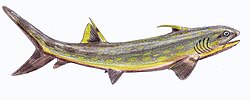
Picture of Sphenacanthus
- Source
- Wikipedia/Commons
- Credit
- Creator: Dmitry Bogdanov
- Licence
- CC BY 3.0
- Commercial use
- the licence allows it
No 3D scan of Sphenacanthus was found in MorphoSource and Sketchfab.
Smithsonian Open Access was not reached for this taxon, so this list is what the others held rather than everything there is.
The description on this site
- Licence
- CC BY-SA 4.0
This is what the site found, which is not the same as what exists.
Keep going
What may have been alongside itSphenacanthidae through timeFormations of the PermianThe world it lived on
Occurrence data from the Paleobiology Database, CC BY 4.0. Agassiz 1837