Sphagesauridae
Sphagesauridae is a Gondwanan family of mesoeucrocodylians that lived during the Late Cretaceous. It was a clade of terrestrial crocodilians that evolved very mammal-like teeth and jaws. Both Sphagesaurus and Adamantinasuchus are known from the Turonian to Santonian of Brazil.

Smokeybjb · CC BY-SA 3.0 · via Wikipedia/Commons. May be a photograph of a specimen, or an artist’s reconstruction — an interpretation of a skeleton, since colour and soft tissue are almost never preserved.
On record
Recorded, not inferred- Sits inside
- SphagesauriaPBDB
- Diet
- carnivorePBDB, for Pseudosuchia
- Motility
- actively mobilePBDB, for Osteichthyes
- Environment
- marinePBDB, for Mesoeucrocodylia
Time the record covers
At most 28 million years on record.
Every occurrence read is dated to somewhere between 93.9 Mya and 66 Mya, and nothing in the dating separates them, so that window is what the record shows rather than a span.
20 occurrences of Sphagesauridae on record, most of them in the Late Cretaceous. Bar height is expected occurrences, not a count: each fossil is spread across the span it is dated to, so a tall narrow bar means tight dating and a low wide one means loose.
When
20 occurrences- Late Cretaceous100%
These are dates about fossils, not the animal: the record can only begin after it arose and end before it died out, so either end may reach further. Shares are expected occurrences: a fossil dated to a span is counted partly in each period it straddles. More on what this infers.
Found in
3 formations
- Adamantina Formation · Bauru Group18
- Cajones Formation1
- Santo Anastácio Formation1
Loading coastlines…
The named rock units Sphagesauridae has been recovered from, largest first. Drawn where the rock is now, not where it formed.
Sphagesauridae and its relatives
Late CretaceousWhere Sphagesauridae and its relatives were recorded in the Late Cretaceous.
Found in the same rock
43 taxa- Morrinhosuchus luziae3 sites
- Sphagesaurus huenei3 sites
- Abelisauridae2 sites
- Dromaeosauridae2 sites
- Theropoda2 sites
- Acanthocephala1 site
- Adamantinasuchus navae1 site
- Anura1 site
- Aplestosuchus sordidus1 site
- Armadillosuchus1 site
- Armadillosuchus arrudai1 site
- Arrudatitan maximus1 site
- Barreirosuchus franciscoi1 site
- Baurubatrachus santosdoroi1 site
- Baurusuchidae1 site
- Baurusuchinae1 site
- Baurusuchus albertoi1 site
- Caipirasuchus1 site
- Caipirasuchus attenboroughi1 site
- Caipirasuchus catanduvensis1 site
- Caipirasuchus mineirus1 site
- Caipirasuchus montealtensis1 site
- Caipirasuchus paulistanus1 site
- Caipirasuchus stenognathus1 site
The Paleobiology Database records 19 sites for Sphagesauridae, and this reads all of them. The number is how many of those sites it was catalogued from too. The 24 sharing the most are listed.
This is not a list of everything alive at the time. It is only what has come out of the same ground as this animal and been written down.
Entered from
18 references- Cranial morphology of Morrinhosuchus luziae (Crocodyliformes, Notosuchia) from the Upper Cretaceous of the Bauru Basin, Brazil2
- On a new crocodilian, Sphagesaurus, from the Cretaceous of the State of São Paulo, Brazil2
- A new species of vocalizing crocodyliform (Notosuchia, Sphagesauridae) from the Late Cretaceous of Brazil1
- A new species of Caipirasuchus (Notosuchia, Sphagesauridae) from the Late Cretaceous of Brazil and the evolutionary history of Sphagesauria1
- Description and phylogenetic relationships of a large-bodied sphagesaurid notosuchian from the Upper Cretaceous Adamantina Formation, Bauru Group, São Paulo, southeastern Brazil1
- The first Caipirasuchus (Mesoeucrocodylia, Notosuchia) from the Late Cretaceous of Minas Gerais, Brazil: new insights on sphagesaurid anatomy and taxonomy1
- Postcranial skeletons of Caipirasuchus (Crocodyliformes, Notosuchia, Sphagesauridae) from the Upper Cretaceous (Turonian-Santonian) of the Bauru Basin, Brazil1
- An additional baurusuchid from the Cretaceous of Brazil with evidence of interspecific predation among Crocodyliformes1
- A new notosuchian from the Late Cretaceous of Brazil and the phylogeny of advanced notosuchians1
- Caipirasuchus paulistanus, a new sphagesaurid (Crocodylomorpha, Mesoeucrocodylia) from the Adamantina Formation (Upper Cretaceous, Turonian–Santonian), Bauru Basin, Brazil1
- A new crocodylomorph (Sphagesauridae, Notosuchia) with horn-like tubercles from Brazil1
- Morrinhosuchus luziae, um novo Crocodylomorpha Notosuchia da Bacia Bauru, Brasil [Morrinhosuchus luziae, a new Crocodylomorpha Notosuchia from the Bauru Basin, Brazil]1
Each of the 20 occurrences read was entered from one of these publications, ordered by how many each accounts for. This is not a search for papers mentioning the name. 6 further references are not listed. Entries link to doi.org where the Paleobiology Database holds an identifier, and to its own record where it does not. Relayed as the Paleobiology Database holds them, not checked against what they resolve to.
Media and terms
Media content1
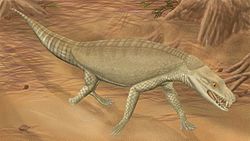
Picture of Sphagesauridae
- Source
- Wikipedia/Commons
- Credit
- Smokeybjb
- Licence
- CC BY-SA 3.0
- Commercial use
- the licence allows it
No 3D scan was found. Smithsonian Open Access, MorphoSource and Sketchfab were all searched.
The description on this site
- Licence
- CC BY-SA 4.0
This is what the site found, which is not the same as what exists.
Keep going
What may have been alongside itSphagesauria through timeFormations of the Late CretaceousThe world it lived on
Occurrence data from the Paleobiology Database, CC BY 4.0. (Kuhn 1968)