Scoliodon laticaudus
The spadenose shark is a species of requiem shark in the family Carcharhinidae. It is common in the tropical Indian and western Pacific Oceans, where it forms large schools in shallow water. A small shark reaching a length of 74 cm (29 in), the spadenose shark is named for its distinctively flattened, triangular snout. It is a predator of small bony fishes and invertebrates. This species exhibits the most advanced mode of viviparity of any fish, in which the developed embryos form a highly complex placental connection to the mother at a very small size. Females breed year-round, giving birth to six to 18 pups after a gestation period of 5–6 months. The spadenose shark is harmless to humans and is valued by artisanal and commercial fishers for its meat and fins. Its abundance ensures it forms a significant component of many fisheries in South and Southeast Asia. The International Union for Conservation of Nature has assessed this species as Near threatened. This fish is also known as mori in Goa

Müller & Henle · Public Domain · via Wikipedia/Commons. May be a photograph of a specimen, or an artist’s reconstruction — an interpretation of a skeleton, since colour and soft tissue are almost never preserved.
On record
Recorded, not inferred- Also called
- spadenose sharkPBDB
- Sits inside
- ScoliodonPBDB
- Diet
- carnivorePBDB, for Carcharhiniformes
- Life habit
- nektonicPBDB, for Carcharhiniformes
- Motility
- actively mobilePBDB, for Carcharhiniformes
Time the record covers
At most 4.4 million years on record.
Every occurrence read is dated to somewhere between 15.98 Mya and 11.63 Mya, and nothing in the dating separates them, so that window is what the record shows rather than a span.
4 occurrences of Scoliodon laticaudus on record, most of them in the Miocene. The Paleobiology Database records this as a living group, and the chart stops with its fossils rather than at the present. Bar height is expected occurrences, not a count: each fossil is spread across the span it is dated to, so a tall narrow bar means tight dating and a low wide one means loose.
When
4 occurrences- Miocene100%
These are dates about fossils, not the animal: the record can only begin after it arose and end before it died out, so either end may reach further. Shares are expected occurrences: a fossil dated to a span is counted partly in each period it straddles. More on what this infers.
Scoliodon laticaudus and its relatives
MioceneWhere Scoliodon laticaudus and its relatives were recorded in the Miocene.
Found in the same rock
47 taxa- Pristis aquitanicus4 sites
- Carcharhinus3 sites
- Hypoprion3 sites
- Ammonia2 sites
- Elphidium2 sites
- Galeocerdo aduncus2 sites
- Nonion2 sites
- Ostrea2 sites
- Planulina2 sites
- Sphyrna lewini2 sites
- Aetobatus irregularis1 site
- Alopias1 site
- Asterorotalia1 site
- Bolivina1 site
- Buliminella curta curta1 site
- Cancris auriculus1 site
- Carcharhinus egertoni1 site
- Carcharhinus frequens1 site
- Carchariolamna heroni1 site
- Carcharodon hastalis1 site
- Cibicides1 site
- Cibicidina1 site
- Dasyatis1 site
- Discorbis vesicularis1 site
The Paleobiology Database records 4 sites for Scoliodon laticaudus, and this reads all of them. The number is how many of those sites it was catalogued from too. The 24 sharing the most are listed.
This is not a list of everything alive at the time. It is only what has come out of the same ground as this animal and been written down.
Entered from
1 referenceEach of the 4 occurrences read was entered from one of these publications, ordered by how many each accounts for. This is not a search for papers mentioning the name. Each entry links to the Paleobiology Database's own record for the work.
Media and terms
Media content1
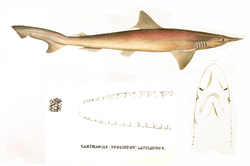
Picture of Scoliodon laticaudus
- Source
- Wikipedia/Commons
- Credit
- Müller & Henle
- Licence
- Public Domain
- Commercial use
- the licence allows it
No 3D scan of Scoliodon laticaudus was found in Sketchfab.
Smithsonian Open Access and MorphoSource were not reached for this taxon, so this list is what the others held rather than everything there is.
The description on this site
- Licence
- CC BY-SA 4.0
This is what the site found, which is not the same as what exists.
Keep going
What may have been alongside itScoliodon through timeFormations of the MioceneThe world it lived on
Occurrence data from the Paleobiology Database, CC BY 4.0. Müller and Henle 1838