Schizodus obscurus
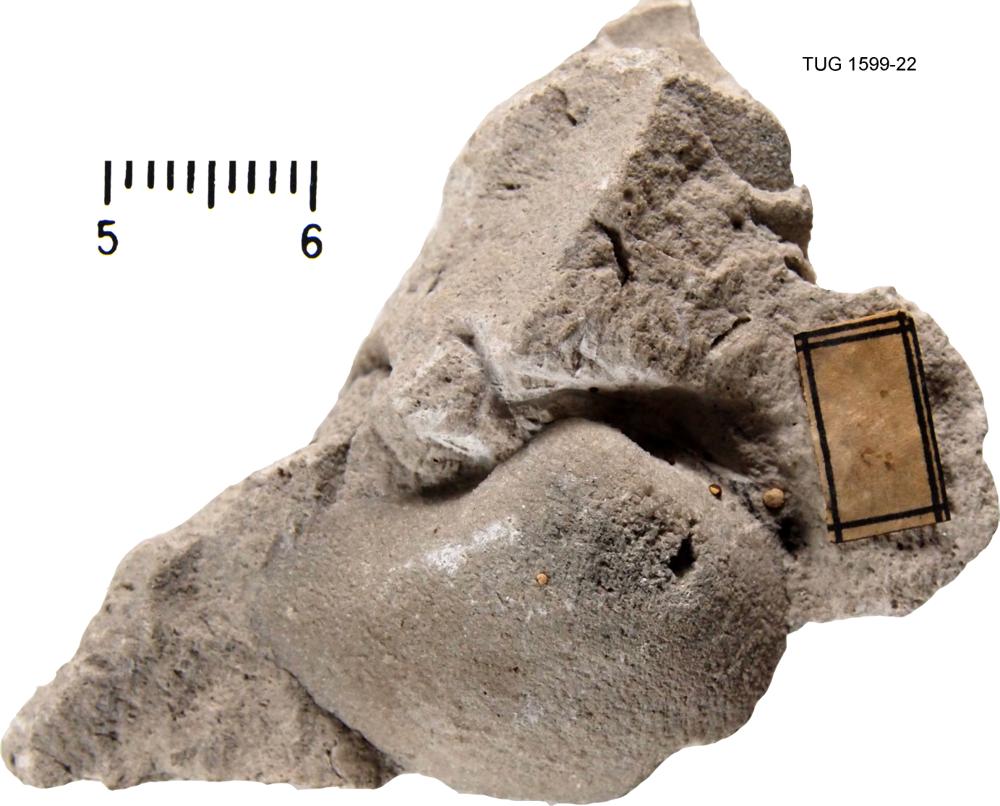
via GBIF · CC BY-NC 4.0 · via GBIF. May be a photograph of a specimen, or an artist’s reconstruction — an interpretation of a skeleton, since colour and soft tissue are almost never preserved.
On record
Recorded, not inferred- Sits inside
- SchizodusPBDB
- Diet
- suspension feederPBDB, for Trigoniida
- Life habit
- infaunalPBDB, for Trigoniida
- Motility
- facultatively mobilePBDB, for Trigoniida
- Vision
- blindPBDB, for Bivalvia
Time the record covers
At least 20 million years on record.
The record covers at least 274.4 Mya to 254.14 Mya. No occurrence read is dated outside 283.3 Mya to 251.902 Mya.
65 occurrences of Schizodus obscurus on record, most of them in the Permian. Bar height is expected occurrences, not a count: each fossil is spread across the span it is dated to, so a tall narrow bar means tight dating and a low wide one means loose.
When
65 occurrences- Permian100%
These are dates about fossils, not the animal: the record can only begin after it arose and end before it died out, so either end may reach further. Shares are expected occurrences: a fossil dated to a span is counted partly in each period it straddles. More on what this infers.
Found in
8 formations
- Ford Formation12
- Bellerophon Formation10
- Naujoji Akmené Formation5
- Wegener Halvo Formation5
- Naujoji Akmené Formation4
- Zalgiris Formation1
Loading coastlines…
The named rock units Schizodus obscurus has been recovered from, largest first. Drawn where the rock is now, not where it formed. 26 occurrences have no formation on record, which is common for older literature.
Schizodus obscurus and its relatives
PermianWhere Schizodus obscurus and its relatives were recorded in the Permian.
Found in the same rock
152 taxa- Permophorus costatus12 sites
- Bakevellia (Bakevellia) binneyi10 sites
- Bakevellia (Bakevellia) ceratophaga10 sites
- Eumorphotis striatocostata9 sites
- Liebea squamosa7 sites
- Parallelodon striatus7 sites
- Stutchburia tschernyschewi7 sites
- Edmondia hautmanni6 sites
- Naticopsis minima6 sites
- Tunstallia helicina6 sites
- Unionites jacobi6 sites
- Coelostylina obtusa5 sites
- Gardenapecten comelicanus5 sites
- Lovaralucina covidi5 sites
- Pseudobakewellia ceratophagaeformis5 sites
- Volsellina carinata5 sites
- Acharax frenademezi4 sites
- Bakevellia4 sites
- Coelostylina gibsoni4 sites
- Coelostylina leighi4 sites
- Dielasma elongatum4 sites
- Gardenapecten trinkeri4 sites
- Palaeolima badiotica4 sites
- Pseudobakewellia antiquaeformis4 sites
The Paleobiology Database records 60 sites for Schizodus obscurus, and this reads all of them. The number is how many of those sites it was catalogued from too. The 24 sharing the most are listed.
This is not a list of everything alive at the time. It is only what has come out of the same ground as this animal and been written down.
Entered from
14 references- Bivalves from the Changhsingian (upper Permian) Bellerophon Formation of the Dolomites (Italy): ancestors of Lower Triassic post-extinction benthic communities10
- Permskaya sistema Pribaltiki (fauna i stratigrafiya). Permian deposits of the Baltic region (stratigraphy and fauna)10
- Monograph of the Permian fossils of England9
- Sketch of the geology of Manchester and its vicinity8
- Permian pelecypods of east Greenland5
- Zechstein reef fossils and their palaeoecology4
- A review of the marine fossils from the Upper Permian rocks of Northern Ireland and north-west England4
- A catalogue of the fossils of the Permian system of the counties of Northumberland and Durham3
- On the geological relations and internal structure of the Magnesian Limestone, and the lower portions of the New Red Sandstone Series in their range through Nottinghamshire, Derbyshire, Yorkshire, and Durham, to the southern extremity of Northumberland3
- No. LV of the mineral conchology of Great Britain; or colored figures and descriptions of those remains of testaceous animals or shells, which have been preserved at various times and depths in the Earth3
- Yao et al., 19802
- The Permian Bivalvia of northern England2
Each of the 65 occurrences read was entered from one of these publications, ordered by how many each accounts for. This is not a search for papers mentioning the name. 2 further references are not listed. Entries link to doi.org where the Paleobiology Database holds an identifier, and to its own record where it does not. Relayed as the Paleobiology Database holds them, not checked against what they resolve to.
Media and terms
Media content1
Picture of Schizodus obscurus
- Source
- GBIF
- Credit
- via GBIF
- Licence
- CC BY-NC 4.0
- Commercial use
- the licence does not allow it
No 3D scan was found. Smithsonian Open Access, MorphoSource and Sketchfab were all searched.
This is what the site found, which is not the same as what exists.
Keep going
What may have been alongside itSchizodus through timeFormations of the PermianThe world it lived on
Occurrence data from the Paleobiology Database, CC BY 4.0. (Sowerby 1821)