Pseudotextularia
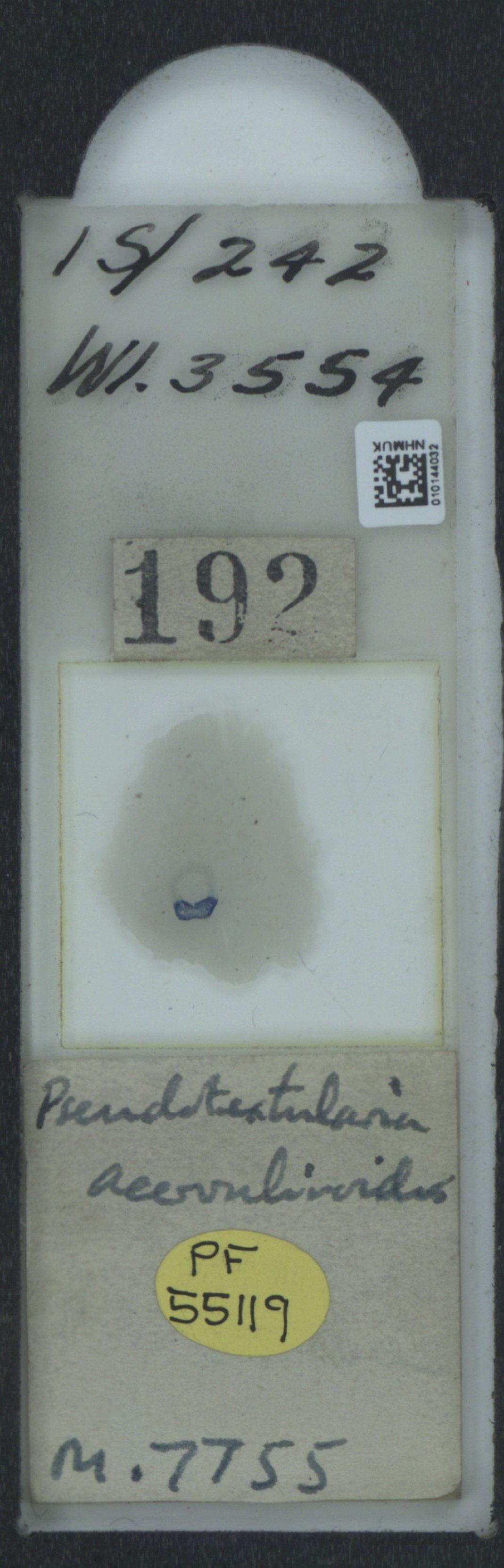
via iDigBio · CC BY · via iDigBio. May be a photograph of a specimen, or an artist’s reconstruction — an interpretation of a skeleton, since colour and soft tissue are almost never preserved.
On record
Recorded, not inferred- Sits inside
- HeterohelicinaePBDB
- Diet
- omnivorePBDB, for Foraminifera
- Life habit
- planktonicPBDB, for Globigerinina
- Motility
- stationaryPBDB, for Foraminifera
- Environment
- marinePBDB, for Globigerinina
Time the record covers
At least 17 million years on record.
The record covers at least 83 Mya to 66 Mya. No occurrence read is dated outside 100.5 Mya to 56 Mya.
155 occurrences of Pseudotextularia on record, most of them in the Late Cretaceous. Bar height is expected occurrences, not a count: each fossil is spread across the span it is dated to, so a tall narrow bar means tight dating and a low wide one means loose.
When
155 occurrences- Late Cretaceous69%
- Paleocene31%
These are dates about fossils, not the animal: the record can only begin after it arose and end before it died out, so either end may reach further. Shares are expected occurrences: a fossil dated to a span is counted partly in each period it straddles. More on what this infers.
Found in
4 formations
Loading coastlines…
The named rock units Pseudotextularia has been recovered from, largest first. Drawn where the rock is now, not where it formed. 3 occurrences have no formation on record, which is common for older literature.
Pseudotextularia and its relatives
Late CretaceousWhere Pseudotextularia and its relatives were recorded in the Late Cretaceous.
Found in the same rock
69 taxa- Rugoglobigerina rugosa103 sites
- Heterohelix globulosa102 sites
- Pseudoguembelina costulata101 sites
- Heterohelix100 sites
- Rugoglobigerina98 sites
- Globotruncana93 sites
- Heterohelix navarroensis93 sites
- Guembelitria cretacea91 sites
- Rugoglobigerina scotti91 sites
- Heterohelix dentata90 sites
- Ventilabrella carseyae84 sites
- Rugoglobigerina macrocephala79 sites
- Globotruncanella petaloidea78 sites
- Pseudoguembelina kempensis75 sites
- Muricohedbergella monmouthensis72 sites
- Globotruncanella68 sites
- Globotruncana aegyptiaca65 sites
- Pseudoguembelina palpebra65 sites
- Heterohelix planata63 sites
- Globotruncanita61 sites
- Pseudoguembelina hariaensis60 sites
- Globigerinelloides59 sites
- Plummerita55 sites
- Globotruncanita stuarti53 sites
The Paleobiology Database records 107 sites for Pseudotextularia, and this reads all of them. The number is how many of those sites it was catalogued from too. The 24 sharing the most are listed.
This is not a list of everything alive at the time. It is only what has come out of the same ground as this animal and been written down.
Entered from
9 references- Guembelitria-dominated late Maastrichtian planktic foraminiferal assemblages mimic early Danian in central Egypt88
- High stress late Maastrichtian paleoenvironment: inference from planktonic foraminifera in Tunisia26
- Paleoecology of the Cretaceous-Tertiary mass extinction in planktonic foraminifera18
- The Cretaceous/Tertiary boundary stratotype section at El Kef, Tunisia: how catastrophic was the mass extinction?16
- Maastrichtian inoceramid bivalves from Central Chiapas, southeaster México2
- Sedimentology and extinction patterns across the Cretaceous-Tertiary boundary interval in East Texas2
- Site U15141
- Site U13481
- Latest Maastrichtian species-rich rudist associations of the Apulian margin of Salento (S Italy) and the Ionian Islands (Greece)1
Each of the 155 occurrences read was entered from one of these publications, ordered by how many each accounts for. This is not a search for papers mentioning the name. Each entry links to doi.org. Relayed as the Paleobiology Database holds them, not checked against what they resolve to.
Media and terms
Media content1
Picture of Pseudotextularia
- Source
- iDigBio
- Credit
- via iDigBio
- Licence
- CC BY
- Commercial use
- the licence allows it
No 3D scan of Pseudotextularia was found in MorphoSource and Sketchfab.
Smithsonian Open Access was not reached for this taxon, so this list is what the others held rather than everything there is.
This is what the site found, which is not the same as what exists.
Keep going
What may have been alongside itHeterohelicinae through timeFormations of the Late CretaceousThe world it lived on
Occurrence data from the Paleobiology Database, CC BY 4.0.