Pontocyprella
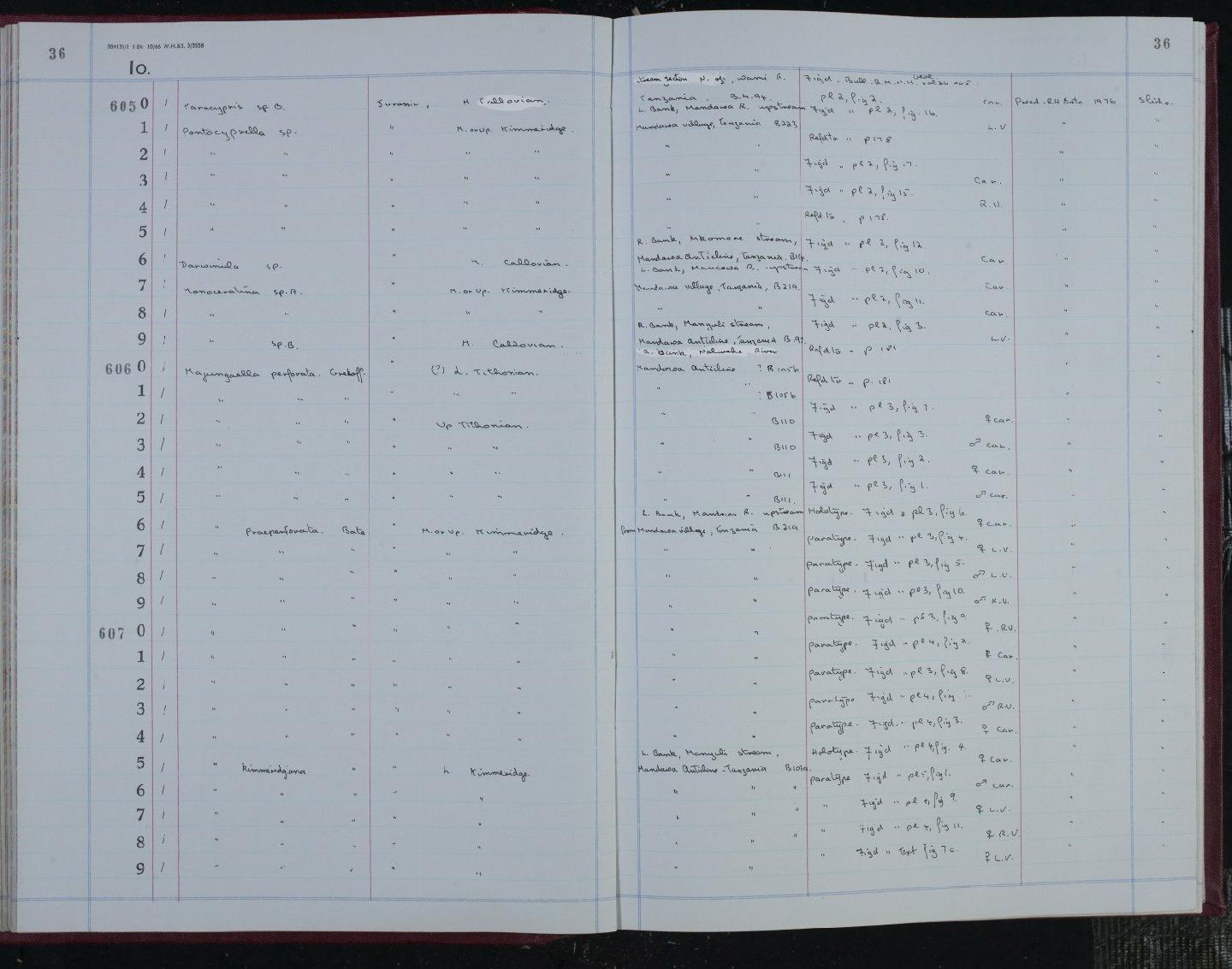
via iDigBio · CC BY · via iDigBio. May be a photograph of a specimen, or an artist’s reconstruction — an interpretation of a skeleton, since colour and soft tissue are almost never preserved.
On record
Recorded, not inferred- Sits inside
- PontocyprididaePBDB
- Diet
- detritivore, grazerPBDB, for Podocopida
- Life habit
- epifaunalPBDB, for Podocopida
- Motility
- actively mobilePBDB, for Ostracoda
- Vision
- limitedPBDB, for Ostracoda
- Environment
- marinePBDB, for Ostracoda
Time the record covers
At least 167 million years on record.
The record covers at least 233.6 Mya to 66 Mya. No occurrence read is dated outside 237 Mya to 61.66 Mya.
44 occurrences of Pontocyprella on record, most of them in the Early Jurassic. Bar height is expected occurrences, not a count: each fossil is spread across the span it is dated to, so a tall narrow bar means tight dating and a low wide one means loose.
When
44 occurrences- Late Triassic5%
- Early Jurassic55%
- Middle Jurassic16%
- Late Jurassic7%
- Early Cretaceous15%
- Late Cretaceousunder 1%
- Paleocene2%
These are dates about fossils, not the animal: the record can only begin after it arose and end before it died out, so either end may reach further. Shares are expected occurrences: a fossil dated to a span is counted partly in each period it straddles. More on what this infers.
Found in
8 formations
- Brian de Vère Formation8
- Djangura Formation6
- Denton Formation · Washita Group5
- Renggeri-Ton Formation2
- Huglu Tuffite Formation2
- Zebbeus Formation1
Loading coastlines…
The named rock units Pontocyprella has been recovered from, largest first. Drawn where the rock is now, not where it formed. 18 occurrences have no formation on record, which is common for older literature.
Pontocyprella and its relatives
Early JurassicWhere Pontocyprella and its relatives were recorded in the Early Jurassic.
Found in the same rock
396 taxa- Ogmoconcha amalthei18 sites
- Cytherella16 sites
- Isobythocypris tatei16 sites
- Bairdia15 sites
- Bairdiacypris15 sites
- Ledahia bispinosa15 sites
- Bairdia molesta13 sites
- Bairdia rostrata10 sites
- Cytherelloidea10 sites
- Isobythocypris postera10 sites
- Ogmoconchella10 sites
- Ogmoconchella gruendeli10 sites
- Bairdia donzei9 sites
- Paracypris9 sites
- Paracypris redcarensis9 sites
- Cardobairdia liasica8 sites
- Lenticulina8 sites
- Anisobairdia salisburgensis7 sites
- Bythocypris7 sites
- Cythereis7 sites
- Gramannella apostolescui7 sites
- Isobythocypris7 sites
- Liasina lanceolata7 sites
- Ogmoconchella aequalis7 sites
The Paleobiology Database records 37 sites for Pontocyprella, and this reads all of them. The number is how many of those sites it was catalogued from too. The 24 sharing the most are listed.
This is not a list of everything alive at the time. It is only what has come out of the same ground as this animal and been written down.
Entered from
12 references- Ostracoden aus dem Lias der Kalkalpen Bayerns und Nordtirols15
- Opportunistic development of Ogmoconcha amalthei (ostracod) in the lower Liassic of Quercy (SW France): an indicator of sedimentary disturbance8
- Ammonites, Microfauna, and Palynomorphs from the Lower Part of the Upper Bajocian Parkinsoni Zone of the Basin of the Bolshoi Zelenchuk River, Northern Caucasus6
- A Paleoecologic Study of the Upper Denton Formation, Tarrant, Denton, and Cooke Counties, Texas5
- Discovery of a long-term refuge for ostracods (Crustacea) after the end-Permian extinction: a unique Carnian (Late Triassic) fauna from the Mersin Mélange, southern Turkey2
- Mikropaläontologische Untersuchungen an Ophiuren. IV. Die Ophiuren aus dem Renggeri-Ton (Unter-Oxford) von Chapois (Jura) und Longecombe (Ain)2
- Early Jurassic ostracods from the Glasenbach Gorge, Northern Calcareous Alps, Austria, and evidence for upper slope deposition1
- Barremian ostracods from the Serre de Bleyton (Drôme, SE France)1
- Ostrácodos del Albiano de la Cuenca Austral, Argentina1
- Bioconstructions bajociennes à madréporaires et faciès associés dans l'Ile Crémieu (Jura du Sud; France)1
- Danian ostracodes from Tunisia1
- Mikropaläontologische Untersuchungen an Ophiuren. V. Die Ophiuren aus dem Argovien (unteres Ober-Oxford) von Guldenthal (Kt. Solothurn) und von Savigna (Dépt. Jura)1
Each of the 44 occurrences read was entered from one of these publications, ordered by how many each accounts for. This is not a search for papers mentioning the name. Entries link to doi.org where the Paleobiology Database holds an identifier, and to its own record where it does not. Relayed as the Paleobiology Database holds them, not checked against what they resolve to.
Media and terms
Media content1
Picture of Pontocyprella
- Source
- iDigBio
- Credit
- via iDigBio
- Licence
- CC BY
- Commercial use
- the licence allows it
No 3D scan was found. Smithsonian Open Access, MorphoSource and Sketchfab were all searched.
This is what the site found, which is not the same as what exists.
Keep going
What may have been alongside itPontocyprididae through timeFormations of the Early JurassicThe world it lived on
Occurrence data from the Paleobiology Database, CC BY 4.0.